
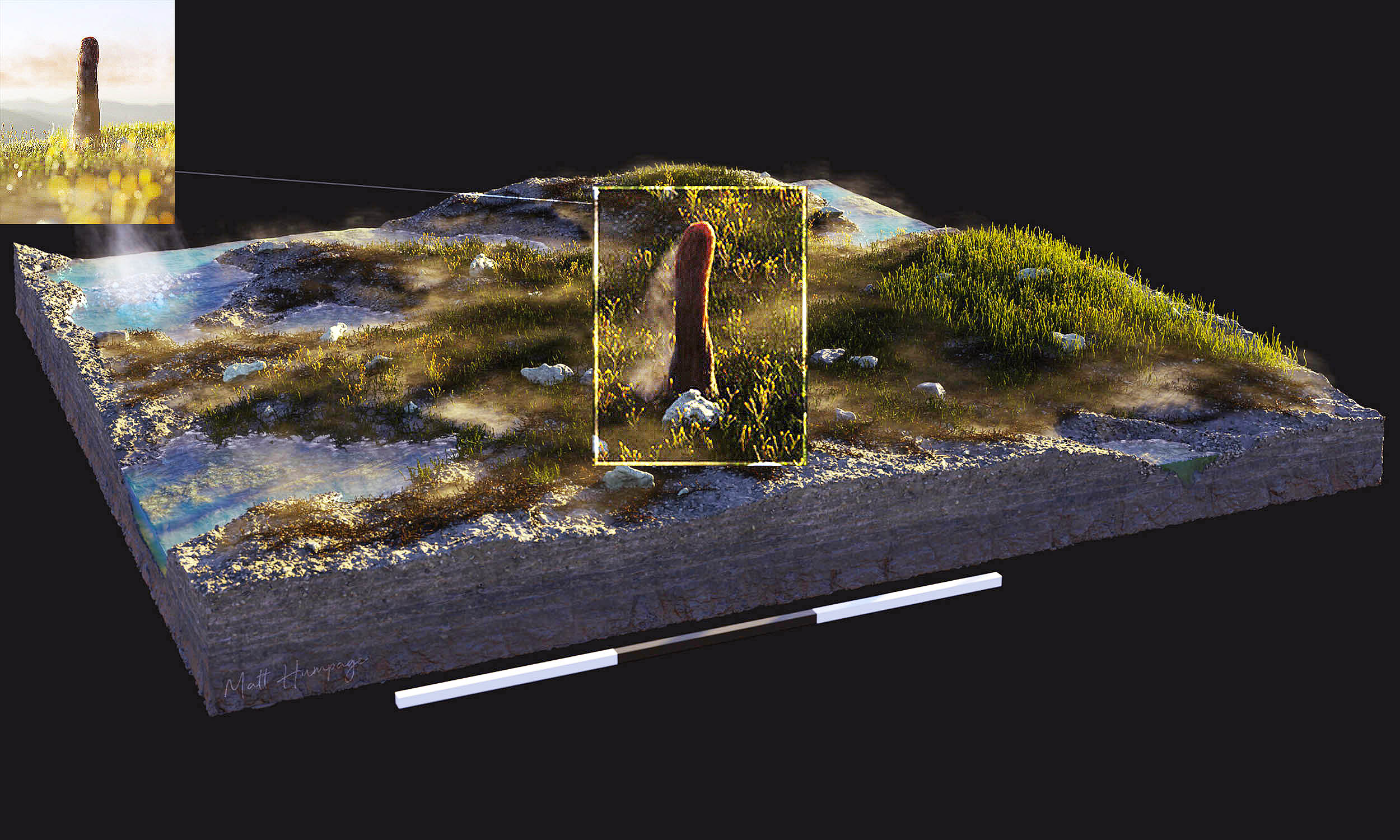
For over 165 years, a fossil discovered in Scotland has defied easy categorization, prompting debate among paleontologists about its origins. Now, a new analysis suggests the 400-million-year-ancient organism, known as Prototaxites taiti, represents a previously unknown branch of eukaryotic life, distinct from both fungi and plants.
The fossil, first identified in 1859 by Canadian geologist John William Dawson, initially led him to believe he had found evidence of early conifers. Standing up to 26 feet tall, Prototaxites resembled a towering tree, but lacked branches and leaves, features characteristic of modern trees. Dawson’s initial assessment, though ultimately inaccurate, gave the fossil its enduring name.
For decades, the prevailing theory posited that Prototaxites was a giant fungus. Paleontologist Francis Hueber proposed this in 2001, citing anatomical features like tubular structures within the fossil. Further research in 2017 identified structures believed to be fruiting bodies, linking Prototaxites to the Ascomycota group of fungi. However, a critical connection – evidence linking these reproductive structures to the main body of the organism – remained elusive, casting doubt on the fungal hypothesis.
Researchers at the University of Edinburgh re-examined a well-preserved specimen of P. Taiti, found within the Rhynie chert, a fossil deposit renowned for its exceptional preservation of early Devonian life. Their analysis, published in the journal Science Advances, challenges previous assumptions about the organism’s identity.
The team focused on a cross-section of the fossil, revealing three distinct types of tubes running lengthwise through its structure. These tubes varied in size and internal structure, with one type exhibiting ring-like thickenings not found in any known fungal group. The fossil also contained “medullary spots” – dark, circular features – containing all three tube types, arranged in a complex, chaotic branching pattern unlike the hierarchical organization seen in modern fungi.
Further analysis using FTIR spectroscopy revealed a lack of chitin and chitosan, essential compounds found in fungal cell walls. Instead, the fossil contained aromatic and phenolic compounds resembling lignin, a component of plant cell walls, but with a distinct chemical signature. Machine learning models, trained to identify organisms based on their molecular fingerprints, consistently classified P. Taiti as separate from fungi, plants, animals, and bacteria with over 90% accuracy.
The researchers systematically ruled out other potential classifications, including algae, early land plants, and lichens. The organism’s unique combination of anatomical and molecular characteristics defied categorization within any known taxonomic group. “We conclude that the morphology and molecular fingerprint of P. Taiti is clearly distinct from that of the fungi and other organisms preserved alongside it in the [Devonian deposit], and we suggest that We see best considered a member of a previously undescribed, entirely extinct group of eukaryotes,” the authors wrote.
Prototaxites likely absorbed nutrients from decaying matter, similar to modern saprotrophs, but its precise ecological role and evolutionary history remain unknown. With no known living relatives, it represents a lost experiment in the history of life on Earth. The study leaves open the question of how many other unique life forms existed in the distant past, awaiting rediscovery and re-evaluation.
