
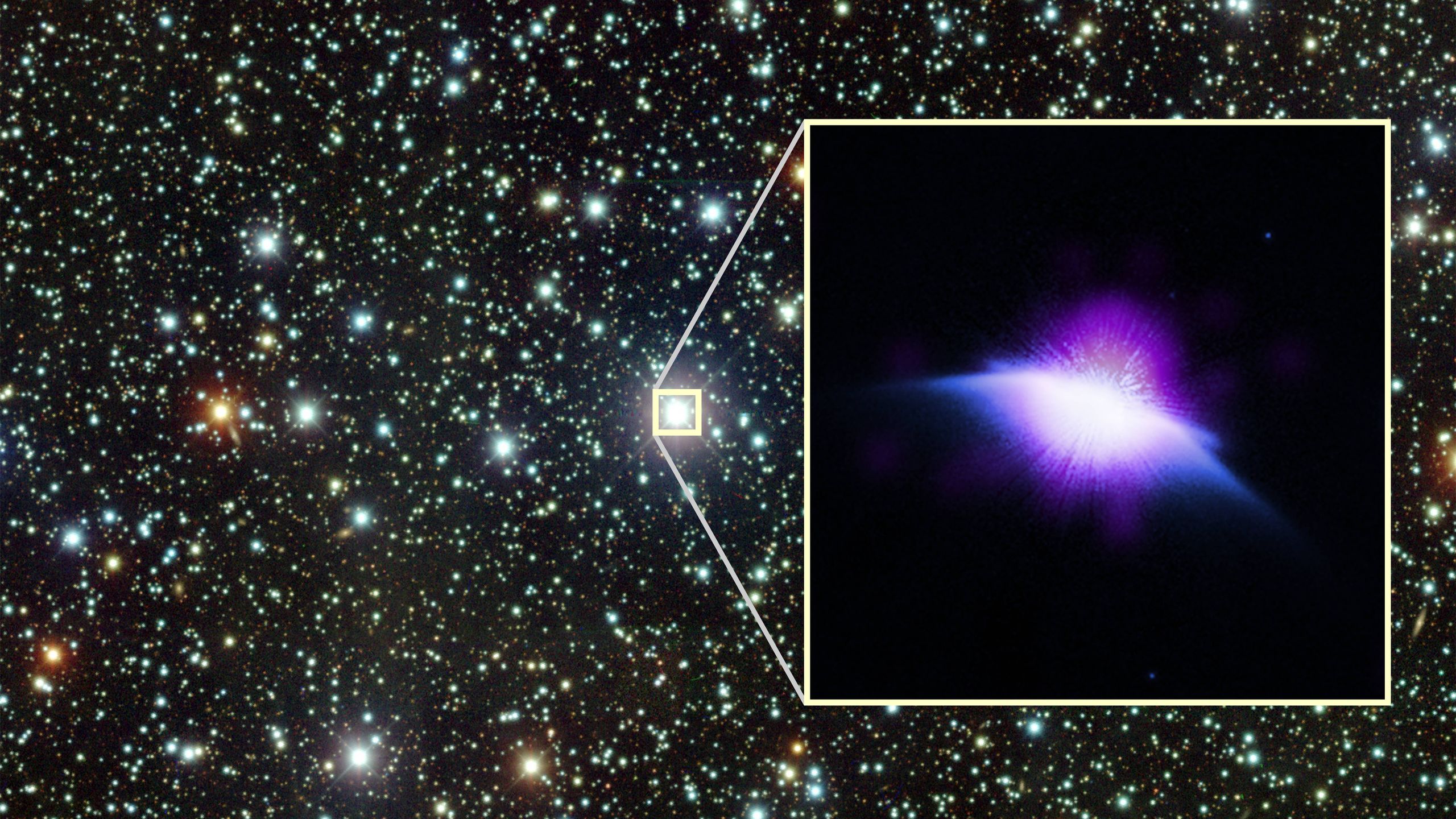
For the first time, astronomers have observed a sun-like star enveloped in a protective bubble of hot gas, a phenomenon known as an astrosphere. NASA’s Chandra X-ray Observatory captured the image of HD 61005, a young star approximately 117 light-years away in the constellation Puppis, revealing a structure remarkably similar to the heliosphere that surrounds our own sun.
The discovery, announced February 23, 2026, offers a unique glimpse into the early life of stars and potentially sheds light on the conditions surrounding our solar system billions of years ago. HD 61005, nicknamed the “Moth” due to a distinctive dust tail trailing behind it, is estimated to be around 100 million years old, significantly younger than our sun’s 4.6 billion years.
The astrosphere around HD 61005 was identified through X-ray emissions detected by Chandra, resulting from the star’s powerful stellar wind colliding with the interstellar medium. This collision creates a bubble of hot gas that shields the star from interstellar radiation. The images combine X-ray data with infrared observations from the Hubble Space Telescope and optical data from telescopes in Chile, providing a comprehensive view of the stellar environment.
“We have been studying our Sun’s astrosphere for decades, but we can’t see it from the outside,” said astronomer Carey Lisse of Johns Hopkins University in a statement. “This fresh Chandra result about a similar star’s astrosphere teaches us about the shape of the Sun’s, and how it has changed over billions of years as the Sun evolves and moves through the galaxy.”
While comparable in mass and temperature to the sun, HD 61005 exhibits a much more vigorous stellar wind – approximately three times faster and 25 times denser than the sun’s current emissions. NASA estimates that if HD 61005 were to replace our sun, its heliosphere would extend up to 10 times further into space.
The star’s unusual dust tail, swept back by its motion through space, has earned it the nickname “Moth,” with physicist Brad Snios noting, “There’s a saying about a moth being drawn to a flame. In the case of HD 61005, the ‘Moth’ can’t easily escape from the flame because it was born around it.”
Astronomers have been attempting to observe astrospheres around other stars since the 1990s. The successful detection around HD 61005 was facilitated by the star’s interaction with an unusually dense region of interstellar material, amplifying the X-ray emissions detectable by Chandra. The discovery is expected to provide valuable insights into the evolution of young planetary systems and the conditions under which planets form.
