
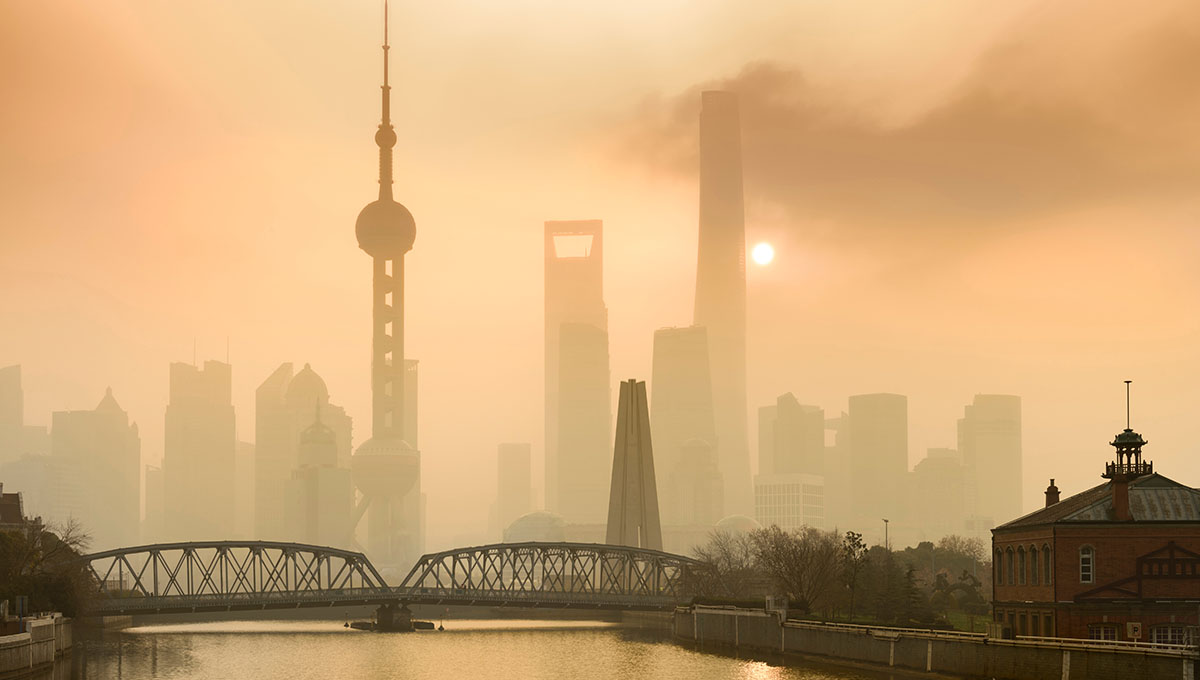
A newly identified threshold for exposure to particulate matter could facilitate public health officials base air-quality warnings on the cardiovascular health risks associated with short-term exposure to poor-quality air, according to research published last week in the Journal of the American College of Cardiology.
In a systematic review and meta-analysis of 100 epidemiologic studies spanning 28 countries, Chinese investigators isolated an optimal alert value of 136 µg/m3—a global average—which they say could prevent 73.2% of cardiovascular deaths attributable to short-term exposure to air pollution. The study estimates that approximately 60,000 deaths in 2023 were related to cardiovascular events caused by short-term daily exposures to PM2.5 pollution at levels exceeding 75 μg/m3.
Study investigator Tao Xue, PhD, of Peking University Health Science Centre in Beijing, China, told TCTMD that the findings provide a data-driven analytical framework for policymakers to conduct similar analyses tailored to their country and to air pollution-sensitive diseases.
Xue and colleagues similarly believe the information is applicable to clinical practice. “Our study identified a supralinear exposure-response relationship, revealing a critical ‘tipping point’ at approximately 150 μg/m3,” Xue noted in an email. “Although the optimal alert value of 136 μg/m3 we calculated is primarily a population-level assessment designed for public health efficiency, the 150 μg/m3 threshold holds significant clinical relevance.”
According to Xue, when daily concentrations exceed 150 μg/m3, the risk for acute cardiovascular disease events accelerates sharply. “Clinicians can use this specific threshold to personalize recommendations, prioritizing targeted prevention and proactive communication for their high-risk patients during severe pollution spikes,” he suggested.
The researchers found the supralinear pattern implies that the cardiovascular risk per unit of pollution is not static, but rather suggests heightened population vulnerability at lower concentrations and a severe impact during extreme pollution events.
In an accompanying editorial, María Neira, MD, MPH, of the World Health Organization in Geneva, Switzerland, agreed that a key contribution of the research is the understanding that the harm associated with pollution is not linear. “Most air-quality alert systems still use broad categories, often derived from legacy standards or political negotiations, rather than from updated epidemiologic evidence,” Neira writes. “This is where the study’s policy implications develop into particularly relevant.”
Neira suggests the findings can be useful in strengthening alert systems by setting one threshold for the general population and a more protective one for vulnerable groups. She also recommends integrating air pollution forecasting into care management for high-risk patients, with physicians encouraging patients to use “personal protective measures (eg, reducing outdoor exertion, air purification, medication management) during forecasted peaks.”
Neira described air pollution as “in many ways, the modern tobacco: a massive, preventable cardiovascular risk.”
Evidence has been growing over the last decade regarding the contribution of long-term exposure to fine particulate matter (PM2.5) to cardiovascular disease morbidity and mortality, with recent research suggesting the problem needs to be better recognized and addressed by the cardiology community. Less is known about the risks associated with short-term exposures.
Led by Yongkang Yang, MPH, also of Peking University Health Science Centre, the researchers note that while high pollution days are infrequent, “they contribute a stable approximately 20% of the total burden of PM2.5-attributed cardiovascular mortality.”
Between 2000 and 2023, they found the global burden of cardiovascular death attributable to short-term PM2.5 exposure, beyond what the World Health Organization considers acceptable, nearly tripled from 184,757 to 345,164. The analysis identified two major hot spots as outliers in PM2.5 attributable burden: the North China Plain in East Asia and the Indo-Gangetic Plain in South Asia, which the authors say “reflects the compounded impacts of extreme air pollution and high population density.”
The researchers urge clinicians to consider whether short-term spikes in PM2.5 greater than 100 to 150 μg/m3 justify proactive communication with their high-risk patients, even during periods when formal air-quality alerts are not issued.
Sadeer Al-Kindi, MD, of Houston Methodist DeBakey Heart & Vascular Center in Texas, commented to TCTMD that having a threshold that can be optimized and used on a daily scale is an crucial first step, but with caveats. He noted that with about half of the studies in the analysis being from China, the threshold needs to be heavily considered in the context of the local area where it is employed.
“I think it’s a reasonable first step, evidence-based approach to understanding the cutoff globally,” Al-Kindi said. “But the other thing which is important is that this is a continuous risk. There’s no specific safe threshold. So, it’s really all a trade-off of how many alerts can we do and how effective are the alerts. Without knowing [that] People can’t really decide on a specific threshold, in my opinion, due to the fact that if you go lower you’ll capture more, but maybe people will get alert fatigue and they just don’t follow the alerts.”
Al-Kindi added that it also bears considering whether the threshold for risk of exposure differs by the source of the air pollution, such as smog and industrial pollutants versus wildfire smoke.
While pollution is becoming more of a talking point in cardiology circles, Al-Kindi noted a lack of education on the subject in medical schools and residency limits that knowledge unless people get proactive about it. He also pointed to a recent decision by the Environmental Protection Agency to loosen restrictions on coal-burning power plants that release heavy metals into the air and further limit the scope of the Clean Air Act.
Despite these challenges, Al-Kindi said cardiologists can help educate patients about the connection between air pollution and cardiovascular disease, empower them to make their own decisions about exposures and personal protection, and contribute to the growing evidence base in a way that provides practical public health protections for those at greatest risk.
“Are we there yet? No. But are we heading there? Yes,” he added. “I think this is one of the studies that will help us create evidence-based alerts that also capture into account patient preferences, cultural practices, and needs while improving cardiovascular health.”
