
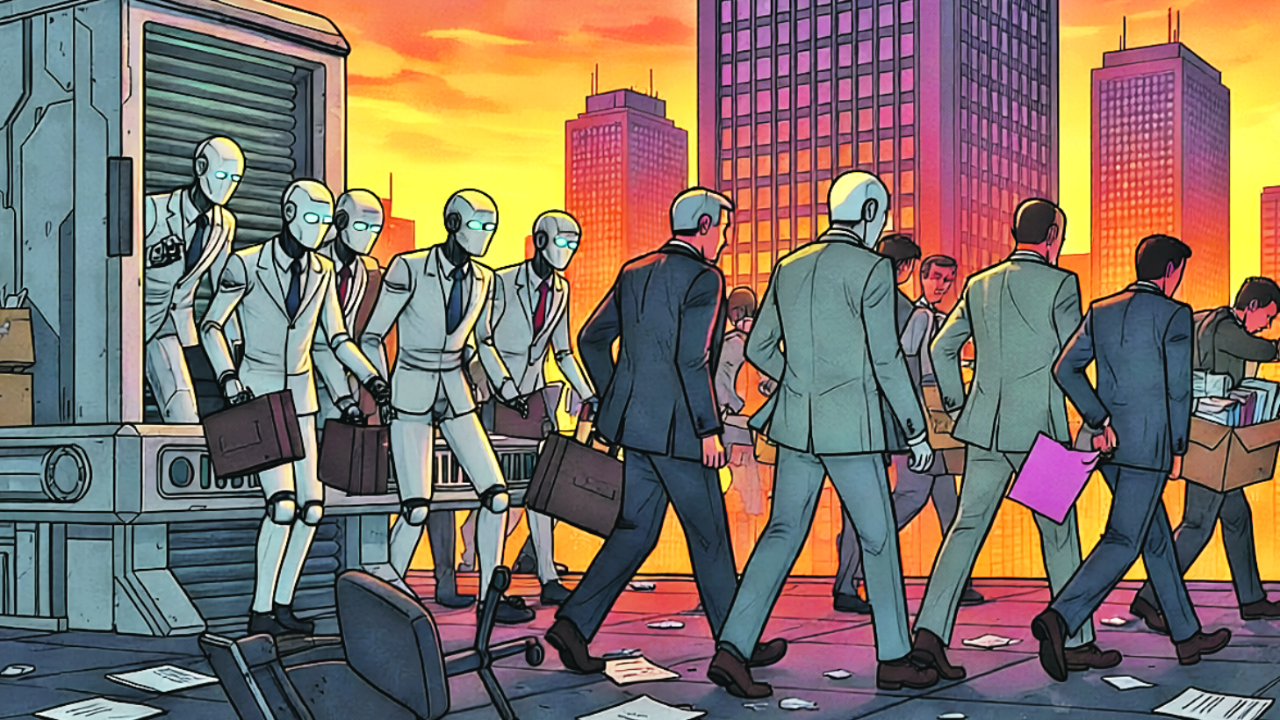
Microsoft AI CEO Mustafa Suleyman has predicted that artificial intelligence will be capable of performing most, if not all, professional tasks at a human level within the next 18 months, potentially displacing workers across a range of white-collar professions. The forecast, delivered in a recent conversation with the Financial Times, suggests a rapid acceleration in AI’s capabilities, impacting fields like accounting, law, marketing, and project management.
Suleyman’s assessment echoes growing concerns within the tech industry regarding the potential for widespread job automation. AI researcher Matt Shumer recently published an essay comparing the current moment to February 2020, just before the onset of the COVID-19 pandemic, but suggesting the coming disruption will be more dramatic. He points to the exponential growth in computational power as a key driver of this change, noting that AI models will soon be able to code more effectively than many human programmers.
The predictions are not isolated. Anthropic CEO Dario Amodei warned last May that AI could eliminate half of all entry-level white-collar jobs. Ford CEO Jim Farley similarly stated that AI could halve the number of white-collar positions in the U.S. Even OpenAI CEO Sam Altman has expressed alarm at the rapid advancement of his own company’s technology, acknowledging the possibility of obsolescence for his life’s work.
However, the extent to which AI is currently impacting white-collar employment remains limited. A 2025 report by Thomson Reuters found that while professionals in law, accounting, and auditing were experimenting with AI for tasks like document review and routine analysis, the resulting productivity gains were marginal and did not indicate significant job losses. The economic benefits of AI have largely been concentrated within the technology sector itself, suggesting a limited impact on the broader economy.
Despite this, early indicators of job displacement are emerging. Employment consulting firm Challenger, Gray & Christmas reported approximately 55,000 job cuts in the U.S. In 2025 that were linked to AI. Microsoft, while not explicitly citing new technology as the reason, laid off 15,000 employees last year. In a memo released following the cuts, CEO Satya Nadella stated the company needed to “redefine its mission for a new era.”
The predictions build on a historical context where advanced education once guaranteed professional success. Fortune founder Henry Luce coined the term “The American Century” to describe the period following World War II, during which an MBA or law degree served as a pathway to a stable career and the American Dream. The current wave of AI development is now challenging that established paradigm.
