
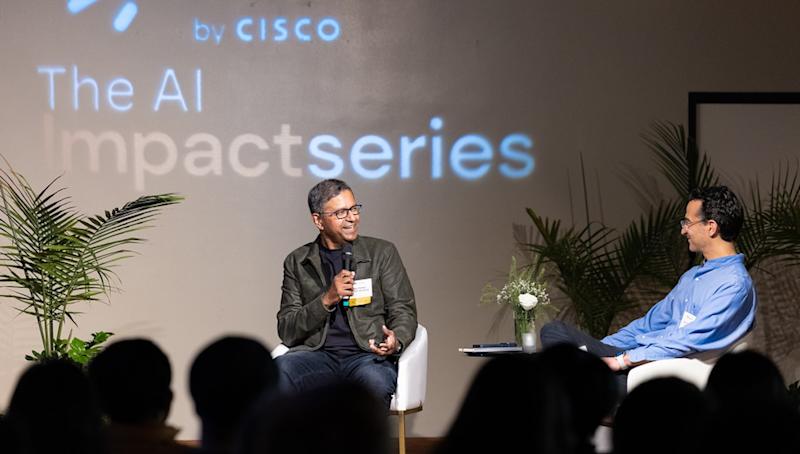
The challenge of enabling artificial intelligence agents to truly collaborate, moving beyond simple connectivity, was a central theme at the latest VentureBeat AI Impact Series event, according to discussions between Cisco’s Vijoy Pandey and Stanford professor Noah Goodman.
Pandey, SVP and GM of Outshift by Cisco, argued that current agent systems can connect, but lack the capacity for genuine collective thought. He likened existing protocols like MCP and A2A to establishing a basic phone connection between individuals who don’t share a language, while AGNTCY addresses discovery, identity, and communication, but doesn’t solve the underlying problem of shared understanding. The core issue, he stated, is the need for collective intelligence, not merely coordinated action.
Goodman, co-founder of Humans&. , echoed this sentiment, drawing a parallel to human cognitive development. He explained that while individual human intelligence emerged approximately 300,000 years ago, true collective intelligence didn’t appear until around 70,000 years ago with the development of sophisticated language. This linguistic breakthrough facilitated shared intent, shared knowledge, and collective innovation. “Once you have a shared intent, a shared goal, you have a body of knowledge that you can modify, evolve, build upon, you can then go towards collective innovation,” Pandey said.
Goodman emphasized that language isn’t simply about encoding and decoding information. It requires understanding context, intention, and the broader world to decipher meaning. This nuanced understanding, he argued, is crucial for human collaboration and cultural evolution, and is currently absent in agent-to-agent interactions.
Pandey proposed a concept he calls the “Internet of Cognition,” a three-layer architecture designed to foster collective thinking among diverse agents. This architecture consists of a protocol layer focused on understanding, intent sharing, and negotiation; a fabric layer acting as a shared memory system for evolving collective context; and a cognition engine layer providing accelerators and guardrails for secure and compliant operation.
A key difficulty, Pandey noted, lies in building collective intelligence across organizational boundaries. “Think about shared memory in a heterogeneous way,” he said. “We have agents from different parties coming together. So how do you evolve that memory and have emergent properties?”
Humans& is approaching this challenge by altering the training of foundation models, focusing on interactions between humans and multiple agents, and between agents and multiple humans. Goodman explained that their team is prioritizing long-horizon interactions during training to enable models to understand how interactions should unfold to achieve optimal long-term outcomes. This approach represents a deliberate shift away from the pursuit of greater agent autonomy, with a focus instead on improved collaboration. “Our goal is not longer and longer autonomy. It’s better and better collaboration,” he said. The company is developing agents with “deep social understanding,” capable of identifying expertise and connecting individuals at the appropriate time.
Establishing appropriate guardrails for multi-functional agents remains a significant challenge. Goodman highlighted the need to balance strict rules with the contextual judgment that characterizes human decision-making, suggesting a principle of “minimal harm” and consideration of consequences. Pandey added that determining the scope for interpretation requires collaboration and a “common understanding and grounding and discovery and negotiation,” rather than relying solely on rigid rules or documentation.
Pandey predicted that true superintelligence will emerge not from increasingly powerful individual models, but from distributed systems, scaling intelligence both vertically—through improved individual agents—and horizontally—through more collaborative networks, mirroring the principles of traditional distributed computing. Goodman stressed the importance of an integrated, distributed ecosystem that seamlessly merges human and AI capabilities, cautioning against a future where AI operates in isolation.
