
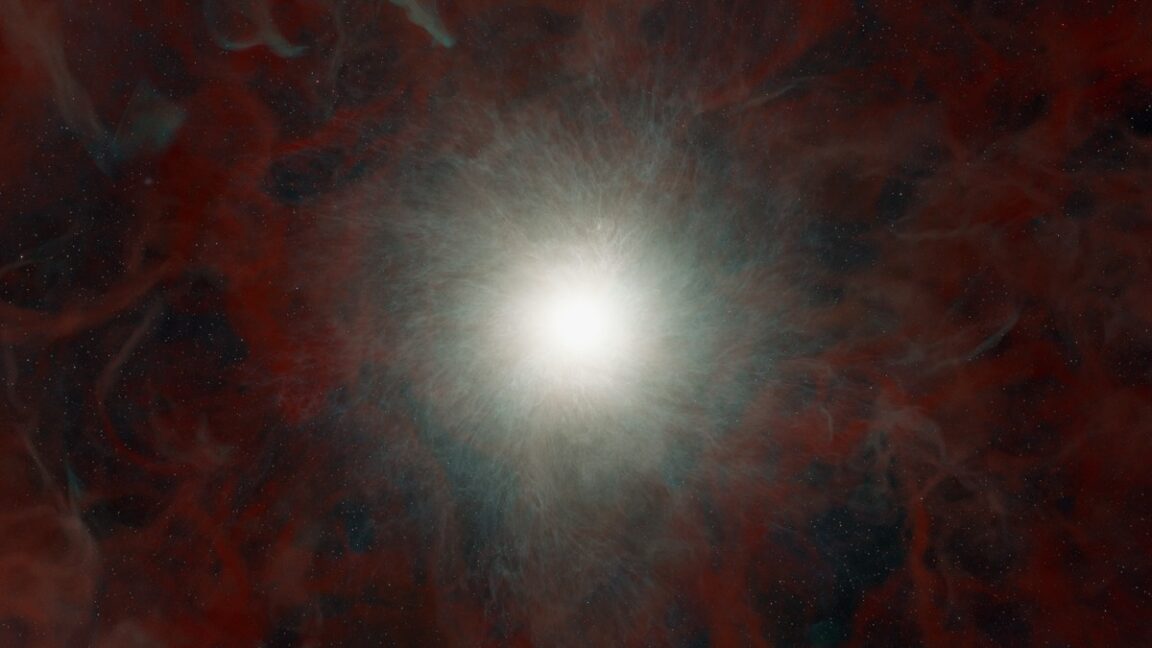
A massive star in the Andromeda galaxy vanished without a traditional supernova explosion, offering astronomers a rare glimpse into the direct collapse of a star into a black hole. The event, designated M31-2014-DS1, was initially detected in 2014 by NASA’s Near-Earth Object Wide-field Infrared Survey Explorer (NEOWISE) as a gradual brightening in infrared light, and subsequently monitored by other ground- and space-based observatories.
By 2023, the star had dimmed in visible light by a factor of more than 10,000, effectively disappearing from view. “This star used to be one of the most luminous stars in the Andromeda Galaxy, and now it was nowhere to be seen,” said Kishalay De, a professor at Columbia University and an associate research scientist at the Simons Foundation’s Flatiron Institute, who led the research. The findings, published Thursday in the journal Science, provide the most intimate gaze yet at how a black hole can form without the dramatic explosion typically associated with the death of massive stars.
The observation challenges conventional understanding of stellar death. Massive stars are generally expected to end their lives as supernovae, triggered by a shockwave created by neutrinos released during core collapse. However, theoretical work dating back to the 1970s suggested that, under certain conditions, this shockwave might be insufficient to fully disrupt the star. Instead, the core could collapse directly into a black hole, with the remaining stellar material falling inward without a supernova.
According to the research team, convection – the movement of gas due to temperature differences – played a crucial role in this “failed” supernova. As the star’s core collapsed, rapidly moving gas in the outer layers prevented material from falling inward. This allowed the inner layers to orbit the newly formed black hole and eject the outer layers, which cooled and formed a shell of dust. This dust, warmed by the orbiting gas, emits infrared radiation, creating a faint glow detectable by NEOWISE and other telescopes.
The initial infrared brightening in 2014 was attributed to the star shedding its outer layers as its core ran out of fuel. The subsequent dimming in visible light, coupled with the continued infrared emission, confirmed the direct collapse scenario. The NEOWISE mission, managed by NASA’s Jet Propulsion Laboratory (JPL) for NASA and operated from 2009 to 2024, was instrumental in capturing the long-term data necessary to piece together the star’s fate. Data from the mission were processed and archived at IPAC, a data and science center for astronomy at Caltech.
Astronomers anticipate that the dust shell surrounding the black hole will continue to emit infrared radiation for decades, providing a continued opportunity to study this unusual event. Further research will focus on identifying other stars undergoing similar direct collapses, potentially revealing whether this process is more common than previously thought.
