
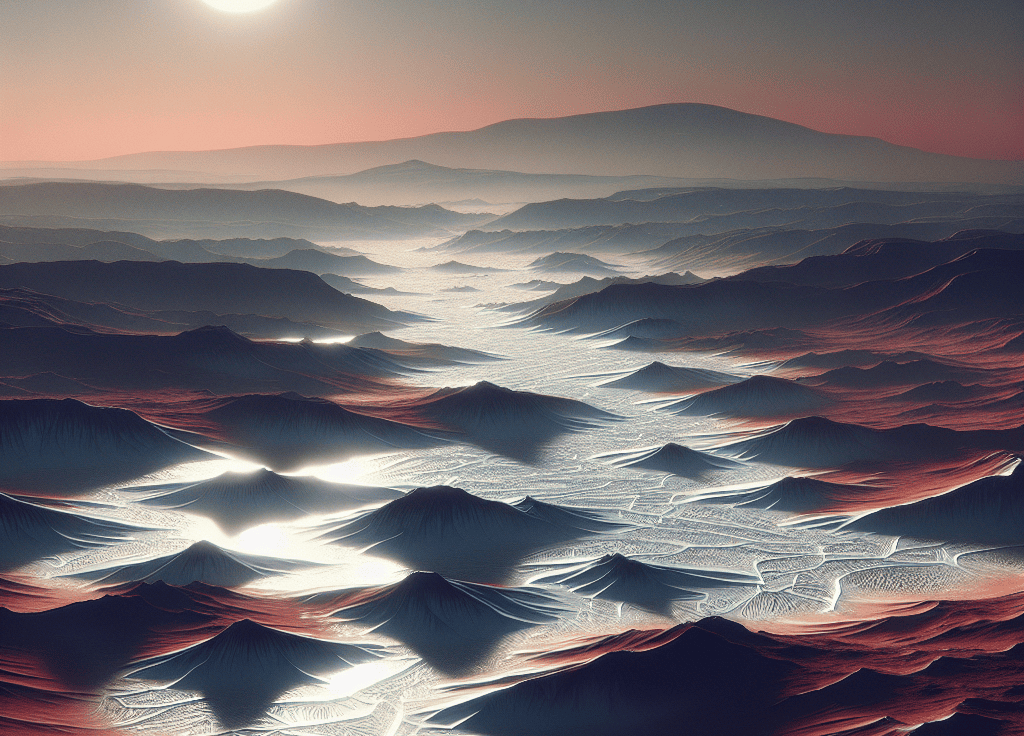
New research from NASA suggests that key building blocks of proteins can survive for tens of millions of years trapped in Martian ice, bolstering the search for ancient life on the Red Planet. The study, led by Alexander Pavlov, a space scientist at NASA Goddard Space Flight Center, challenges previous assumptions about the rapid degradation of organic material in Martian ice and soil mixtures.
Experiments simulating Martian conditions revealed that over 10% of amino acids remained intact after 50 million years of radiation exposure when embedded in pure water ice. This contrasts sharply with samples mixed with Martian-like sediment, which degraded ten times faster due to reactive films forming at the interface between the ice and minerals, allowing radiation to more easily damage the amino acids.
“Pure ice is very excellent at capturing those harmful radiation particles and preventing them from damaging the organic material,” explained Pavlov. “The result was surprising – putting organics in pure water ice dramatically slows down degradation compared to samples containing water and soil.” This finding suggests that future missions should prioritize drilling into clean, buried ice deposits rather than focusing on surface rocks or soil, according to the research.
The findings, published in the journal Astrobiology, align with recent discoveries indicating Mars may have been habitable in the past. NASA’s Curiosity rover has recently analyzed unusual, spiderweb-like box structures resembling ancient underground water channels, suggesting the potential for past subsurface water and potentially, life. Curiosity has also detected organic compounds in rock samples, further supporting the presence of water resources on Mars.
NASA’s Perseverance rover is also contributing to this understanding, autonomously navigating ancient lakebed regions and collecting microbial samples with increased efficiency. These discoveries reinforce the argument for prioritizing the exploration of Martian ice in the search for evidence of past or present life. According to NASA, Pavlov holds a doctorate in geosciences from Penn State University, completing his degree in 2001. He can be reached at alexander.pavlov@nasa.gov or 301.614.5945.
