
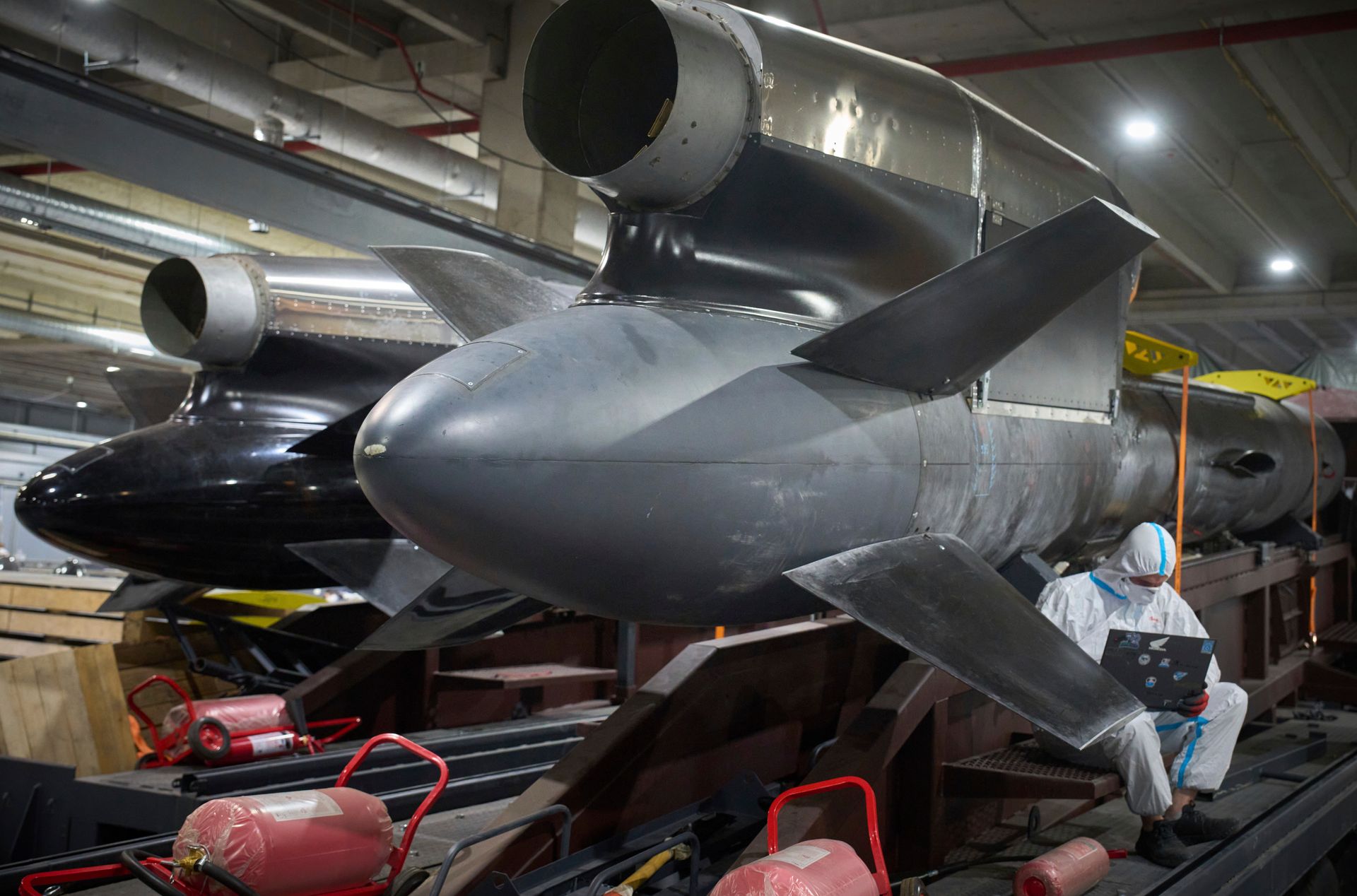
A recent strike on a key Russian missile production facility, confirmed by Ukrainian officials, appears to demonstrate the increasing operational capability of Ukraine’s domestically produced FP-5 Flamingo cruise missile. The General Staff of the Armed Forces of Ukraine stated on February 21 that Flamingo missiles were used in the overnight attack on the JSC Votkinsk Machine Building Plant, located approximately 1,400 kilometers (870 miles) from Ukraine.
The attack on Votkinsk, a facility crucial to the production of missiles for the 9K720 Iskander-M system and the intermediate-range Oreshnik ballistic missile, marks the first successful strike by Ukraine on a core target of Russia’s missile industry using a heavy missile capability, according to Fabian Hoffmann, a Doctoral Research Fellow at the University of Oslo specializing in missile technology. Hoffmann detailed his analysis in a blog post on February 25.
Kyiv has publicly highlighted the Flamingo missile since the summer of 2025, with President Volodymyr Zelenskyy describing it as Ukraine’s “most successful missile” and announcing the commencement of mass production in September 2025. The missile boasts a reported range of 3,000 kilometers (1,864 miles). But, details regarding its deployment and specific operational parameters have remained closely guarded, citing operational security.
Whereas initial reports of the Flamingo’s capabilities were met with skepticism, the confirmed strike on Votkinsk suggests Ukraine is expanding its use of the missile for attacks on high-value targets within Russia. The distance to the Votkinsk plant, exceeding 1,300 km in a straight line, potentially surpasses the previously publicized combat range of Russia’s Kalibr cruise missile, according to analysis from Defence Express.
The Flamingo, developed by the Ukrainian defense firm Fire Point following the 2022 Russian invasion, is a ground-launched cruise missile weighing approximately 6,000 kg (6.0 tons) with a wingspan of 6 meters and a length of 12-14 meters. It is equipped with a 1,150 kg (1.15 tons) warhead and utilizes an AI-25TL turbofan engine. The missile employs GPS/GNSS guidance with inertial navigation system (INS) backup, achieving an accuracy of 14 meters.
Ukraine’s increasing reliance on domestically produced weaponry, including the Flamingo and long-range drones, comes as Western allies have hesitated to provide deep-strike capabilities due to concerns about potential Russian escalation. Outmanned and outgunned, Ukraine has focused on degrading Russia’s military capabilities through long-range strikes on military targets, oil refineries, and airbases.
Production of the Flamingo has not been without challenges. President Zelenskyy revealed in a February 23 interview with German broadcaster Tagesschau that a Russian strike on a Ukrainian manufacturing facility had temporarily disrupted the missile’s rollout. “There was a delay in production. Later, production resumed, and a certain number of missiles were built,” Zelenskyy stated. Despite the setback, Zelenskyy expressed confidence in the continued increase of Flamingo production.
Fire Point, the manufacturer of the Flamingo, is currently under investigation by Ukraine’s National Anti-Corruption Bureau (NABU) regarding potential inflation of component values or discrepancies in delivery numbers, sources with knowledge of the investigation told the Kyiv Independent in August. Fire Point has denied the accusations.
Compared to long-range drones, the Flamingo missile offers a significantly higher velocity – approximately 1,000 kilometers (620 miles) per hour – and a larger warhead exceeding 1,100 kilograms, with roughly half comprised of high explosives. This combination allows for deeper penetration of targets and greater destructive potential, according to Hoffmann. “So if that thing lands at the target, it hurts a lot more than when you land a long-range drone,” he said.
Hoffmann suggests Ukraine will likely continue to develop and integrate both long-range drones and heavy missile capabilities like the Flamingo, Long Neptune, and Sapsan to enhance its deep strike arsenal. The future of Ukraine’s reliance on the Flamingo will depend on Fire Point’s production capacity and the missile’s continued operational effectiveness.
