
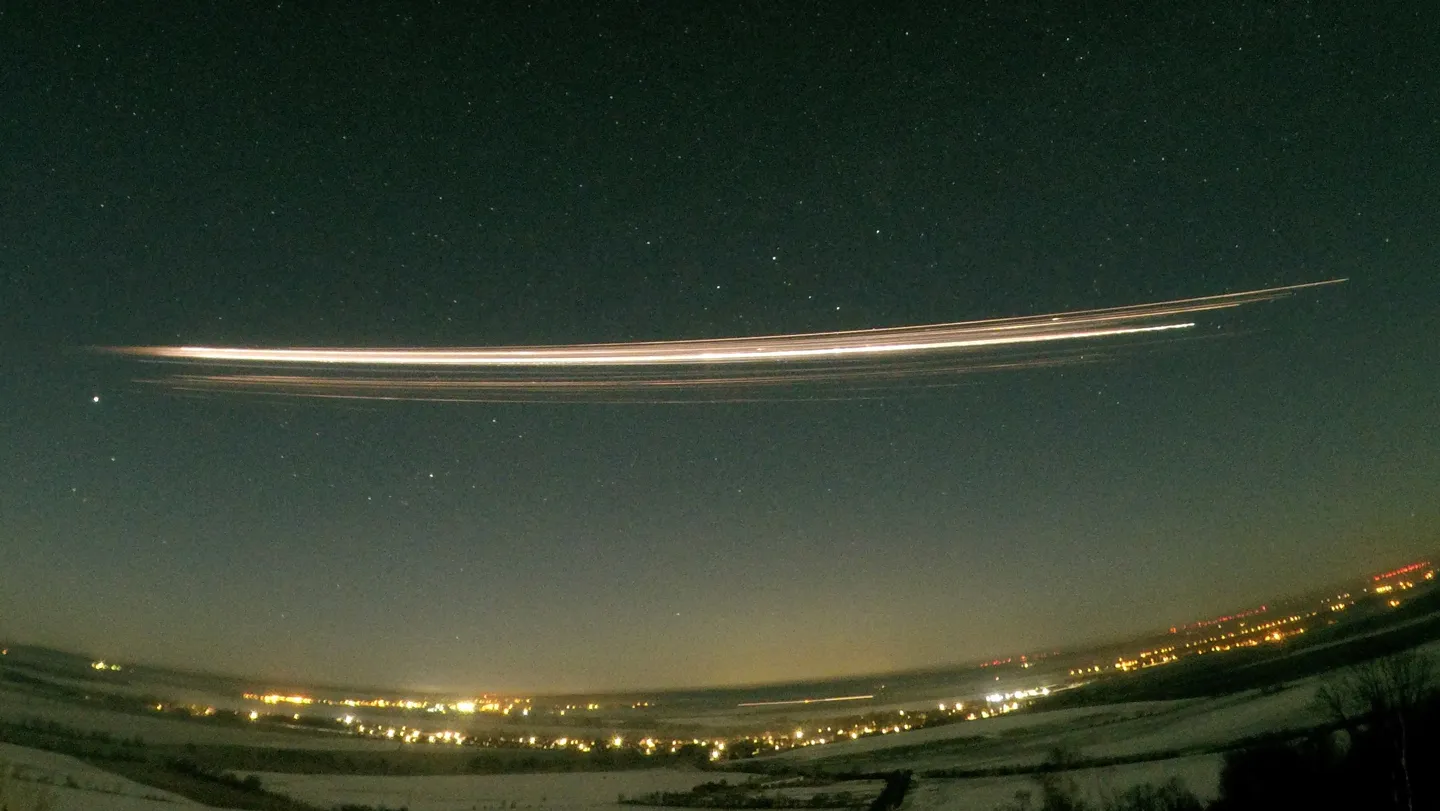
Scientists have directly observed metal pollutants, specifically lithium, released from a disintegrating SpaceX Falcon 9 rocket as it burned up in Earth’s atmosphere. The observation, made on February 19, 2025, over Ireland and the United Kingdom, and detected by lidar instruments in Germany, marks the first time such pollution has been directly traced to a specific piece of space debris, according to research published February 19 in Communications Earth and Environment.
The research team, led by Claudia Stolle at the Leibniz Institute of Atmospheric Physics in Germany, detected a cloud of lithium approximately 100 kilometers above Germany. “A few hours after the reentry of this rocket, we could witness 10 times more lithium than we would have observed otherwise,” Stolle said.
The findings come as the number of satellite launches continues to increase dramatically. Currently, nearly 15,000 active satellites orbit Earth, many as part of “mega-constellations” with relatively short lifespans. SpaceX’s Starlink system, which aims to provide global internet access, is a prominent example, with plans to eventually deploy more than 40,000 satellites. Nearly 10,000 Starlink satellites are currently in orbit.
As satellites reach the end of their operational lives, most operators intentionally de-orbit them, causing them to burn up in the upper atmosphere. This process, known as “demisability,” releases metals like lithium, aluminum, and copper. Researchers are increasingly concerned that these metals could catalyze chemical reactions that deplete the ozone layer and contribute to climate change. A 2023 study indicated that roughly 10 percent of stratospheric particles already contain pollutants from burnt-up satellites and rocket stages.
SpaceX is planning to launch even larger satellites, with its V3 models comparable in size to a Boeing 737 airliner. The company recently applied to the US Federal Communications Commission (FCC) for permission to launch one million more satellites for “AI data centers.” The increased mass and sheer number of these satellites raise concerns about the potential for significantly increased atmospheric pollution.
While metals naturally enter the atmosphere from meteorites, the research suggests that the influx from reentering space debris could increase overall metal pollution by around 40 percent. The team used atmospheric simulations to confirm that prevailing winds carried the lithium plume from the reentry point over the North Atlantic to the location of the lidar detection in Germany.
The study underscores the demand for continued monitoring of these pollutants and their effects as space activity continues to expand. “All of them will burn up sooner or later,” Stolle stated, highlighting the ongoing nature of the issue.
