
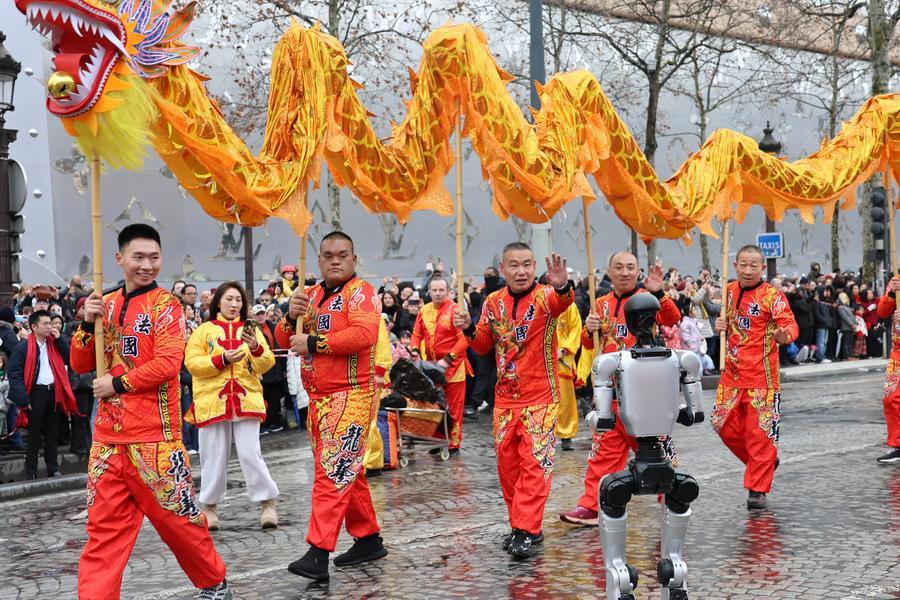
Robots with futuristic aesthetics, young foreigners demonstrating martial arts… As the Chinese New Year celebrations come to an end, the 2026 edition in France truly marked a turning point.
PARIS, February 25 (Xinhua) — The 2026 Chinese New Year celebrations in France concluded with a notable shift, integrating technology and youth participation into the traditional festivities. Beyond parades and cultural events, museums, racecourses, and other institutions have begun incorporating the festival into their programming, signaling a growing acceptance of the tradition within French society.
A key element of this year’s celebrations was the introduction of robotics. On February 1, a humanoid robot, developed jointly by Chinese company Unitree Robotics and the French group Innov8, participated in the New Year’s parade on the Champs-Élysées. The robot interacted with the public, waving and clapping to the music, marking the first appearance of a Chinese robot in the parade. The parade route began at Fouquet’s Paris and proceeded towards the Arc de Triomphe.
The technological integration extended beyond the Champs-Élysées. The China Cultural Center in Paris hosted an open day on February 14, featuring interactive artificial intelligence devices and a light projection reveal dedicated to the Yungang Grottoes. A robot dog, costumed as a red lion for the traditional lion dance, proved particularly popular with visitors, performing movements and interacting with the crowd.
“It’s incredible and impressive,” said Myriam, a visitor to the China Cultural Center, describing the fusion of modernity and tradition as “magical,” transporting her audience “as if we were no longer in Paris, but indeed in China.”
Youth participation also played a significant role in the celebrations. The Polysons de Paris choir performed Chinese classics, including “Jasmin Flower” and “The Moon Represents My Heart,” alongside “Auld Lang Syne” at a concert in the 20th arrondissement town hall on February 14. Léna, a 13-year-old choir member, spoke of friendships forged during previous visits to China and expressed her hopes for future reunions, describing Chinese New Year as “a celebration of love… We exchange greetings and give happiness to people.”
A “hanfu evening” held at the 13th arrondissement town hall featured a reconstruction of a traditional Ming dynasty wedding, with a Franco-Chinese couple performing ancient rituals. Antoine, a 19-year-old French student participating in the celebrations for the third year, noted the coincidence of Chinese New Year with Valentine’s Day, framing it as an opportunity to celebrate both the new year and love.
The celebrations extended beyond traditional Chinatowns. The Musée de La Poste dedicated a special program to the Chinese New Year on February 21, offering guided tours of French stamps depicting the signs of the Chinese zodiac, along with workshops on New Year print engraving, calligraphy, and painting. The theme of the Year of the Horse resonated particularly strongly in France, a country with a strong equestrian tradition. On February 11, the Château de Chantilly hosted a Franco-Chinese evening featuring equestrian demonstrations, Chinese martial arts, and Yingge dances.
Xavier Darcos, chancellor of the Institut de France, which owns the Château de Chantilly, emphasized the importance of continued cultural partnership with China, stating, “China is a considerable country, with an immense culture. We have every interest in seeing these emotional, intellectual and cultural ties continue to develop.”
The Chinese New Year is evolving within the French cultural landscape, extending from Parisian avenues to municipal halls, becoming a shared experience that blends tradition with new perspectives.
