
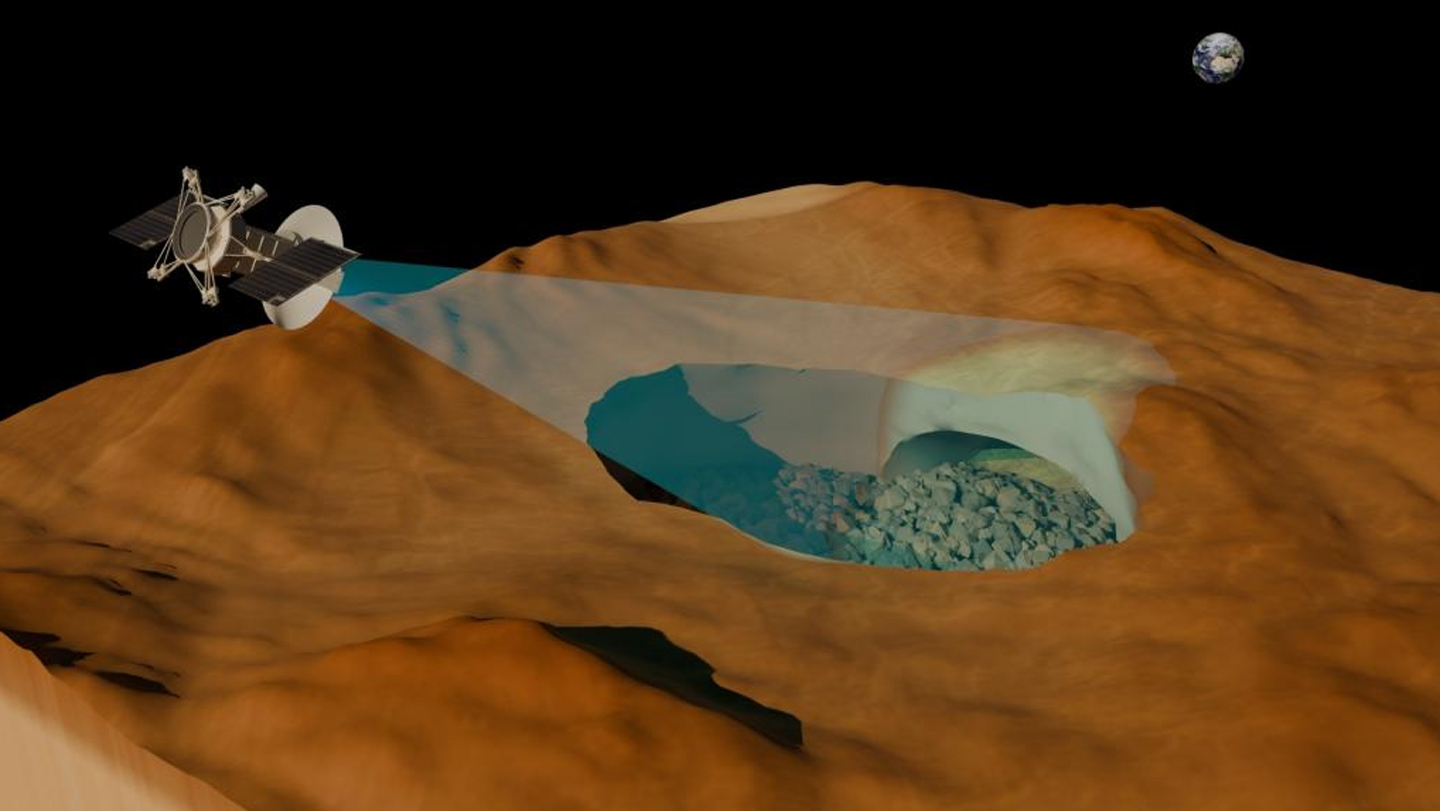
Scientists have discovered evidence of a massive lava tube hidden beneath the surface of Venus, a finding that could reshape our understanding of the planet’s volcanic history and internal structure. The discovery, announced February 12, 2026, centers on a large, empty conduit detected near the Nyx Mons region, a massive shield volcano on Venus.
The finding, published in Nature Communications, stems from a re-analysis of radar data collected by NASA’s Magellan spacecraft in the early 1990s. Researchers at the University of Trento in Italy employed specialized imaging techniques to identify what appears to be a collapsed “skylight” – an opening in the roof of the lava tube – revealing the subterranean structure. Lorenzo Bruzzone, a remote sensing scientist at the University of Trento, stated that the discovery will influence the planning of two upcoming Venus probes: NASA’s VERITAS mission, slated to launch before June 2031, and the European Space Agency’s EnVision mission, expected to launch later that same year. “Both spacecraft will carry advanced radar instruments capable of acquiring images of the Venus surface at significantly higher resolution than those currently available,” Bruzzone said.
The detected skylight is approximately 150 meters deep, opening into a lava tube at least 375 meters deep. Researchers estimate the tube itself is roughly one kilometer in diameter and extends for at least 300 meters from the skylight, though its total length remains unknown. This makes it significantly larger than lava tubes found on Earth or Mars, and comparable in size to those observed on the Moon, where lower gravity allows for larger subterranean voids.
Lava tubes form when the surface of a flowing lava stream cools and hardens, whereas the molten lava continues to flow beneath, creating a tunnel. On Earth, these tubes are often found in Hawaii and Iceland. The presence of lava tubes on Venus suggests that the planet’s volcanic activity may have been more extensive – and potentially more recent – than previously thought.
Venus, often called Earth’s “sister planet” due to its similar size and proximity, is perpetually shrouded in dense clouds, making direct observation of its surface challenging. Magellan’s radar mapping revealed a surface shaped by active volcanism, but the planet lacks evidence of plate tectonics, a key feature of Earth’s geological activity. The re-examination of Magellan data highlights the enduring value of the mission, even decades after its completion.
Anna Gülcher, a planetary scientist at Germany’s University of Freiburg who was not involved in the study, emphasized the significance of the finding. “It is remarkable that we are still extracting new insights from Magellan data, which was collected more than three decades ago,” Gülcher said. “This highlights both the lasting value of that mission, the progress we have made in data analysis, and the renewed interest in the planet.”
While the extreme conditions on Venus – including surface temperatures hot enough to melt lead and an atmospheric pressure 93 times that of Earth – preclude human exploration of the lava tube, the discovery offers valuable insights into the planet’s geological evolution. Lava tubes on other celestial bodies, like the Moon, are being considered as potential shelters for future astronauts, protecting them from radiation and micrometeorites. The finding on Venus validates existing models of volcanism on the planet and suggests that further, similar structures may await discovery.
