
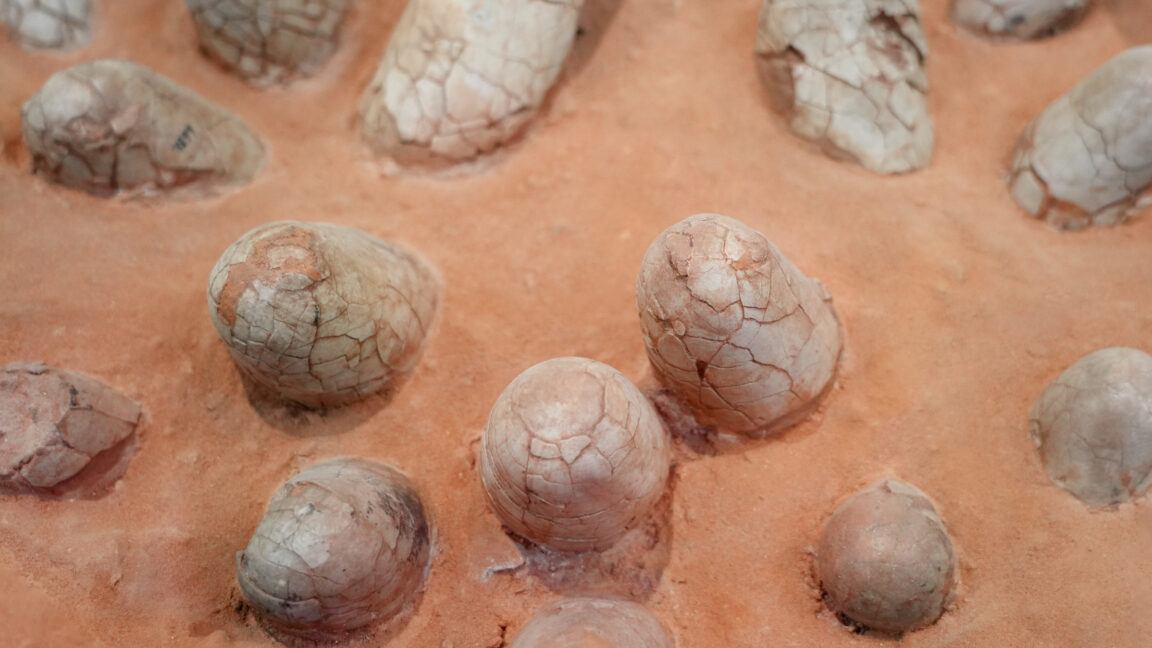
A recent method for dating dinosaur fossils, centered on the analysis of eggshells, promises to refine the timeline of the Mesozoic Era and improve the accuracy of dating continental rock formations. The research, led by paleontologist Ryan Tucker of Stellenbosch University, offers a potential solution to longstanding challenges in establishing precise ages for fossils found in sedimentary rock.
For decades, determining the age of dinosaur remains has been hampered by the inherent difficulties in dating the sedimentary rock in which they are embedded. While sedimentary rock layers represent successive periods of geologic history, accurately pinpointing their age – and the age of the fossils within – has often been imprecise. Traditional methods of dating fossilized bones and teeth have yielded inconsistent results, as the fossilization process itself can alter the material’s composition and interfere with accurate analysis. Uranium-lead dating, a commonly used technique for geological materials, is still in its early stages of application for directly dating fossils.
The breakthrough lies in the unique microstructure of calcium carbonate found in fossilized dinosaur eggshells. According to a study published recently in Nature Communications Earth & Environment, the arrangement of crystals within these shells records physical and chemical changes that occurred during fossilization, a process known as diagenesis. These changes, including water damage and fractures caused by sediment compaction, provide a traceable record for determining how long ago the eggshells – and any surrounding fossils in the same rock layer – were buried.
“If validated, this approach could greatly expand the range of continental sedimentary successions amenable to radioisotopic dating,” Tucker stated in the published study. This suggests the method could be applied to a wider range of inland fossil sites, where dating has historically been more challenging than in marine environments.
The utility of eggshells stems from the fact that vertebrates have been laying calcified eggs for hundreds of millions of years, though early dinosaur eggs lacked the hard shells seen in many modern species. The National Park Service notes that all direct evidence of dinosaurs comes from sedimentary rock formations dating back to the Triassic, Jurassic and Cretaceous periods. The USGS Publications Warehouse highlights that while dinosaurs capture public imagination, they represent only a small fraction of the fossil record, which is largely comprised of marine animal shells and microscopic plant and animal remains found in sedimentary rocks.
The process of fossilization, as described by Britannica, typically begins when an organism with hard parts, like bones or shells, dies and is rapidly buried. Minerals from surrounding sediment then seep into the pores of these hard parts, gradually replacing the organic material with stone and preserving the original shape. This process, however, can complicate dating efforts.
The Natural History Museum notes that dinosaur fossils are relatively rare compared to those of marine animals, making each discovery and the ability to accurately date it all the more significant. Researchers are continuing to refine the eggshell dating method, with ongoing validation studies expected to further solidify its reliability and expand its application to a broader range of paleontological sites.
