
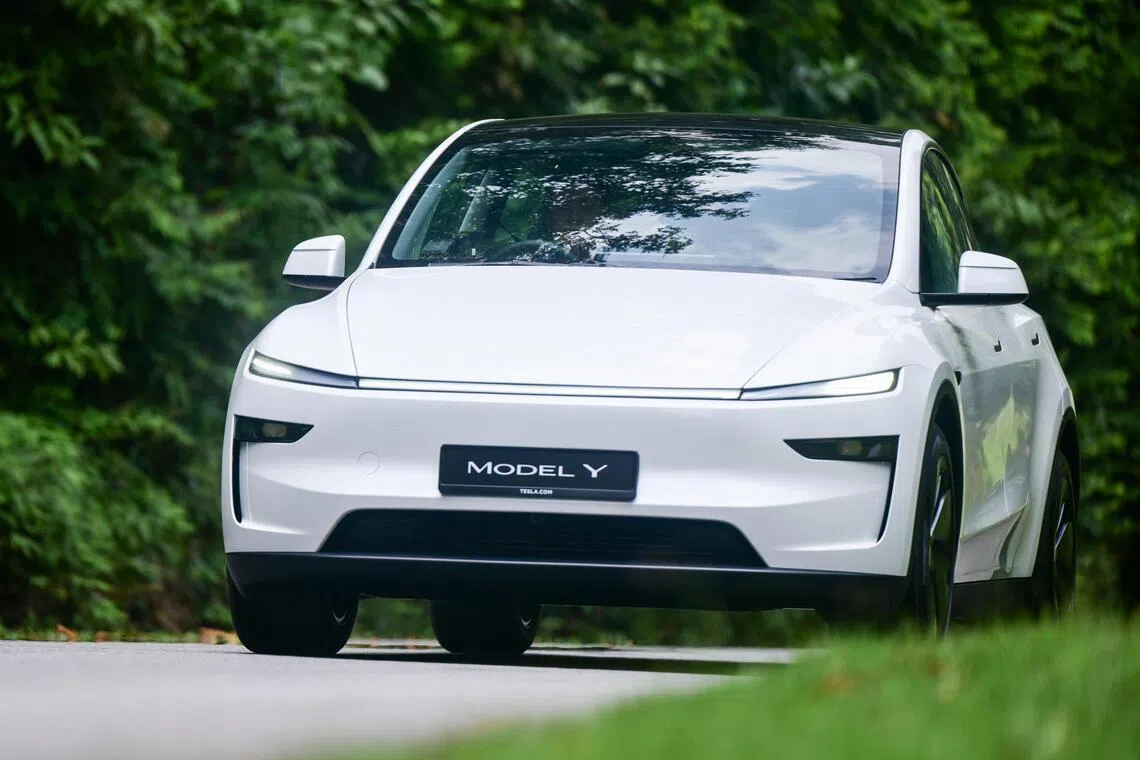
Singapore’s Land Transport Authority (LTA) has affirmed the safety of customized battery packs designed for Tesla vehicles required to install On-Board Units (OBUs) for the nation’s next-generation Electronic Road Pricing (ERP) system, responding to concerns raised by the Tesla Owners Club Singapore earlier this month.
The Tesla Owners Club Singapore had written to the LTA in early February, expressing apprehension regarding the installation of external lithium battery systems to power the OBUs, which will be mandatory for all vehicles in Singapore by the end of 2026. The club’s letter specifically highlighted potential fire hazards associated with continuously charged lithium battery systems lacking “visible active cooling or thermal management subsystems” within Tesla cabins.
In a statement responding to queries from The Straits Times on February 20, the LTA stated that the external battery device meets international safety standards for electronic devices and does not continuously charge. The need for external power sources arises because Tesla vehicles, unlike most other cars on the road, do not provide a constant power supply when switched off, a requirement for reliable OBU operation.
The LTA explained that the decision to equip Tesla cars with an external battery device was reached in collaboration with Tesla Singapore to find a viable solution. Currently, Tesla vehicles delivered with pre-fitted OBUs since December 2, 2024, are equipped with the iRoad Powerpack Pro 12, manufactured by a South Korean company specializing in in-car cameras.
For older Tesla models requiring retrofitting from January 2026, a customized external battery device developed by local engineering firm Hope Technik will be used. This device utilizes lithium iron phosphate battery cells, a technology also employed by other major electric vehicle manufacturers, according to the LTA.
Installation of the OBU and external battery system for Teslas is being handled exclusively by Indeco Engineers. The LTA is offering a three-month window, beginning with the issuance of final reminders in February 2026, for owners to have the devices installed free of charge.
Both the OBU and the customized battery device undergo rigorous testing against International Electrotechnical Commission (IEC) standards – IEC-60068 and IEC-60529 – to ensure resilience against environmental factors such as temperature, humidity, vibration, shock, dust and water. The LTA emphasized that these standards are widely recognized for assessing the operational reliability of electronic devices.
As of the end of 2025, approximately 4,200 Tesla cars have been fitted with the iRoad model, while 380 have received the customized unit. Singapore currently has 8,635 registered Tesla vehicles. Around 930,000 vehicles, representing 93 percent of the national vehicle population, have been equipped with OBUs.
