
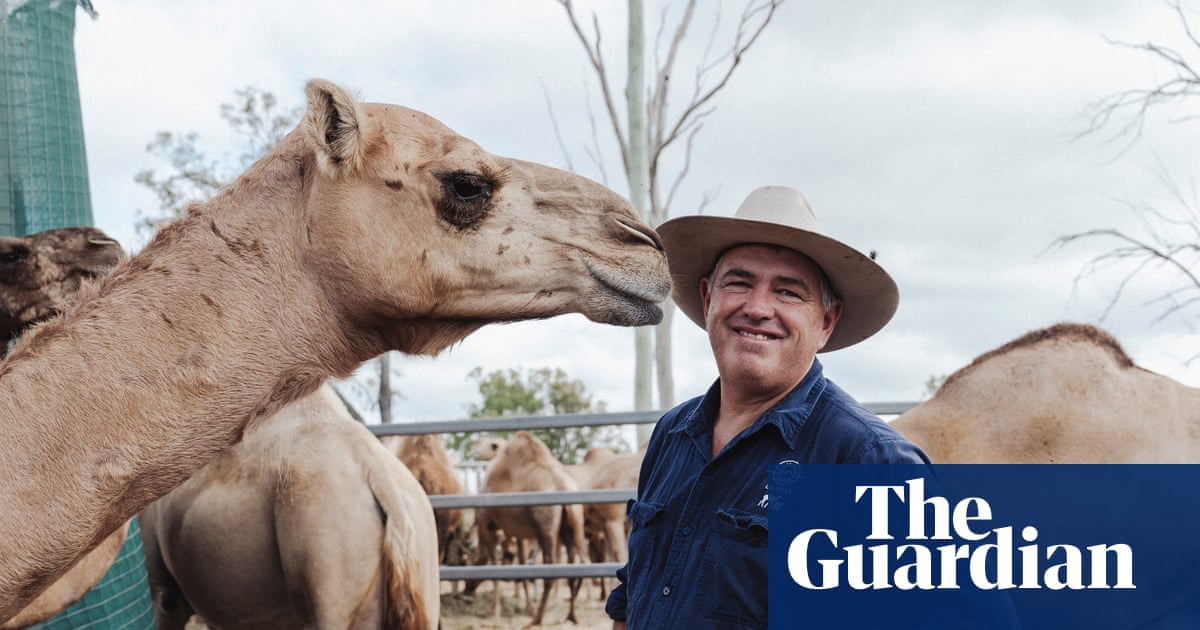
An Australian farmer is preparing to ship 60,000 litres of camel milk to the United States this year, a move that could establish a new commodity export for Australia and tap into a growing market for alternative dairy products.
Paul Martin, who runs a 130-hectare camel dairy in Queensland’s Scenic Rim, an hour’s drive from Brisbane, has spent a decade supplying the domestic Australian market. His farm, one of the first commercial camel dairies in the country, now aims to capitalize on the unique properties of camel milk and increasing consumer interest in allergen-friendly and wellness-focused foods.
Martin’s operation centers around camels like Caroline, a high-yield producer whose lineage he believes holds the key to improving herd productivity. Unlike cows, camels can “hold their milk,” requiring a more nuanced approach to milking that focuses on animal psychology and positive reinforcement. “Once you do that with these animals, they’re like a grass-eating labrador,” Martin says, noting their docile nature despite their size.
Camel milk differs significantly from cow’s milk in its composition, lacking beta-lactoglobulin, a protein responsible for many dairy allergies. This characteristic has drawn interest from individuals with sensitivities and those seeking alternative options for conditions like diabetes and eczema. It’s also being marketed as a “superfood” due to its nutritional profile and potential gut health benefits.
The potential for export is bolstered by camel milk’s natural homogenization, which allows it to be frozen, thawed, and reconstituted without separation – a crucial factor for long-distance shipping. Martin points to similarities between Australian and US health trends and demographics, including the presence of significant Somali and Arab communities with a traditional affinity for camel milk, as key market drivers.
Australia’s unique position stems from its large feral camel population. A government cull undertaken between 2010 and 2013 halved the population to approximately 300,000. But, Dr. Carol Booth, policy director at the Invasive Species Council, argues that relying on feral camels for commercial purposes is “biological bunkum,” stating that controlling the widespread damage caused by feral camels requires culling, not commercial harvesting.
Booth estimates that preventing population growth would require harvesting 40,000 camels annually, a figure she deems commercially impossible given the vast and remote areas they inhabit. A government review of the cull program acknowledged the prohibitive costs and logistical challenges of widespread mustering, whereas also noting a “strong preference” among traditional owners for population control through commercial use.
The report recommended a shift away from reliance on feral harvest towards building captive herds, a strategy Martin is already pursuing. Faysel Ahmed Selat, president of the Queensland African Communities Council, highlights the cultural significance of camels for Somalis, where the animal represents “culture, its history, its survival and its resilience.”
Ahmed Selat, who fled Somalia as a child, regularly visits Martin’s farm with friends to purchase milk and reconnect with a piece of his heritage. “It really makes me perceive like I am at home,” he says. Martin’s farm reflects a fusion of traditions, offering camel milk cappuccinos, pies, vodka, and sausages alongside more conventional dairy products.
While the scale of Martin’s ambition is significant, the Australian feral camel management project’s final report suggests commercial use could “contribute” to feral camel control in “targeted areas.” The long-term viability of the industry, and its impact on both the environment and cultural connections, remains to be seen.
