
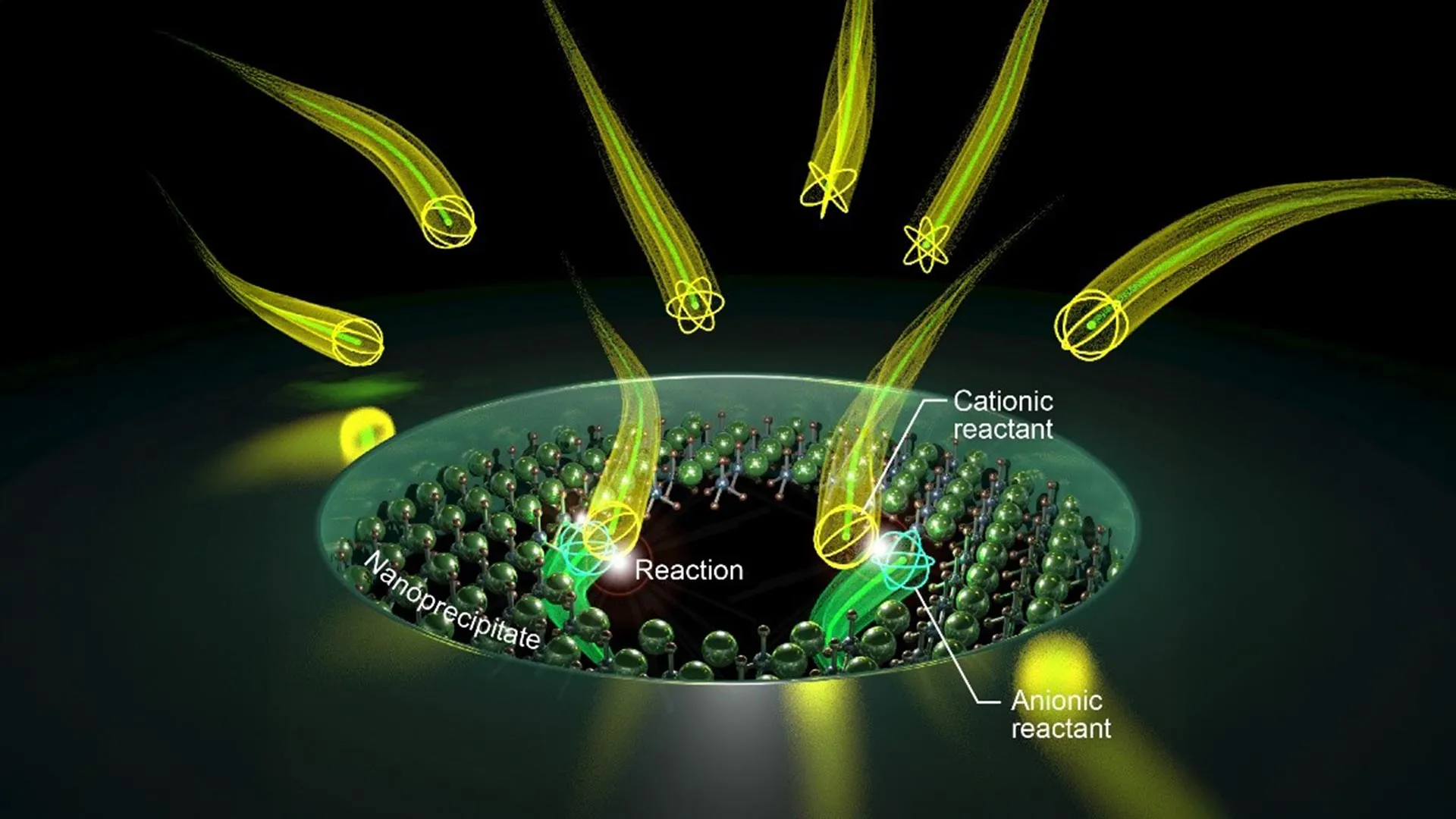
Osaka, Japan – Scientists at The University of Osaka have created ultra-small pores mimicking biological ion channels, a breakthrough that could accelerate advancements in DNA sequencing and neuromorphic computing. The research, published in Nature Communications, details a novel method for fabricating pores approaching subnanometer dimensions using a miniature electrochemical reactor.
Ion channels are critical components of living cells, controlling the flow of charged particles and enabling essential biological functions like nerve impulses. These natural channels can be incredibly narrow, sometimes just a few angstroms wide – roughly the size of individual atoms. Replicating such precise structures has long been a significant challenge in nanotechnology.
The Osaka team’s approach centers on a solid-state analogue inspired by the conformational changes observed in biological ion channels. Researchers began by creating a nanopore within a silicon nitride membrane. This nanopore then served as a reaction chamber for the creation of even smaller pores. By applying a negative voltage across the membrane, they induced a chemical reaction that produced a precipitate, gradually blocking the pore. Reversing the voltage dissolved the precipitate, reopening conductive pathways.
“We were able to repeat this opening and closing process hundreds of times over several hours,” said lead author Makusu Tsutsui, demonstrating the robustness and controllability of the reaction scheme. The team monitored ion current passing through the membrane, observing spikes consistent with the formation of numerous subnanometer pores within the initial nanopore.
Further refinement allowed the researchers to tailor the pore’s behavior. Adjusting the chemical composition and pH of the reactant solutions altered both the size and properties of the ultra-small openings, enabling selective transport of ions. “We were able to vary the behavior and effective size of the ultrasmall pores by changing the composition and pH of the reactant solutions,” explained senior author Tomoji Kawai. “This enabled selective transport of ions of different effective sizes through the membrane by tuning the ultrasmall pore sizes.”
The technology’s potential extends to several emerging fields. Single-molecule sensing, including DNA sequencing, could benefit from the ability to analyze molecules as they pass through these nanoscale gates. Neuromorphic computing, which aims to mimic the human brain’s structure and function, could leverage the electrical spiking behavior of the pores to create more efficient and powerful processors. The creation of unique reaction conditions through confinement also opens possibilities in nanoreactor design.
According to a recent report from ScienceDaily, the breakthrough represents a major step toward mimicking nature’s tiniest gateways. The research team’s method allows for the simultaneous actuation of multiple pores, offering a scalable platform for studying ion transport and fluid dynamics in extreme confinement. The University of Osaka team’s work builds on previous advances in nanopore technology, including research into ion-selective transport in MoS2 membranes and voltage-gated nanopores controlled by electrically tunable in-pore chemistry, as highlighted in recent publications.
