
Intense heat hangs over the sugarcane fields near Cuba’s eastern coast. In the village of Herradura, a blond-maned horse rests under a palm tree after spending all Saturday in the fields with its owner, Roberto, who cultivates maize and beans. Roberto was among those worst affected by Hurricane Melissa, which struck eastern Cuba – the country’s poorest region – late last year. The storm affected 3.5 million people, damaging or destroying 90,000 homes and 100,000 hectares of crops, according to reports.
Without money to buy fuel or pay for transport, Roberto relies on his horse each morning to get to work. Petrol has become prohibitively expensive as Cuba’s oil supplies dwindle under tightening US sanctions – a problem that adds to chronic power shortages. But on his way to work, Roberto passes electricity lines recently built with Chinese investment to carry power from what is expected to become the island’s largest windfarm.
The project is part of the government’s recent contribution to the UN Framework Convention on Climate Change (UNFCCC), committing Cuba to increasing renewables to 26% of total energy supply by 2035. “I think the park is a good thing,” Roberto says. “It will help with electricity and directly benefit the people.”
Amid a severe economic crisis, Cuba is trying to accelerate its energy transition in the hope of freeing itself from its dependence on fossil fuels. Since Venezuela halted oil shipments to Cuba under pressure from Donald Trump in January, the island has been hit by even more prolonged power cuts. By the end of October 2025, outages were lasting up to 24 hours, with eastern Cuba worst affected.
The government argues that renewable energy projects will ease Cuba’s power shortages and help the country adapt to the impacts of the climate crisis. Cuba is among the countries most vulnerable to extreme weather events, according to the Intergovernmental Panel on Climate Change (IPCC). While hurricanes have long been a feature of Caribbean life, the IPCC’s studies suggest the storms are becoming more frequent and intense, along with severe flooding and unusual low temperatures.
Reinaldo Funes, a professor of environmental history at the University of Havana, says the effects of the climate crisis are aggravated by centuries of environmental degradation dating back to the colonial period. The sugar industry caused severe soil erosion, reducing the land’s resilience to floods and droughts – a vulnerability documented in the early 20th century. “Almost 90% of the country’s original forest cover was cleared, first to supply the Spanish naval industry and later to expand sugarcane production,” he says.
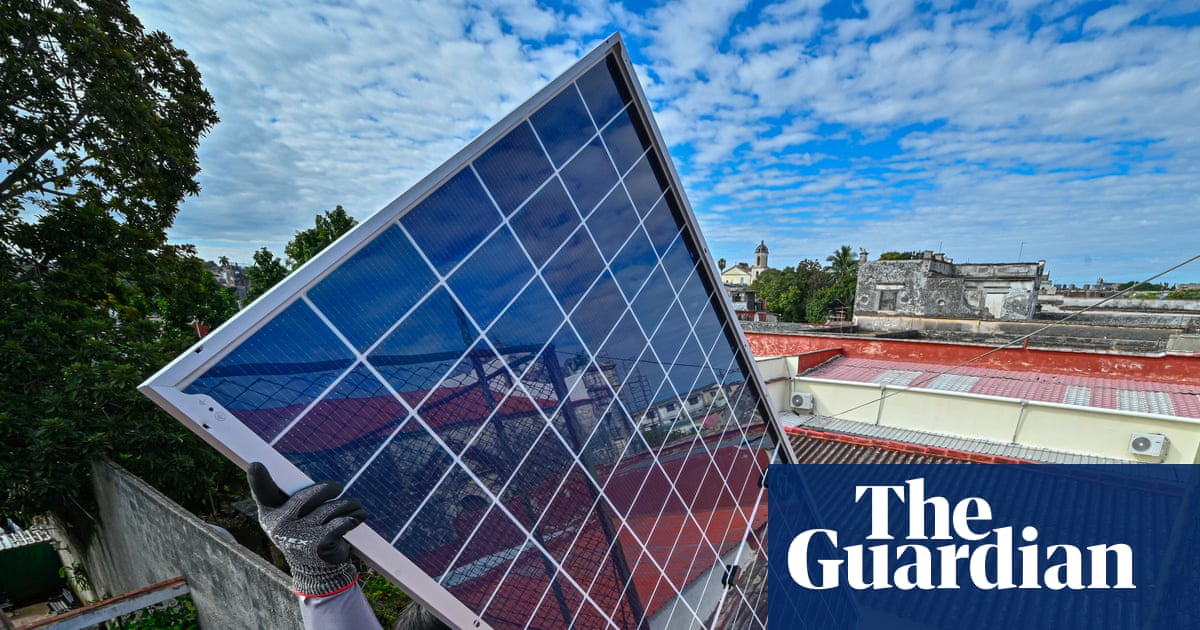
In early February 2026, the government announced emergency measures in response to a crisis likened to the 1990s “special period” after the collapse of the Soviet Union. Óscar Pérez-Oliva Fraga, the deputy prime minister, said the government’s priority would be to press ahead with the construction of solar parks, largely with Chinese support.
Cuba’s engagement with renewable energy is not new. The country began installing solar panels in rural health centres in the late 1980s and opened its first windfarm in 1999. Since 2006, renewables have been part of Cuba’s national “energy revolution”, aimed at improving efficiency and reducing dependence on imported fuel.
The energy transition would require investments of $8bn-$10bn, according to Ricardo Torres, an energy economist at the American University in Washington. “Cuba does not have that kind of money, and China will not pay for everything.”
China has emerged as a key partner in this green transition. In December 2024, Havana and Beijing signed an agreement to build seven solar parks with a combined capacity of 35MW. The Cuban government has as well set a target of installing 92 solar parks with a total capacity of 2GW by 2028, with Chinese investment playing a central role. By October 2025, the island had 35 completed solar parks, with a maximum generating capacity of 750MW and estimated savings of 111,620 tonnes of fossil fuels, according to government data.
The country already has four experimental windfarms with a combined capacity of 11.8MW. Its largest wind project in Herradura is expected to produce 33MW from 22 turbines, again built with Chinese backing. Cuba’s peak energy demand during the day is about 3,200MW, of which renewables, mainly solar, now supply roughly 9%. Installed renewable generation capacity increased by 350% during 2025.
One of the newest solar parks, completed in May 2025 near Vertientes in Camagüey province, produces 21.8MW of electricity, fed directly into the national grid. Raúl, a technical engineer at the Luaces solar park, says the challenge is the lack of battery-storage capacity. “Building a completely new energy system takes time,” he says, adding that renewables will significantly ease the country’s energy shortages. “With renewable energy, the wars over oil will one day reach to an end.”
Jorge Piñon, an expert at the University of Texas’s Energy Institute, says the government’s transition strategy underestimates the investment required to modernise Cuba’s ageing power infrastructure. “Cuba’s transmission system looks like Italian spaghetti,” Piñon says. “About 16% of the electricity generated is lost along the way.”
While praising the rapid expansion of solar parks, Piñon says generation alone is not enough. “You also have to think about how the energy is transmitted and stored.” While solar plants can only supply electricity during daylight hours, peak demand typically occurs between 7pm and 8pm but Cuba lacks battery-storage capacity, and this remains the most expensive component of any solar energy system.
According to Piñon, Cuba’s ambitious energy transition is also constrained by a lack of technical expertise to manage renewable energy projects at the pace required. Torres and Piñon agree that while renewables are essential, they cannot be the sole solution. “Cuba also needs to upgrade its fossil fuel-based thermoelectric plants,” Torres says. “The shift to renewable energy will not happen overnight.”
UNESCO and the Ministry of Education launched the “Rebuilding Hope” Route—an integrated intervention that combines psychosocial support, teacher capacity building, and accompaniment for youth‑led educational projects to restore learning and strengthen resilience in school communities, following damage caused by Hurricane Melissa in the provinces of Granma and Santiago de Cuba. More than half a million students had their classes interrupted, and nearly 2,000 schools were affected.
At the village entrance, Roberto strokes his horse and says the windfarm will help, but farmers face more immediate challenges, including access to irrigation during droughts. “I’m happy living in the countryside,” he says. “But many things still demand to change.”
