
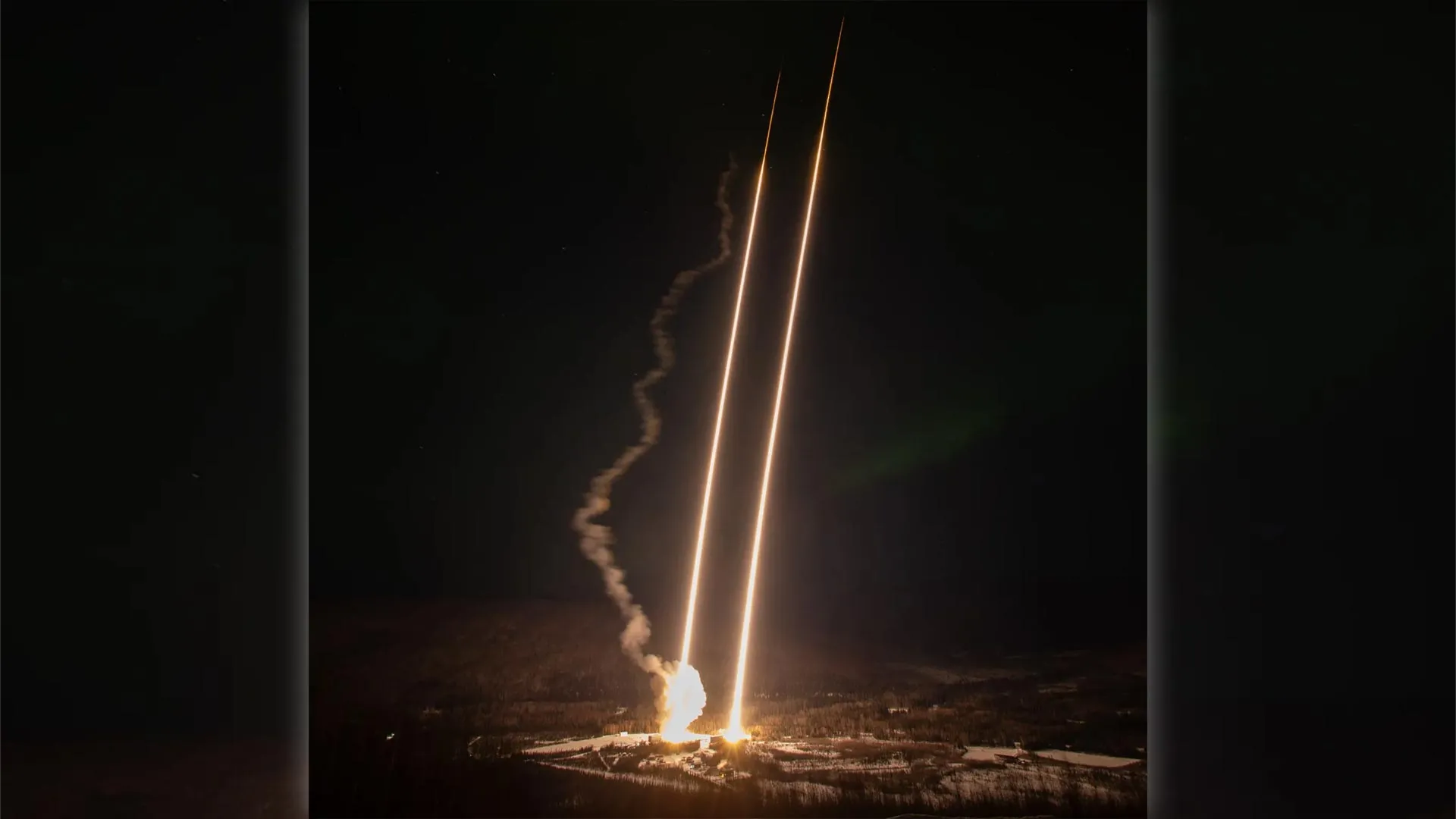
Two NASA sounding rockets successfully launched from Poker Flat Research Range in Alaska on consecutive nights, February 9th and 10th, 2026, to study the electrical currents driving the aurora borealis. The missions, dubbed the Black and Diffuse Auroral Science Surveyor and the Geophysical Non-Equilibrium Ionospheric System Science mission (GNEISS), aim to provide a more detailed understanding of how energy from space interacts with Earth’s upper atmosphere.
The Black and Diffuse Auroral Science Surveyor launched first, reaching an altitude of approximately 224 miles (360 kilometers). According to principal investigator Marilia Samara, the mission returned high-quality data and all instruments, including technology demonstrations, functioned as planned. This mission specifically targeted unusual dark regions within the aurora, known as black auroras, which may indicate reversals in electrical current direction.
Following closely behind, the GNEISS mission employed a unique dual-rocket approach, launching two rockets in rapid succession at 1:19:00 a.m. And 1:19:30 a.m. AKST (5:19:00 a.m. And 5:19:30 a.m. EST) on February 10th. The rockets reached peak altitudes of approximately 198.3 miles (319.06 kilometers) and 198.8 miles (319.94 kilometers) respectively. Kristina Lynch, the principal investigator for GNEISS and a professor at Dartmouth College, reported that all ground stations, subpayloads, and instrument booms operated as expected, and the team is optimistic about the data collected.
The aurora borealis, or northern lights, is created when charged particles from space collide with gases in Earth’s upper atmosphere, causing them to glow. This process is analogous to electricity flowing through a wire. However, the electrical circuit is not complete with just the visible aurora. Electrons must similarly return to space, and the path of this return current is complex and poorly understood.
“We’re not just interested in where the rocket flies,” explained Lynch. “We want to recognize how the current spreads downward through the atmosphere.” GNEISS was designed to map these currents in three dimensions. Each rocket released four subpayloads to take measurements at multiple points within the auroral region. As the rockets flew through the plasma, they transmitted radio signals to ground receivers. Changes in these signals, similar to how X-rays are altered during a CT scan, allowed scientists to determine plasma density and identify areas where electrical currents flow.
This technique effectively creates a “CT scan” of the aurora’s electrical environment, providing a detailed picture of the complex pathways electricity takes through the upper atmosphere. Understanding these currents is crucial because they control how energy from space is distributed, impacting the atmosphere and potentially affecting satellites in orbit.
NASA’s EZIE satellite mission, launched in March 2025, already measures auroral electrical currents from orbit. Combining data from EZIE, ground-based observations, and the direct measurements from the GNEISS sounding rockets will allow scientists to examine the auroral system from multiple perspectives. “If we can put the in situ measurements together with the ground-based imagery, then we can learn to read the aurora,” Lynch stated.
The GNEISS mission builds on a previous attempt in 2025 that was delayed due to unfavorable weather and scientific conditions. Researchers are now analyzing the newly acquired data to determine how the mysterious black auroras fit into the larger auroral circuit. The ongoing research aims to transform fleeting observations of the aurora into a deeper understanding of space weather’s influence on Earth’s upper atmosphere.
