
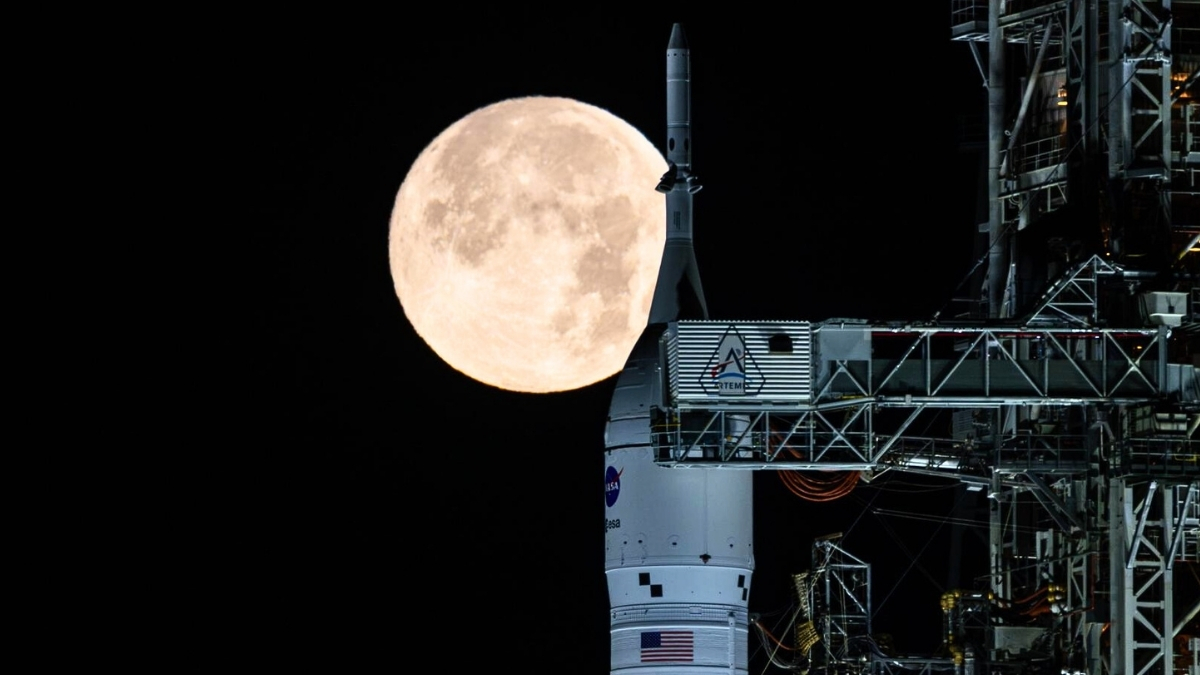
CAPE CANAVERAL, Fla. (AP) – NASA resumed a critical practice launch countdown Tuesday for its Artemis II mission, the first crewed flight to the Moon in over 50 years, after completing repairs to address liquid hydrogen leaks that previously delayed the attempt. The test, a “wet dress rehearsal,” is a crucial step toward confirming the Space Launch System (SLS) rocket is ready for flight.
The initial fueling test, conducted two weeks ago, was interrupted by the same type of hydrogen leaks that plagued the uncrewed Artemis I mission in 2022. Technicians at the Kennedy Space Center replaced seals and cleared a clogged filter on the launch pad, according to NASA officials. The current two-day test will culminate Thursday with a full fueling of the rocket’s tanks.
The Artemis II mission aims to send astronauts Reid Wiseman, Victor Glover, Christina Koch, and Jeremy Hansen on a 10-day flight that will orbit the Moon and return them to Earth. The mission is designed to verify the Orion spacecraft’s life support systems and other critical functions in the environment of deep space. According to NASA, the crew will monitor the wet dress rehearsal remotely.
Launch viewing opportunities from the Kennedy Space Center Visitor Complex are currently sold out, though packages were available for viewing from both the main visitor complex and the Apollo/Saturn V Center. The “Feel the Heat” package, offering a closer view from the Apollo/Saturn V Center, was particularly limited. Both packages included admission for two launch attempts and a one-day admission ticket for use after the launch.
NASA is currently targeting a launch no earlier than March 2026, after previously considering an earlier date. Officials stated the additional time is necessary to thoroughly analyze the results of the fueling test. The earliest possible launch date is now March 6, but remains contingent on the outcome of Thursday’s test.
The Artemis II mission builds upon the success of the Artemis I flight and represents a significant step toward establishing a sustained human presence on the Moon, with future missions planned for the lunar south polar region. The SLS rocket and Orion spacecraft are central to NASA’s long-term goals of lunar exploration and eventual missions to Mars.
