
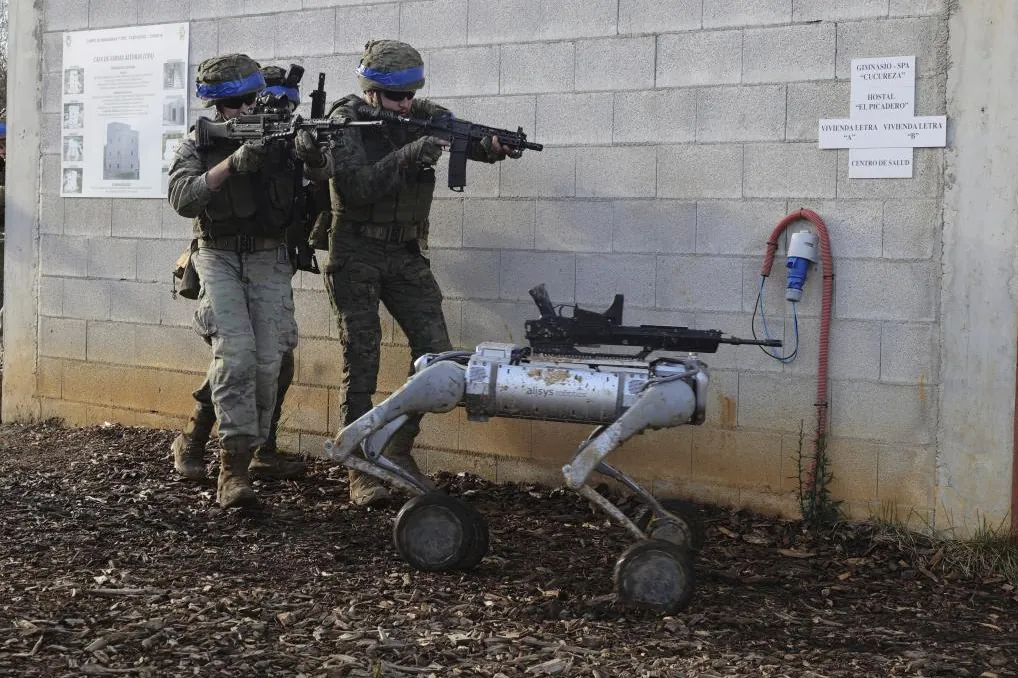
Soldiers with the Spanish Army’s Brigada Galicia VII are currently field-testing a robotic quadruped equipped with cameras and a mounted rifle at the Cabo Noval military base in Asturias, Spain, according to a report from El Mundo. The robot, developed by the Asturian firm Alisys Robotics, is being evaluated for reconnaissance and potentially combat roles, functioning as an advance guard to reduce risk to soldiers in potentially dangerous situations.
The deployment is part of a broader initiative driven by the Asturias HUB Defensa, a consortium of 55 companies focused on advancing military technology in the region. The collaboration between the Army and the HUB aims to bolster technological innovation within the Spanish armed forces. Defense officials emphasize that the technology is intended to augment, not replace, human soldiers, stating, “The technology does not substitute the human factor, it reinforces it,” as reported by El Mundo.
The robotic “dog,” as it’s been colloquially termed, is designed to navigate complex terrain and access structures before human troops, providing real-time intelligence and assuming initial risks. The system’s capabilities include visual surveillance via integrated cameras and the ability to engage targets with its mounted firearm. This development mirrors similar advancements in other nations, including China, where armed robotic quadrupeds have been showcased in military exercises, as detailed in a report by WIRED. In late 2022, Kestrel Defense, a Chinese firm, demonstrated a drone-delivered quadruped armed with a light machine gun, and further tests involved robots equipped with smoke grenades and other combat systems.
The Spanish Army’s adoption of this technology follows a trend of increasing investment in robotic systems for military applications globally. The European Union recently presented plans to Congress to reinforce defense capabilities, including anti-drone technology and support for Ukraine, signaling a heightened focus on modernizing military assets. Within Spain, the Ministry of Defense and the defense industry have committed nearly 3.8 billion euros this year to new armaments programs, according to El Mundo.
While the specific model of rifle mounted on the Spanish robot has not been disclosed, the Chinese examples utilize variants of the QBZ-95 assault rifle. The integration of firearms onto robotic platforms raises ethical and strategic considerations regarding autonomous weapons systems and the potential for unintended consequences. The Spanish Ministry of Defence has not yet commented on the long-term deployment strategy or the level of autonomy granted to the robotic system. Further testing and evaluation are planned to assess the robot’s effectiveness and integration into existing military protocols.
The development and deployment of this robotic system in Asturias represent a significant step in the modernization of the Spanish armed forces and highlight the growing role of robotics in contemporary warfare. The ongoing validation exercises will determine the extent to which this technology will be incorporated into future military operations.
