
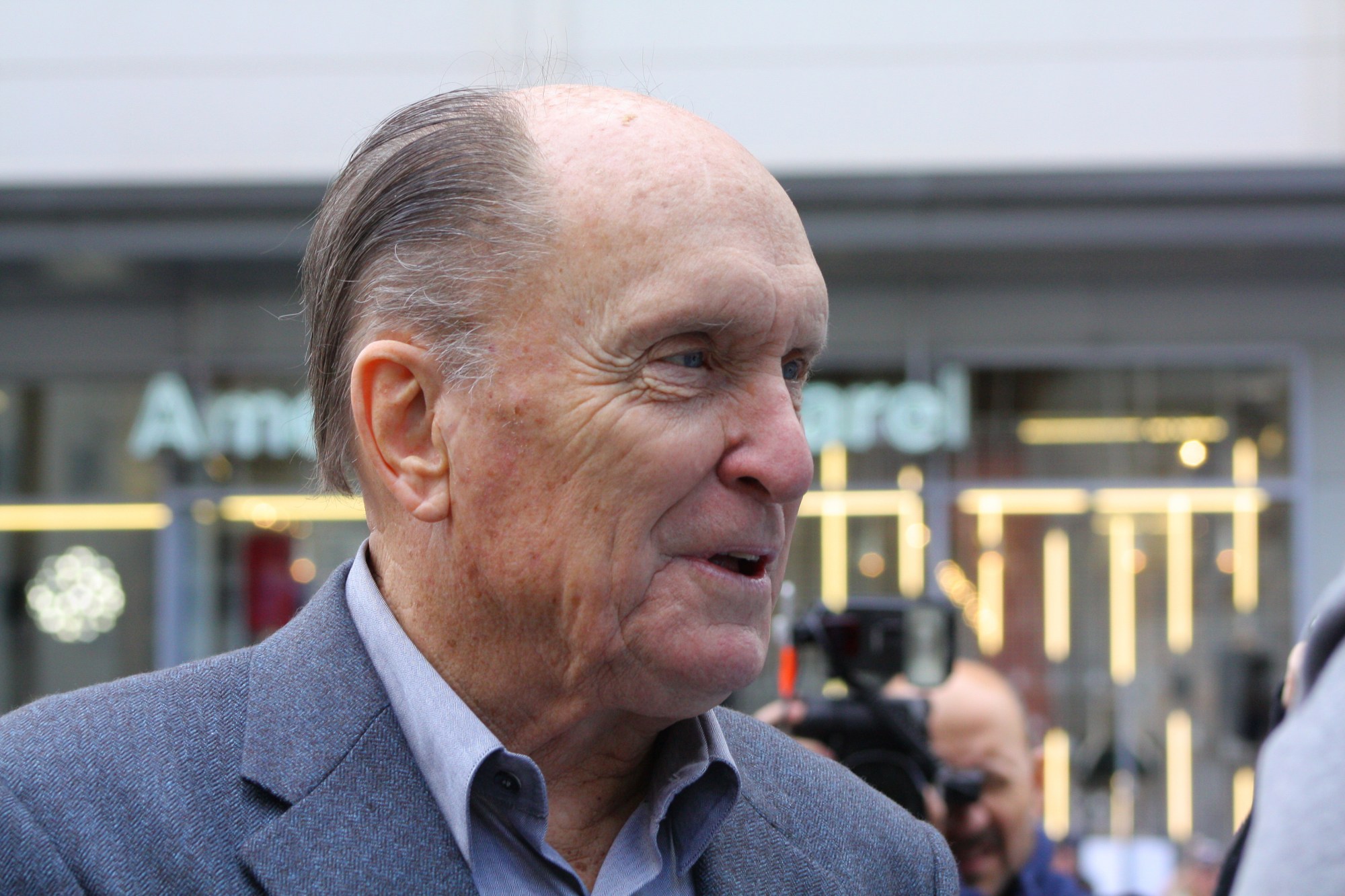
Robert Duvall, the Academy Award-winning actor whose commanding presence and versatility graced the screen for over seven decades, died Sunday at his home in Middleburg, Virginia. He was 95.
The news was confirmed by his wife, Luciana Pedraza, who shared a heartfelt statement on Facebook. “Yesterday we said goodbye to my beloved husband, cherished friend, and one of the greatest actors of our time,” she wrote. “Bob passed away peacefully at home, surrounded by love and comfort. To the world, he was an Academy Award-winning actor, a director, a storyteller. To me, he was simply everything.” Pedraza added, “For each of his many roles, Bob gave everything to his characters and to the truth of the human spirit they represented.”
Duvall’s career spanned nearly six decades, marked by a remarkable range and a willingness to inhabit characters both heroic and deeply flawed. He was equally adept at portraying forceful figures, such as Lieutenant Colonel Bill Kilgore in Francis Ford Coppola’s “Apocalypse Now” and the overbearing Bull Meechum in “The Great Santini,” as he was at depicting vulnerability and redemption, notably in his Oscar-winning role as Mac Sledge, a troubled country singer, in Bruce Beresford’s “Tender Mercies.”
Born Robert Seldon Duvall on January 5, 1931, in San Diego, California, he was the son of Mildred Hart, an amateur actress, and William Duvall, a U.S. Navy rear admiral. His upbringing was nomadic, largely dictated by his father’s naval career, with extended periods spent at the U.S. Naval Academy in Annapolis, Maryland. He graduated from Principia College in Elsah, Illinois, in 1953.
Duvall’s early career included a stint in the U.S. Army during the Korean War, followed by intensive study at New York’s Neighborhood Playhouse under the tutelage of Sanford Meisner. This training honed his ability to fully embody his roles, a hallmark of his performances.
He first gained widespread recognition with his portrayal of Boo Radley in the 1962 adaptation of Harper Lee’s “To Kill a Mockingbird.” This breakthrough led to a series of prominent roles in films like “Bullitt,” “True Grit,” and “M*A*S*H,” where he originated the role of the rigid and often exasperating Major Frank Burns.
However, it was his collaboration with Francis Ford Coppola that cemented his status as a cinematic icon. Duvall’s portrayal of Tom Hagen, the shrewd and pragmatic consigliere in “The Godfather” (1972), earned him his first Academy Award nomination. He reprised the role in “The Godfather: Part II” (1974), further solidifying Hagen as one of the most memorable characters in film history. He likewise appeared in Coppola’s “The Conversation.”
Duvall’s accolades included an Academy Award for Best Actor in 1984 for “Tender Mercies,” as well as seven Academy Award nominations and seven Golden Globe nominations throughout his career. He continued to operate prolifically, taking on diverse roles in films such as “Network,” “The Apostle,” and “The Judge.”
He is survived by his wife, Luciana Pedraza, whom he also directed in the 2001 film “Assassination Tango.”
