
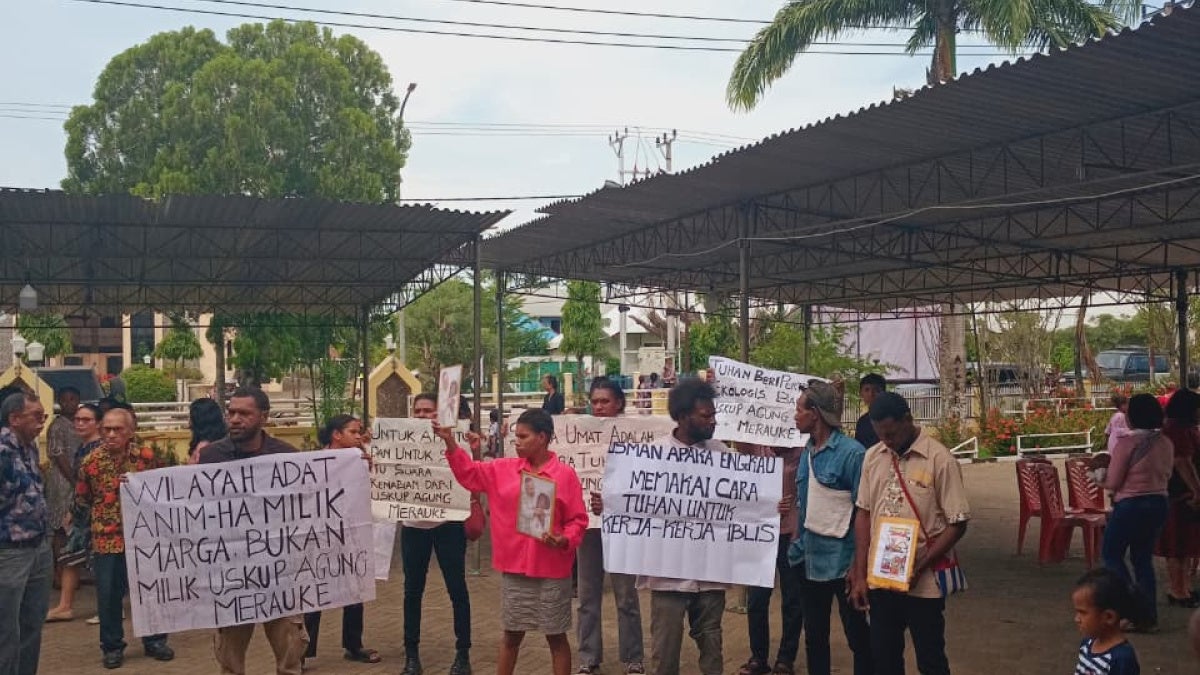
Indonesian police used force to disperse a peaceful protest in Merauke City, South Papua, on January 25, 2026, detaining 11 demonstrators and allegedly inflicting physical abuse, Human Rights Watch reported today. The protesters, members of the Voice of Catholic People of Papua, were calling on church officials to protect Indigenous Papuans impacted by the government’s Merauke Integrated Food and Energy Estate project and voicing opposition to the local bishop’s support for the initiative.
According to Human Rights Watch, authorities arrived at the St. Francis Xavier Catholic Cathedral and forcibly broke up the gathering in the church courtyard, arresting the 11 individuals. Protesters allege officers employed unnecessary force during the dispersal and subsequent detention. Stenlhy Dambujai, 30, stated that police “choked and beat” him, and that two other protesters, Maria Amote, 24, and Angel Gebze, 22, were struck on the head with batons.
Following their arrest, the detainees were taken to the Merauke Traffic Police Station, where they claim they were again subjected to physical violence before being transferred to the Merauke police precinct for questioning. All 11 were released without charge after midnight, but their legal counsel, Arnold Anda of the Merauke Legal Aid Institute, reported that police refused to provide a legal justification for their detention. Dambujai also alleged that police seized a smartphone belonging to a protester and deleted photos and videos before returning it.
The Merauke Integrated Food and Energy Estate project, initiated in 2010 by then-President Susilo Bambang Yudhoyono and later revived and expanded by President Joko Widodo in 2023, aims to convert nearly three million hectares of forest and swampland into agricultural land for rice, sugarcane, and other crops. The project was granted National Strategic Project status under Widodo, leading to increased deforestation in the Merauke region. Since assuming office in October 2024, President Prabowo Subianto has accelerated the project’s expansion, stating his ambition to transform Indonesia into a “granary of the world.”
Human Rights Watch reports that the project poses a risk to the customary land rights of over 40,000 people from the Indigenous Malind, Maklew, Yei, and Khimaima communities, who rely on the forest and swampland for their livelihoods and traditional practices. These communities allege the project is causing displacement, land grabbing, deforestation, biodiversity loss, and the suppression of dissent through military force.
The Indonesian government maintains that no applications have been submitted for the designation of customary forests within the Merauke project area and that the project adheres to national laws and regulations, including those pertaining to Indigenous rights, environmental protection, and human rights. Still, the civic group Solidarity for Merauke asserts that the project has worsened human rights violations, and displacement.
Norton Kamuyen, a Marind resident of Nakias village, Nguti district, told Human Rights Watch that he and his family were forced to flee their village in January due to a land dispute related to the project. “We once lived safely and without fear, free to forage in our forests,” Kamuyen said. “But since we disagree with the National Strategic Project, we are considered to be opposing the government. The military makes us afraid, so we have to depart our villages to find safety and protect our lives.”
Indigenous Papuans rarely protest in Merauke due to a significant military presence, with a Malind tribal leader noting that “Bulldozers here are always guarded by soldiers with semi-automatic weapons.” On February 5, the Communion of Churches in Indonesia, representing 105 Protestant denominations, issued a joint statement in Merauke calling on the Indonesian government to “end land grabbing of Indigenous Papuans, even in the name of National Food Security” and to engage in “honest, equal, and dignified dialogue” with Indigenous communities regarding the food estate project.
In March 2025, nine United Nations special rapporteurs expressed concerns in a letter regarding the potential loss of livelihoods and traditional rights for Indigenous peoples living in 40 villages within and around the project area. They reported systematic human rights and environmental violations, including the denial of customary land rights, deforestation, environmental degradation, limited participation by Indigenous peoples in decision-making, and alleged intimidation by the military.
Human Rights Watch’s Meenakshi Ganguly stated, “The Indonesian government has a responsibility to improve food production in the country. But it should be clear that the Merauke food project cannot be pursued by trampling on the rights to liberty, land, and livelihoods of the Indigenous Papuan population.”
