
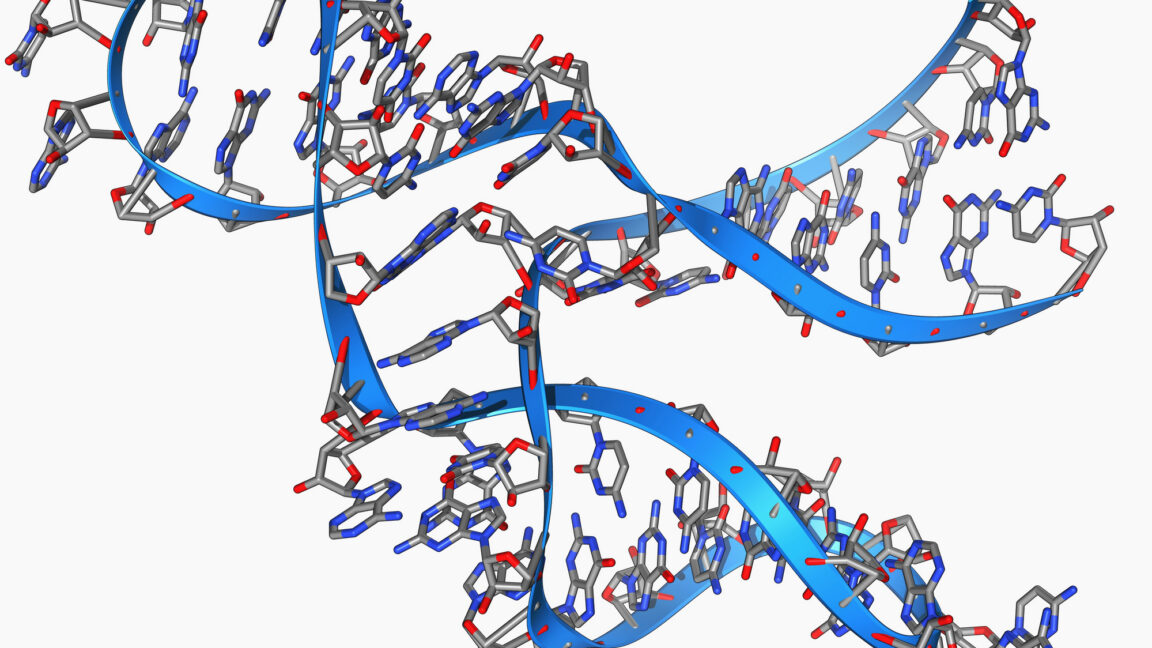
Researchers have engineered an RNA enzyme, dubbed QT-45, capable of self-replication, a development published in Science on February 14, 2026. The enzyme achieved this feat by synthesizing a sequence complementary to itself, then using that sequence as a template for its own creation.
The process, while inefficient – taking months to complete – demonstrated a replication fidelity of approximately 95 percent. This means that for every copy made, an average of two to three errors occurred. Still, scientists emphasize that these errors are crucial, as they introduce the random mutations necessary for evolutionary selection and the potential for improved functionality.
The team’s approach utilized three-base RNA fragments, a method that may more closely mimic the conditions present during the emergence of life. The researchers suggest that in a primordial chemical environment, shorter RNA fragments would likely have been more prevalent than complete, longer strands. These shorter fragments may be essential for QT-45’s activity, as the enzyme likely lacks the ability to separate fully base-paired RNA strands for replication, instead relying on the spontaneous opening and temporary pairing of fragments in a concentrated mixture.
Despite its current limitations, the researchers are optimistic about QT-45’s potential. Having undergone only 18 rounds of selection, its performance is expected to improve with further refinement, mirroring the development of more efficient ribozyme polymerases achieved through years of research by multiple laboratories.
Notably, the team identified three distinct ligases during a limited exploration of the possible RNA sequence space. This suggests a potentially vast number of ribozymes with ligating capabilities – estimated to be on the order of 1011 – within sequences of similar size. This discovery raises the possibility that the emergence of the first self-copying RNA molecule may not be as improbable as previously thought, and that a more exhaustive search could reveal numerous additional self-replicating enzymes.
Research into replication fidelity and its role in early life has been ongoing. A 2020 study published in PubMed utilized a simulation model to determine how self-replication fidelity could have evolved, finding that both survivability and fidelity contributed to fitness, but survivability was the more dominant factor. The study also suggested a “saltation” evolutionary process, a non-continuous jump from low to high levels of fidelity.
