
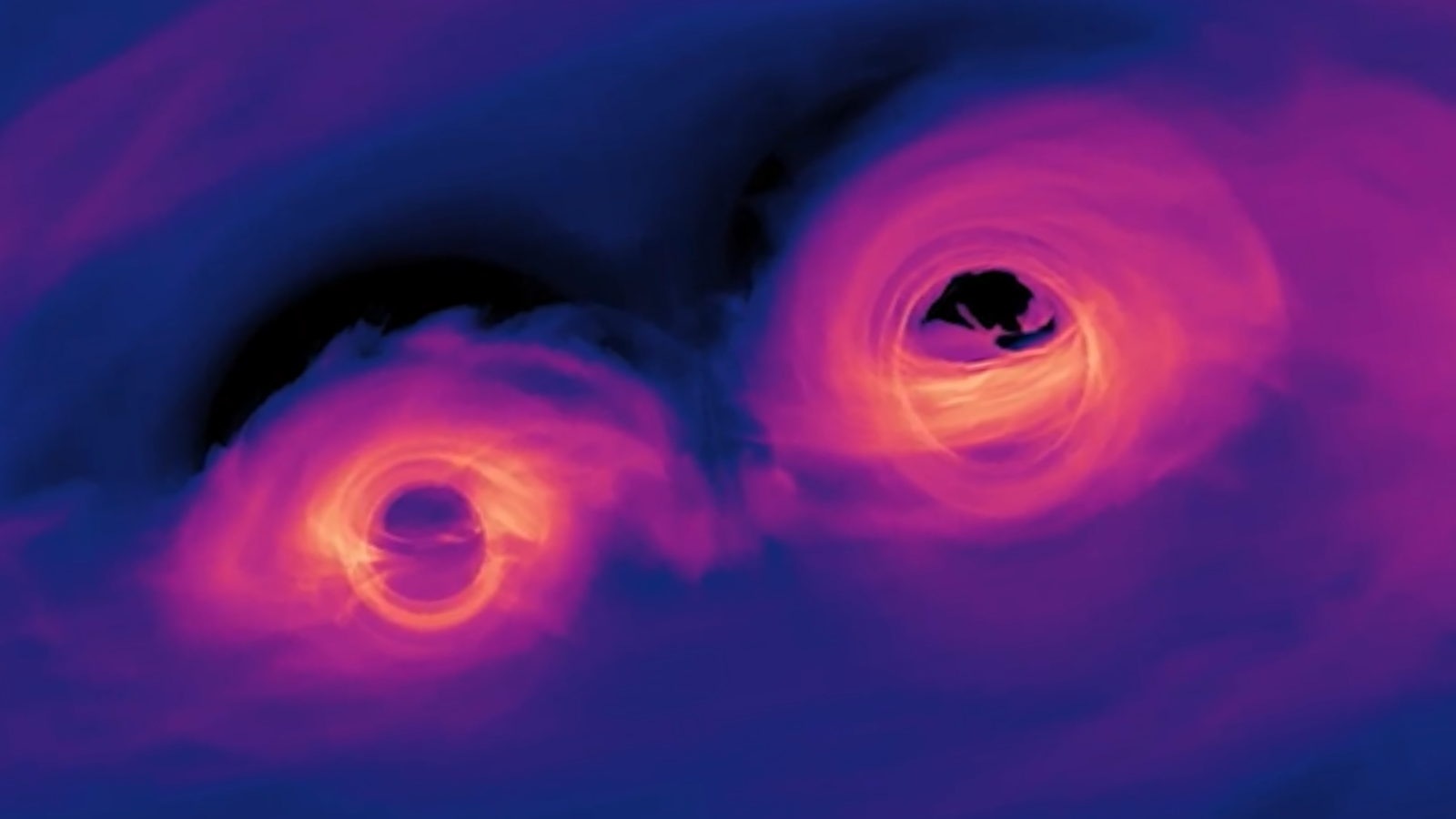
Scientists have identified two supermassive black hole binaries, dubbed Gondor and Rohan, using a novel technique that leverages gravitational waves and observations of quasars. The discovery, announced February 5 in The Astrophysical Journal Letters, offers a new method for mapping these cosmic titans and understanding their role in galaxy evolution.
The North American Nanohertz Observatory for Gravitational Waves (NANOGrav) team detected the binaries – officially designated SDSS J0729+4008 (Gondor) and SDSS J1536+0411 (Rohan) – by analyzing the background hum of ripples in spacetime. This “gravitational wave background” is created as supermassive black hole binaries spiral inward, eventually colliding and merging. The team found that these mergers are five times more likely to occur within quasars, which are galaxies with supermassive black holes actively consuming matter.
“Our finding provides the scientific community with the first concrete benchmarks for developing and testing detection protocols for individual, continuous gravitational wave sources,” said NANOGrav team member Chiara Mingarelli in a statement. The research involved analyzing 114 Active Galactic Nuclei (AGNs), the bright central regions of galaxies where supermassive black holes reside.
The unusual naming convention for the black hole systems stemmed from both the researchers involved and a nod to J.R.R. Tolkien’s “The Lord of the Rings.” According to Mingarelli, Rohan was named after Rohan Shivakumar, a Yale student who conducted the initial analysis and Gondor followed as a playful reference to the beacons of Gondor being lit in the fictional narrative.
NANOGrav first detected a gravitational wave background in 2023. The team is now focused on identifying additional supermassive black hole binaries, believing that even a relatively small catalog of these mergers could help create a detailed map of gravitational wave activity. This research has implications for understanding galaxy mergers, the physics of black holes, and the nature of gravitational waves themselves.
“Our work has laid out a roadmap for a systemic supermassive black hole binary detection framework,” Mingarelli said. “We carried out a systematic, targeted search, developed a rigorous protocol — and two targets rose to the top as examples motivating follow-up.”
The Battle of the Morannon, the final confrontation in the War of the Ring, saw the beacons of Gondor lit to call for aid. The discovery of these black hole binaries, named in homage to that event, represents a different kind of signal – one that promises to unlock new insights into the universe’s most powerful phenomena.
