
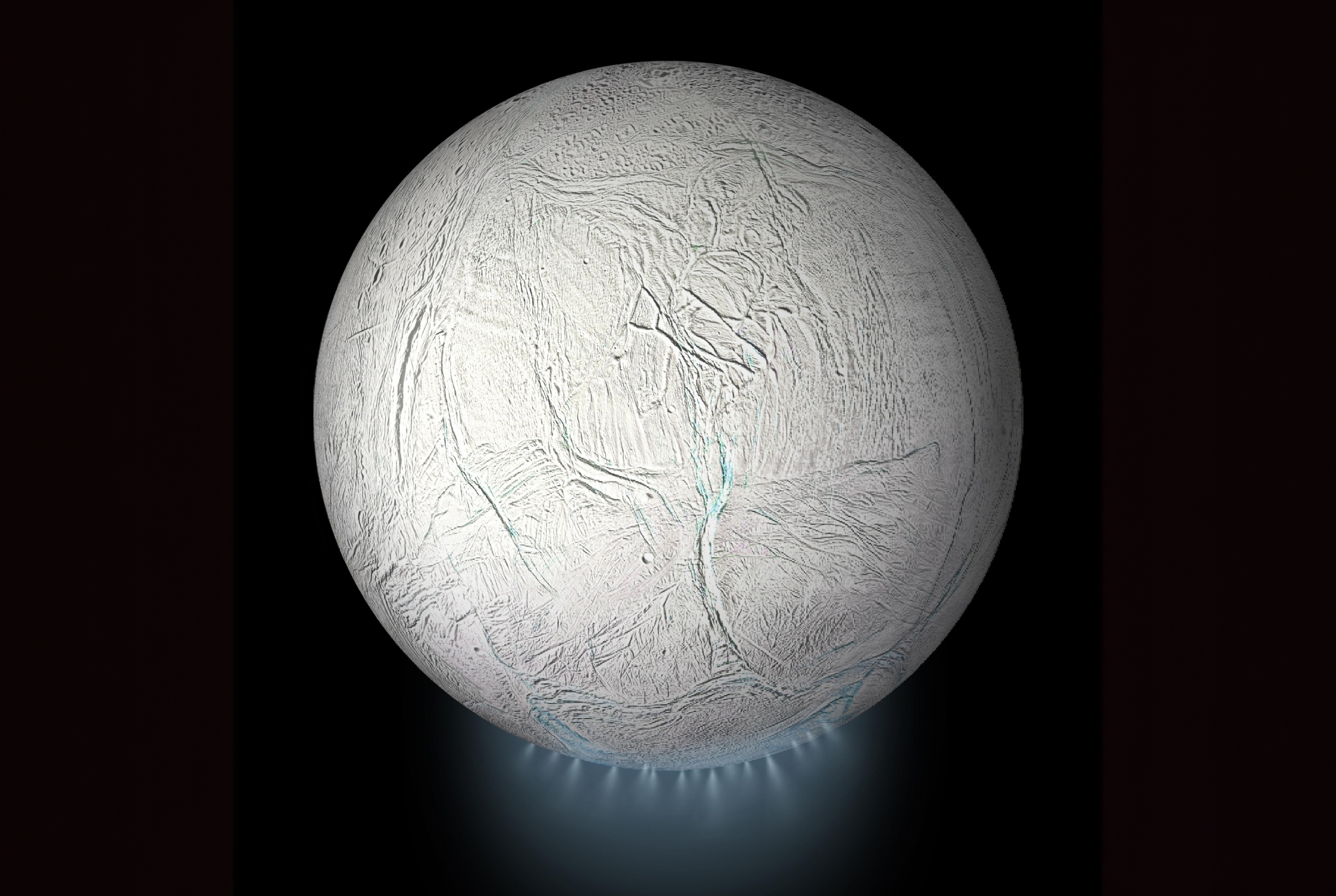
Saturn’s moon Enceladus, renowned for its subsurface ocean and plumes of water ice, exerts a surprisingly powerful electromagnetic influence on the planet’s magnetic environment, according to new research published in the Journal of Geophysical Research: Space Physics. The findings reveal that the small moon, just 313 miles (504 km) in diameter, acts as a significant electrical generator, driving currents and redistributing energy throughout Saturn’s magnetosphere.
For years, scientists have observed repeating magnetic disturbances trailing Enceladus as it orbits Saturn. These disturbances, first detected by NASA’s Cassini spacecraft during its 13-year mission, indicated a connection between the moon and the planet. Lina Hadid at the Laboratory of Plasma Physics (LPP) has now demonstrated that these disturbances form a structured wake, a lattice of electromagnetic waves magnetically linking Enceladus to Saturn’s upper atmosphere.
“Enceladus, Saturn’s small icy moon, is famous for its water geysers, but its actual impact and interaction with the giant planet has remained partly unknown,” Hadid said. The plumes, originating from cracks in Enceladus’s south polar region, release water vapor and dust that become ionized by sunlight and charged particles, creating plasma. This electrically charged flow interacts with Saturn’s magnetic field, generating electric currents and launching electromagnetic disturbances.
These disturbances travel along magnetic field lines, forming what physicists call Alfvén wings – wave-guided channels that carry electric current between worlds. As the waves reach Saturn’s upper atmosphere, they reflect back toward Enceladus, creating a crisscross lattice pattern. Cassini’s observations confirmed this pattern persisted across dozens of encounters, even when the spacecraft was far from Enceladus, revealing a connection spanning both hemispheres.
Cassini detected the strongest wave signatures trailing Enceladus in a band extending far beyond the moon itself. Across 36 separate crossings – including 13 without close flybys – the spacecraft recorded the same pattern. At its furthest extent, the wing system stretched beyond 2,000 Enceladus radii, demonstrating the moon’s planetary-scale electromagnetic activity. Within this main wing, the waves were observed to break up into thin strands, a process called filamentation, which concentrates energy into narrow magnetic channels and allows the connection to reach higher latitudes.
The interaction also results in an energy transfer from Enceladus to Saturn. As the moon’s charged material enters Saturn’s magnetic field, it slows and bends, transferring momentum into the magnetic system. The resulting waves carry this energy outward, and reflections spread the energy across a wider region of space. So Saturn receives power from Enceladus even when a spacecraft is not in close proximity.
Evidence of this energy transfer includes brief auroral glows in Saturn’s upper atmosphere, tied to Enceladus’s orbit. When the waves strike the ionosphere, they accelerate electrons downward, lighting up the atmosphere. Cassini detected these wave signatures at both low and high latitudes, supporting the idea of a magnetic link extending from the equatorial wake to the poles.
Researchers suggest that other moons with oceans or plumes may also interact with their host planets’ magnetic fields. Jupiter’s volcanic moon Io is known to have a similar effect, albeit with greater power. The findings at Saturn provide a framework for testing similar links at Jupiter and beyond. Future missions equipped with advanced field and particle sensors could trace repeated loops through the wake and observe how the coupling evolves toward Saturn’s poles, transforming Enceladus from a case study into a tool for understanding magnetized planets throughout the galaxy.
