
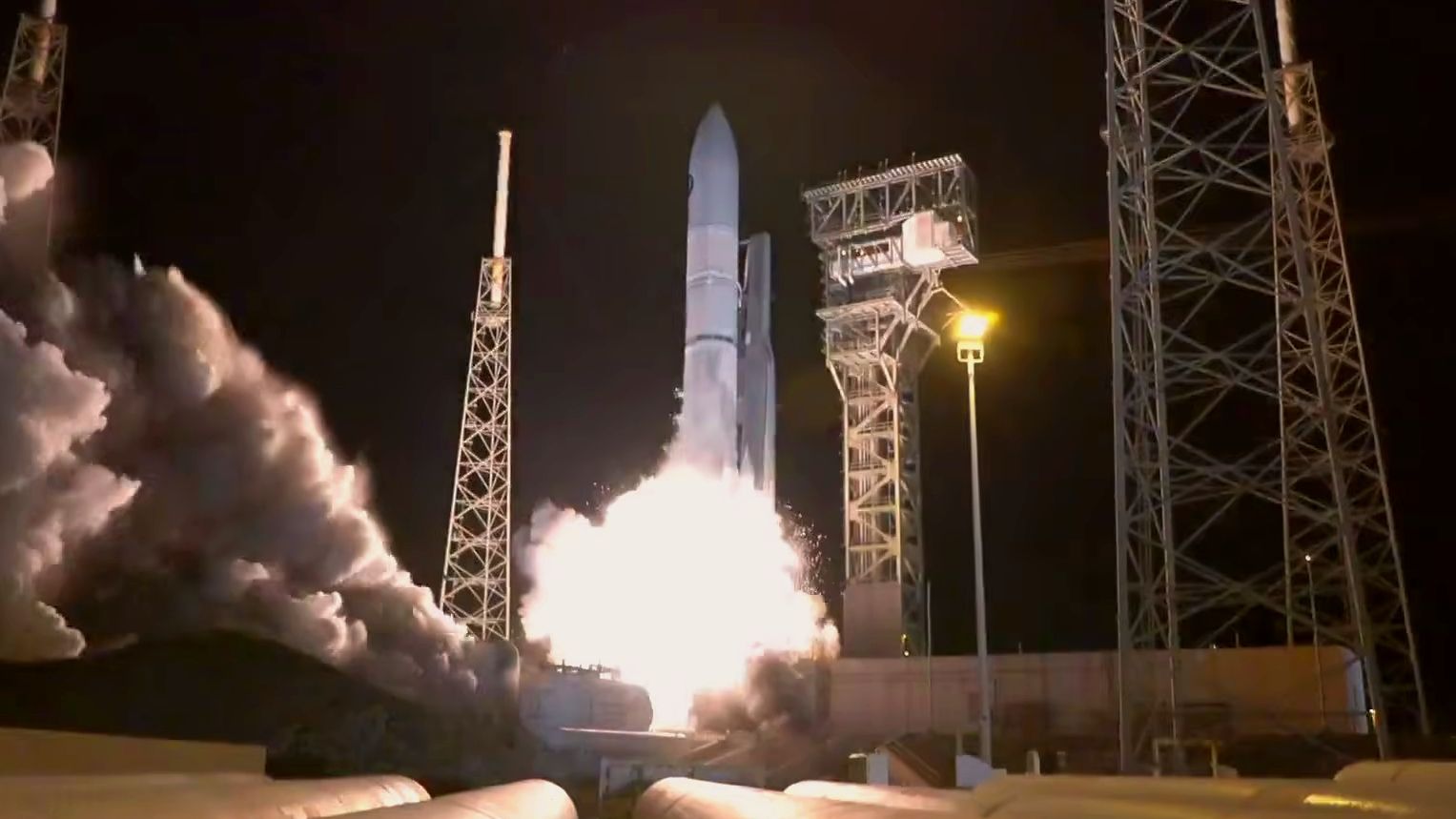
A United Launch Alliance Vulcan Centaur rocket launched a U.S. Space Force mission carrying a pair of space surveillance satellites early Thursday morning, February 12, 2026, at 4:22 a.m. Eastern Time from Cape Canaveral Space Force Station in Florida.
The mission, designated USSF-87, is primarily focused on deploying two satellites for the Geosynchronous Space Situational Awareness Program (GSSAP). These satellites are designed to monitor activity in geosynchronous orbit (GEO), a region approximately 22,236 miles above Earth where satellites remain positioned over a fixed point on the planet. GEO is a critical orbit for weather, reconnaissance, and communications infrastructure.
According to Space Force officials, the GSSAP satellites function as a dedicated Space Surveillance Network sensor, providing what they describe as “neighborhood watch” services in the GEO environment. The system aims to improve flight safety for all nations operating in that orbit by enhancing the ability to detect, warn, characterize, and attribute disturbances to space systems. Data collected will contribute to more accurate orbital predictions and aid in satellite collision avoidance.
USSF-87 marks the fourth flight of the Vulcan Centaur, ULA’s next-generation rocket intended to replace the Atlas V. The Vulcan’s debut in January 2024 carried Astrobotic’s Peregrine lunar lander, though the lander experienced an anomaly after deployment. Subsequent successful launches occurred in October 2024 and August 2025, with the latter being the rocket’s first national security mission, delivering an experimental navigation satellite to GEO.
The February 12th launch utilized the VC4S configuration of the Vulcan Centaur, featuring four solid rocket boosters. ULA previously employed this configuration on the August 2025 mission, and the company has stated the Vulcan can accommodate up to six such boosters. Following a review of data from a minor anomaly observed during the August 2025 flight, the U.S. Space Force certified the Vulcan Centaur for national security launches, joining SpaceX as one of only two launch providers currently approved for such missions.
In addition to the GSSAP satellites, USSF-87 also carried research, development, and training systems intended to improve the precision of orbital maneuvers and bolster the resilience of U.S. Assets in GEO, according to a Space Force statement. ULA has been contracted for over two dozen additional national security missions for the U.S. Space Force, with launches planned from both Cape Canaveral and Vandenberg Space Force Base in California.
During ascent, observers noted what appeared to be an irregular plume from one of the solid rocket boosters. ULA confirmed an observation early in the flight and stated the team is reviewing the data, but that the booster, upper stage, and spacecraft continued to perform on a nominal trajectory. The Centaur upper stage is expected to grab approximately 10 hours to reach geosynchronous Earth orbit and deploy all payloads.
