
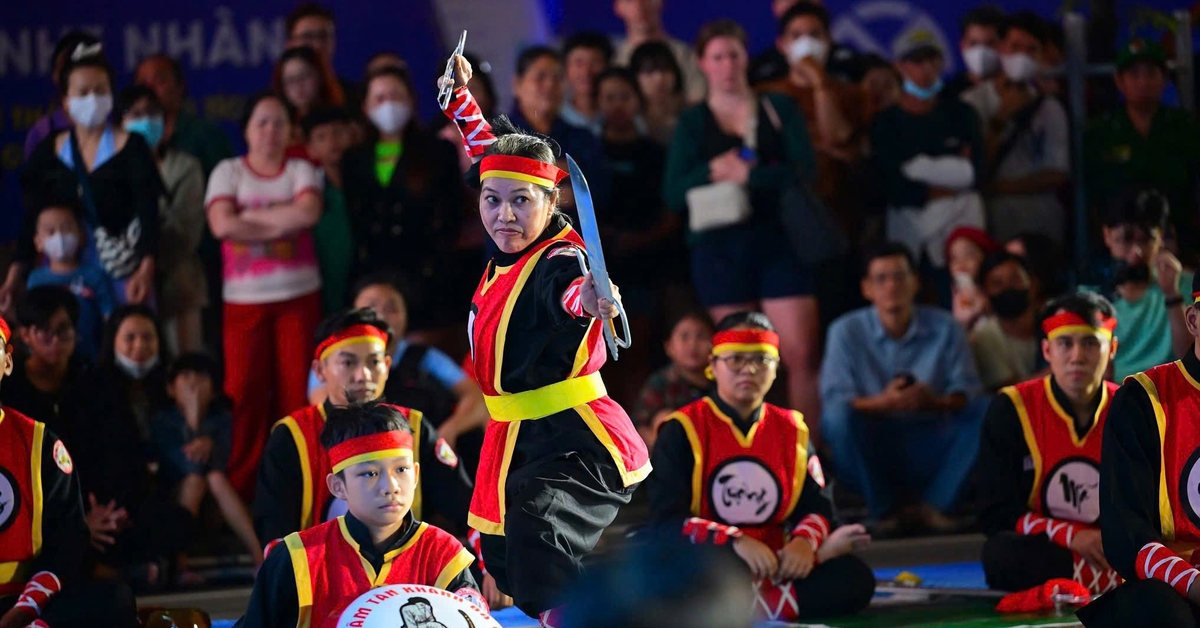
The rhythmic thud of war drums and the calculated movements of “human chess pieces” continue to draw crowds in Ho Chi Minh City, defying a decline in participation that threatens a nearly four-decade-vintage tradition. Combining martial arts prowess with the strategic thinking of chess, the performance, known as Martial Arts Human Chess, faces challenges in attracting new practitioners even as dedicated individuals strive to preserve it.
The tradition began in 1988 when martial arts expert Dr. Ho Tuong witnessed a traditional Go game in Hanoi and envisioned a dynamic fusion with martial arts. He collaborated with Le Van Van, a martial arts instructor and Quan An Thu, then president of the Ho Chi Minh City Go Federation, to bring his vision to life. The first performance debuted in 1989 at the Youth Culture Center, overcoming initial hurdles like fragile name tags and easily erased lime-painted chessboard squares, according to Dr. Tuong.
The period between 2000 and 2015 represented a peak in the art form’s popularity, with teams frequently competing across provinces and cities, becoming a staple of local festivals. Though, participation has dwindled in recent years. Nguyen Van Trong, a martial arts instructor at Thanh Khanh Ba Tra Martial Arts School and current manager of the Youth Cultural Center’s human chess team, noted a significant drop in student numbers. “Back in 2006-2007, we had so many students, sometimes reaching 500. But now, even in the summer, we usually only have about 50 to 60 students. And like this time, right before Lunar New Year, there are only about 20 students left,” he said.
Maintaining a team requires a minimum of 32 players to represent the chess pieces, plus a commander, totaling close to 40 individuals. Mr. Trong emphasizes that while the performance appears theatrical, a strong foundation in martial arts is essential. “This is a performance art, not a fighting ring, but martial artists need to have a solid foundation. We recreate the chess game of famous masters, with each move corresponding to a martial arts counterattack. The key is to execute it safely, beautifully, and in a way that captures the spirit of traditional martial arts,” he explained.
The Fourth Industrial Revolution, characterized by rapid technological advancement, is reshaping entertainment options, potentially contributing to the challenges faced by traditional art forms like Martial Arts Human Chess. The World Economic Forum has described this era as a shift towards embedded connectivity and a blurring of the physical, digital, and biological worlds, impacting how people experience entertainment.
Despite the decline in numbers, a new generation is stepping forward to sustain the tradition. Tran Quoc Thu, a 26-year-old electronics sales employee, has been involved since 2018. He described the experience of performing as “a ‘goosebumps’ experience that cannot be felt in any video game,” recalling the energy of performances in locations like Vung Tau and Binh Duong. For Mr. Thu and his peers, the art form provides a sense of community and connection to cultural heritage.
The art form is adapting to modern times, evolving from impromptu matches to more professional performances with standardized mats and elaborate costumes. Individuals seeking to establish teams often consult with experienced martial arts masters like Dr. Ho Tuong and Mr. Trong for guidance.
As the Lunar New Year approaches, the sound of war drums signals the continuation of this unique cultural tradition, a blend of strategic intellect and martial skill. The future of Martial Arts Human Chess remains dependent on the dedication of its teachers and the passion of its practitioners.
