
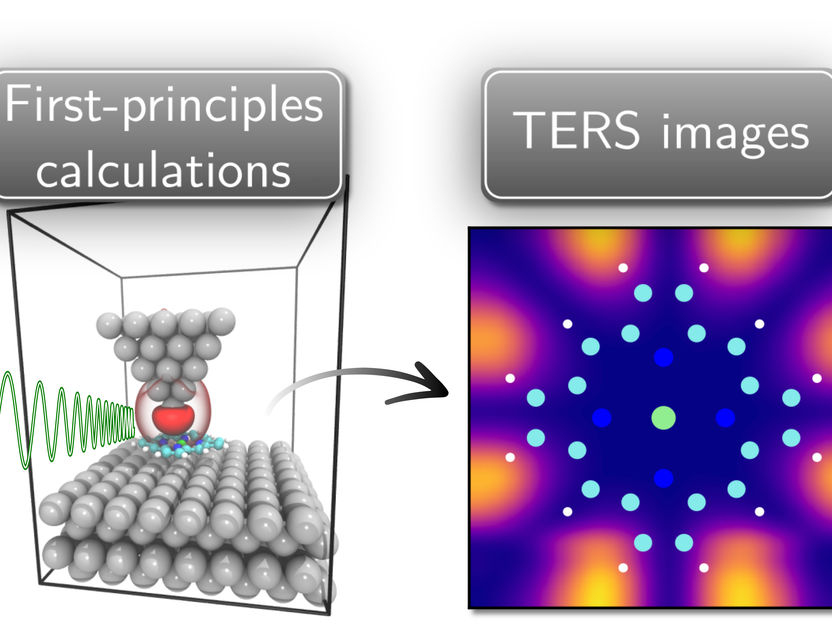
Scientists have achieved a breakthrough in interpreting images generated by tip-enhanced Raman spectroscopy (TERS), a technique used to visualize atomic vibrations at the nanoscale. Researchers at the Max Planck Institute for the Structure and Dynamics of Matter (MPSD) and the Max Planck Institute for Polymer Research (MPIP) have demonstrated the necessity of highly accurate, first-principles simulations for correctly understanding TERS data, revealing how interactions with metallic surfaces reshape vibrational imaging.
At the atomic level, all matter is in constant vibration. These vibrations are fundamental to a material’s properties, influencing everything from how it dissipates heat to the chemical reactions it undergoes. The specific vibrational modes are dictated by the chemical bonding and surrounding environment, making them a powerful tool for characterizing materials. While traditional Raman spectroscopy averages signals across a large number of atoms, limiting its spatial resolution, TERS overcomes this limitation by utilizing a sharp metallic tip to concentrate laser light into an extremely small volume – down to the Ångström scale, or one ten-billionth of a meter.
This enhanced resolution allows scientists to image vibrational motion even in individual molecules or defects on metallic surfaces. However, translating these highly detailed images into meaningful information about atomic behavior requires robust theoretical models. According to the research, published in ACS Nano, interpreting TERS images is far more complex than previously understood.
A key challenge for experimentalists has been separating the various environmental factors that influence TERS signals. The new study addresses this by introducing a computational method capable of simulating TERS signals for systems containing hundreds of atoms, relying solely on the fundamental principles of quantum mechanics. The simulations revealed that common simplifications used in theoretical modeling – such as treating molecules as isolated entities or approximating surfaces with small clusters – can lead to inaccurate interpretations.
The simulations definitively show that TERS is highly sensitive to the symmetry of the local atomic environment, enabling the identification of even subtle defects in two-dimensional materials. The research demonstrates that the electronic properties of the metallic surface significantly alter images of molecular vibrations, particularly those occurring perpendicular to the surface. Vibrations confined to the plane of the molecule are less affected by this electronic screening effect.
“TERS images are often interpreted as direct maps of atomic motion,” explained Mariana Rossi of MPSD. “Our results show that the electronic response of the surface can dominate the signal and fundamentally change what these images imply.” Krystof Brezina added, “A new physical insight gained from our work is that spatially non-local interactions between atoms can strongly influence TERS signals at a particular point in space, meaning that the brightest regions do not necessarily correspond to the largest atomic displacements.”
The researchers state that these advancements in realistic and predictive simulations will improve the quality of TERS images as a nanoscale probe. Accurate modeling using these methods is expected to be crucial in emerging fields such as genome sequencing, advanced material characterization, the design of molecular-scale devices, and the real-time monitoring of surface-catalyzed reactions for sustainable energy production.
