
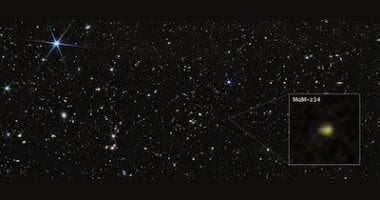
Astronomers have identified the most distant galaxy ever observed, a discovery made using the James Webb Space Telescope that is prompting a reassessment of early galaxy formation theories. The galaxy, designated MoM-z14, existed just 280 million years after the Big Bang, with its light taking approximately 13.5 billion years to reach Earth.
The finding challenges previous assumptions about the characteristics of galaxies in the early universe. Scientists had anticipated that the first galaxies would be small and faint. However, MoM-z14 appears surprisingly bright, dense, and developed, according to observations detailed in recent reports.
Data from the James Webb Space Telescope indicates an unexpectedly high concentration of nitrogen within MoM-z14. This suggests rapid evolution of massive stars within the galaxy. Researchers also noted a significant absence of primordial hydrogen surrounding the galaxy, an atypical characteristic for a structure of that age. This composition is prompting scientists to re-evaluate models of star formation in the early universe.
“These results represent a real challenge to current theories regarding the formation of stars and galaxies,” stated researchers involved in the analysis of the Webb telescope data. “There is a growing gap between theoretical predictions and actual observations.”
The Al Jazeera Media Institute highlighted the importance of senior editors in verifying and implementing newsroom processes for handling data from sources like the James Webb Space Telescope, emphasizing the necessitate for established protocols to avoid errors and maintain credibility when dealing with complex scientific findings.
Since becoming operational, the James Webb Space Telescope has consistently detected remarkably bright galaxies from the universe’s earliest epochs. This ongoing stream of discoveries reinforces the expectation that further groundbreaking findings are imminent, potentially reshaping our understanding of cosmic history. The telescope continues to observe galaxies from the early universe, suggesting more record-breaking discoveries are on the horizon.
