
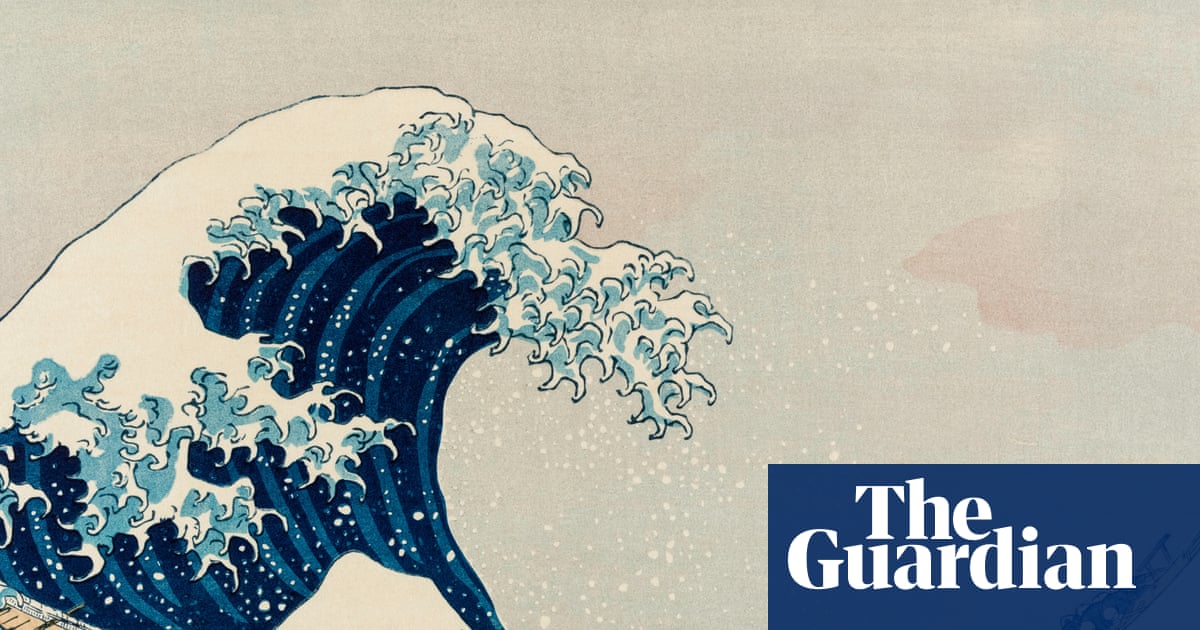
Scottish Opera is staging a world premiere that breaks new ground in operatic storytelling: an adaptation of Katsushika Hokusai’s iconic 19th-century woodblock print, The Great Wave off Kanagawa. The production, which opens at the Theatre Royal in Glasgow on February 12th, represents a rare foray into portraying the life of a visual artist on the operatic stage.
While opera has long inspired set designs from prominent artists – including Oskar Kokoschka, Salvador Dalí, and David Hockney – operas *about* artists remain scarce. Only two regularly performed works focus on painters: Hindemith’s Mathis der Maler, about Matthias Grünewald, and Berlioz’s Benvenuto Cellini, which benefited from the subject’s own detailed memoirs. Scottish Opera’s choice to center an opera on Hokusai, and specifically on his most famous work, therefore enters “largely uncharted territory,” according to the opera’s librettist, Harry Ross.
Hokusai, born in Edo (modern-day Tokyo) in 1760, lived a remarkably long life for his time, reaching the age of 88. He experienced significant hardship, including surviving a lightning strike, a stroke that required him to relearn drawing, and the destruction of his studio by fire. Despite these challenges, he produced an estimated 30,000 works, encompassing paintings, sketches, and the instructional illustrations collected in Hokusai Manga, alongside his celebrated woodblock prints. He was also known for adopting at least 30 different names throughout his life, and for his self-promotional efforts, such as painting a large portrait in a public square.
Under the Wave off Kanagawa, originally titled, was part of Hokusai’s Thirty-Six Views of Mount Fuji series, created around 1831. The image’s enduring appeal lies in its dramatic depiction of a towering wave threatening boats, with Mount Fuji appearing as a distant, serene focal point, considered a deity in Hokusai’s era. The opera’s structure mirrors Hokusai’s approach to Mount Fuji, presenting the artist’s life from multiple, non-chronological perspectives. The opera notably begins with Hokusai’s funeral.
A central thread weaving through the narrative is the relationship between Hokusai and his daughter, Ōi, who was also an artist. Ōi divorced her husband, an artist deemed unsuccessful by her standards, and returned to work alongside her father. Librettist Harry Ross expressed admiration for Ōi’s decision, highlighting its unusual nature for the time. Composer Dai Fujikura and Ross were particularly drawn to the dynamic between father and daughter, noting the special bond they shared.
Fujikura, who grew up in Japan, only became intimately familiar with Hokusai’s work after visiting a British Museum exhibition in 2017. Inspired by the exhibition, he and Ross collaborated on the opera, utilizing an unpublished English translation of Iijima Kyoshin’s 1893 biography of Hokusai. The development of the opera coincided with the Covid-19 lockdowns, a circumstance that Ross noted mirrored the isolation of Japanese society during Hokusai’s lifetime, a period marked by the Tokugawa shogunate’s policy of sakoku, which severely restricted foreign interaction.
The opera features Dr. Philipp Franz von Siebold, a German botanist and traveler, as the only non-Japanese character. Siebold’s arrival with a supply of Prussian Blue pigment – a rare and valuable commodity in Japan – provides a pivotal moment in the story, enabling Hokusai to achieve the vibrant colors he envisioned for his Mount Fuji series. Fujikura sought to musically represent the introduction of this new color, employing “natural harmonic trills blended with artificial harmonics and a shimmering vibraphone played with soft mallets” to evoke the experience of witnessing something extraordinary.
Fujikura’s musical background is rooted in Western classical traditions, but he has increasingly incorporated traditional Japanese instruments into his compositions. The opera features the shakuhachi, a traditional Japanese flute, played by Shozan Hasegawa, who traveled from Japan for the production. The instrument’s sound is interpreted by director Satoshi Miyagi as the voice of Hokusai, resonating within his daughter’s mind. Miyagi emphasized that the production does not attempt to recreate Hokusai’s Japan literally, aiming instead for a universal resonance.
The production benefits from financial support from Japanese government agencies and includes a collaborative team of Japanese designers and choreographers from the Kajimoto company. Scenographer Junpei Kiz addressed the challenge of representing The Great Wave itself, opting to initially present it in monochrome before revealing its full color spectrum. The production will transfer to Tokyo and Kyoto in 2027.
Both Ross and Fujikura spot parallels between Hokusai’s life and the challenges faced by contemporary artists. Ross believes Hokusai’s ability to adapt and reinvent himself is particularly relevant in the 21st century, stating, “we must change to stay the same.” Fujikura echoed this sentiment, praising Hokusai’s “nonstop creativity” and “strong energy” to pursue artistic excellence.
