
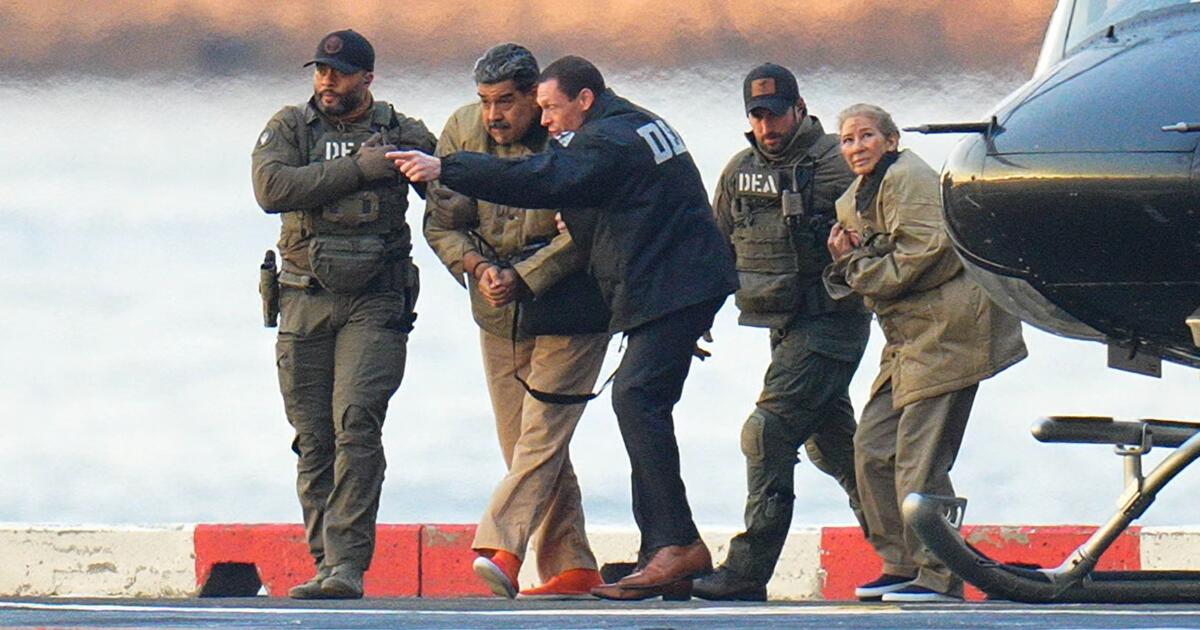
Ousted Venezuelan leader Nicolás Maduro stood in a Manhattan courthouse Monday a captive criminal defendant: surrounded by heavy security, deprived of his power as a head of state and facing drug, weapon and conspiracy charges likely to keep him behind bars for years.
“I was captured,” he said in spanish, before pleading not guilty during a brief arraignment. “I am a decent man, the president of my country.”
Just two days prior, more than 2,000 miles away in Caracas, Maduro was seated “atop a corrupt, illegitimate government that, for decades, has leveraged government power to protect and promote illegal activity, including drug trafficking,” according to a sweeping indictment unsealed Saturday.
What preceded maduro’s swift downfall was not just his weekend capture in what President Trump called “one of the most stunning, effective and powerful displays of American military might” in U.S.history, but decades of partnership with “narco-terrorists” from Venezuela, Colombia and Mexico to enrich himself and his family through “massive-scale” cocaine trafficking, the indictment claims.
The allegations, built off a 2020 indictment, stretch back a quarter-century and implicate other Venezuelan leaders and Maduro’s wife and son. They suggest extensive coordination with notorious drug trafficking organizations and cartels from across the region, and paint a world Trump himself has long worked to instill in the minds of Americans — one in wich the nation’s southern neighbors are intentionally flooding the U.S. with lethal drugs and violent criminals, to the devastation of local communities.
It is a portrait of drugs, money and violence every bit as dramatic as the nighttime raid that sent jets and helicopters into Venezuelan airspace, U.S. special forces into Maduro’s bedroom and Maduro and his wife into U.S. custody and ultimately to their arraignment in court Monday.
It appears to rely on clandestine intelligence and other witness testimony gathered over the course of decades, which Maduro’s defense team will undoubtedly seek to discredit by impugning the cast of characters — some drug traffickers themselves — whom prosecutors relied on.
Legal experts said it could take years for the case to reach trial, slowed not only by the normal nuance of litigating a multi-defendant conspiracy case but the added complexity of a prosecution that is almost certainly predicated in part on classified intelligence.
“That’s very different than a typical drug case, even a very high-level drug case, [where] you’re not going to have classified State Department cables the way you’re going to have them when you’re actually prosecuting a head of state or a former head of state,” said Renato Stabile, an attorney for former Honduran president Juan Orlando Hernández, who was convicted in a similar cocaine trafficking case in 2024 before being pardoned by Trump last month.
Joe McNally, the former acting U.S. attorney for the Central District of California, which includes Los Angeles, said he expects the case will take at least a year to get to trial, after prosecutors “show their cards” and Maduro’s attorneys review that evidence and seek out their own witnesses.
He said he expects a strong case from prosecutors — despite it being “not easy to prove a case that involves high level cartel activity that’s happening thousands of miles away” — that will appropriately play out entirely in public view.
“He’ll have his day in court. It’s not a military tribunal,” McNally said. “His guilt or innocence will be decided by 12 people from the district [in new York where he’s been indicted],and ultimately the burden will be on the prosecutor.”
The case against Maduro
According to the indictment, Maduro and his fellow indicted Venezuelan leaders have since about 1999 “partnered with some of the most violent and prolific drug traffickers and narco-terrorists in the world” — including the FARC and ELN groups in Colombia, the Sinaloa and Los Zetas cartels in Mexico and the Tren de Aragua gang in Venezuela.
Among the others indicte
