
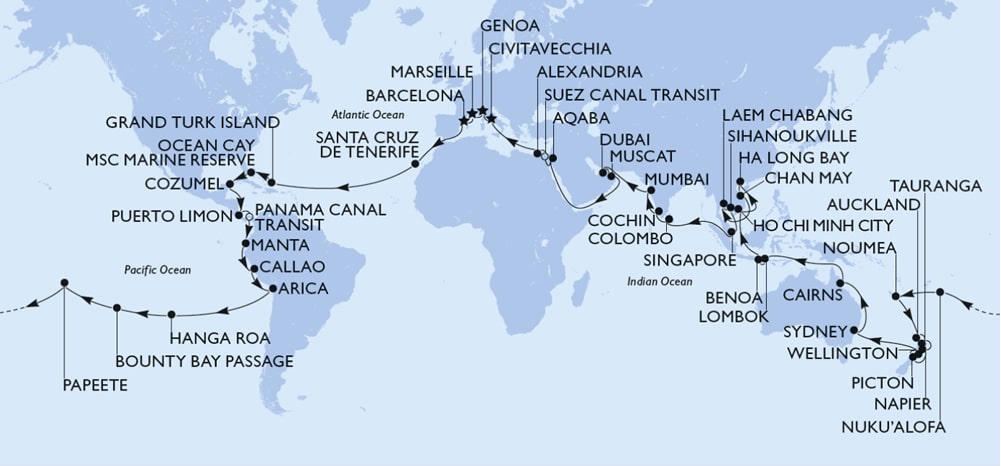
MSC Cruises is now at the center of a structural shift involving premium leisure travel pricing.The immediate implication is a recalibration of global cruise market dynamics toward price‑sensitive, experience‑driven demand.
The Strategic Context
since the pandemic, discretionary travel has rebounded sharply, driven by pent‑up demand and rising household wealth in key source markets (North America, Europe, and parts of Asia).At the same time, the cruise industry faces a convergence of cost pressures-fuel, environmental compliance, and port fees-while competing for a limited pool of affluent travelers. Operators are thus experimenting with “value‑added” itineraries that bundle amenities and leverage loyalty programs to differentiate without inflating headline prices. The launch of a sub‑$20 k around‑the‑world cruise reflects MSC’s response to these macro‑level forces, aiming to capture a segment that seeks global exposure but is price‑sensitive enough to balk at customary premium offerings.
Core Analysis: Incentives & Constraints
Source Signals: MSC announced a 115‑day world cruise covering six continents, 29 countries, and 44 ports, priced at $19,709 for interior cabins (with taxes and fees included). The product includes 15 shore excursions and a “Dine & Drink” package. Discounts are offered to members of MSC’s loyalty program, and shorter segment options are available at lower price points.
WTN Interpretation: MSC’s incentive is to increase occupancy rates on a mid‑size vessel (≈2,500 passengers) that can be filled more efficiently than mega‑ships, thereby improving unit economics amid rising fuel and carbon‑tax costs. By bundling excursions and beverage packages, MSC shifts ancillary revenue from on‑board spend to a fixed‑price model, reducing per‑guest cost volatility. The loyalty discount leverages existing customer data to lock in repeat business and generate higher lifetime value.Constraints include exposure to volatile bunker fuel prices, tightening IMO emissions regulations that may require costly retrofits, and geopolitical risks along strategic chokepoints (Panama, Suez) that could disrupt itineraries or raise transit fees. Additionally,consumer confidence swings could affect willingness to commit to a four‑month voyage.
WTN Strategic Insight
“The price‑compression of flagship world cruises signals a broader industry pivot: operators are betting that bundled,experience‑centric products will unlock demand from a growing cohort of affluent yet cost‑conscious travelers.”
Future Outlook: Scenario Paths & key Indicators
Baseline Path: If global consumer confidence remains robust, fuel prices stabilize, and regulatory regimes evolve predictably, MSC’s low‑priced world cruise will achieve high occupancy, prompting competitors to launch similar value‑bundled itineraries. This could intensify price competition, expand overall cruise market size, and reinforce MSC’s market share in the premium‑mid segment.
risk Path: If bunker fuel costs surge sharply, or if emissions regulations impose sudden retrofitting mandates, MSC’s cost base could erode, forcing price hikes that diminish the product’s attractiveness. Concurrently, any disruption at the Panama or Suez canals (e.g., geopolitical tension, operational delays) could lengthen itineraries, increase operational costs, and trigger cancellations, undermining confidence in long‑duration cruises.
- Indicator 1: MSC’s booking velocity for the 2028 world cruise (tracked monthly through the next 3‑6 months).
- Indicator 2: global bunker fuel price index and upcoming IMO emissions compliance deadlines.
- Indicator 3: Consumer confidence indices in MSC’s primary source markets (U.S., EU, china) for the next two quarters.
