
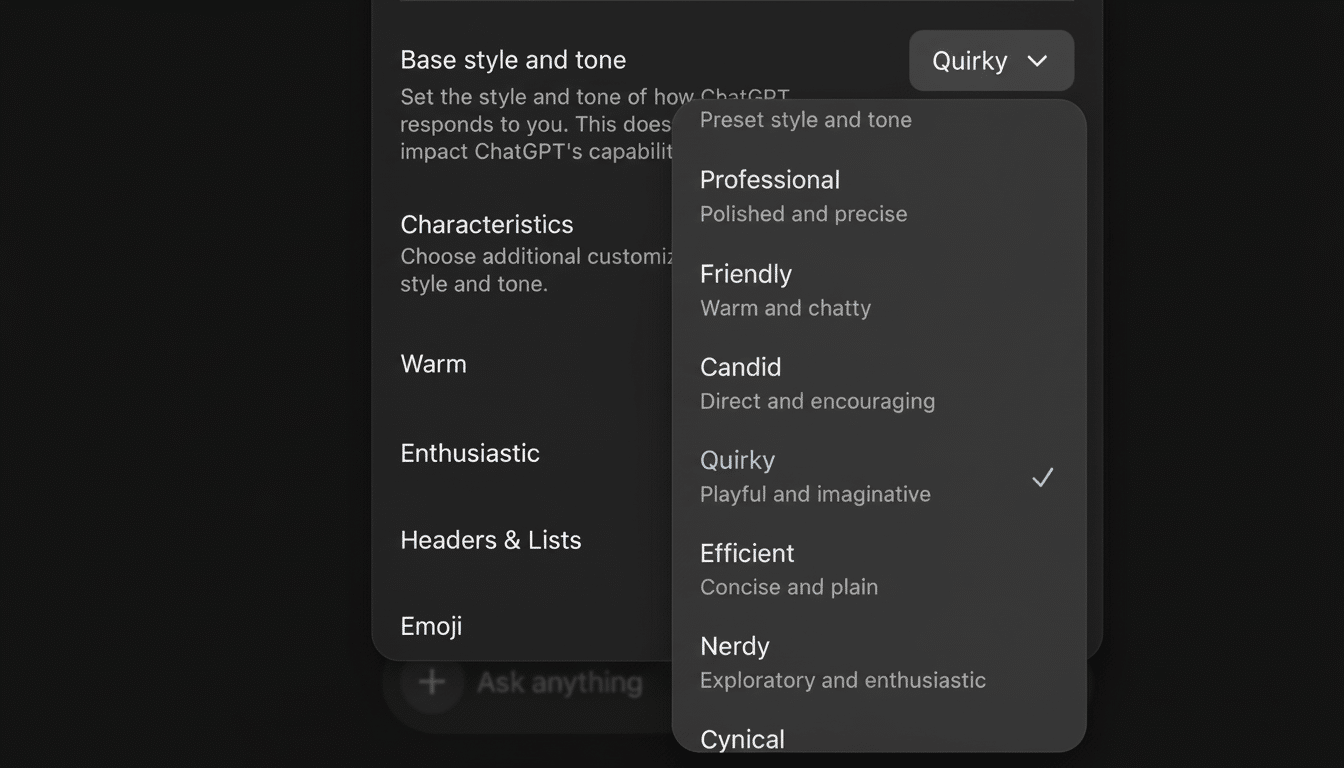
AI tone‑control feature is now at the center of a structural shift involving model steerability. The immediate implication is heightened user agency over generative output, reshaping enterprise governance and brand‑voice consistency.
The Strategic Context
Historically, large language models have offered limited direct user control, leaving tone and style to be coaxed through verbose prompting. Recent UI innovations-saturation and brightness sliders that sit atop system instructions, custom profiles, and base style presets-reflect a broader industry move toward explicit steerability. Enterprises, facing growing regulatory and brand‑risk pressures, are demanding governance levers that can be codified in policy frameworks. Simultaneously occurring, competitive dynamics among AI providers (e.g., Microsoft’s tone toggles in its productivity suite) push the feature set from a hidden prompt trick to a visible product attribute.
Core Analysis: Incentives & Constraints
Source Signals: The text confirms the rollout of tone sliders (saturation, brightness) that overlay system instructions and custom profiles; admin policies can preset defaults for brand alignment; limitations include inconsistent outputs across domains and unclear interaction with shared workspaces; broader context cites Microsoft’s existing tone controls and Gartner’s view of controllability as a cornerstone for responsible AI scaling.
WTN Interpretation:
- Incentives: Vendors seek differentiation by packaging steerability as a UI feature, while enterprises aim to lock down voice to meet brand guidelines and compliance mandates. Users benefit from reduced prompt engineering effort.
- Leverage: Admin‑level defaults give organizations a top‑down lever to enforce tone, turning a previously ad‑hoc practice into a policy‑driven setting.
- Constraints: Technical variability-tone sliders do not guarantee uniform style across topics, especially where domain language diverges.Integration with shared workspaces raises questions about hierarchy of defaults (org‑level vs. user‑level). Contradictory settings (e.g., high enthusiasm but low emoji use) expose limits in the model’s internal weighting.
- Risk Management: Enterprises may hedge by retaining custom prompting templates or limiting AI use in high‑stakes communications until consistency improves.
WTN Strategic Insight
“Steerability is evolving from a hidden prompt art into a configurable interface layer, turning tone into a first‑class, policy‑driven product attribute.”
Future Outlook: Scenario Paths & Key Indicators
Baseline Path: If the current trajectory of UI‑driven steerability continues, tone controls become standard across enterprise AI platforms, integrated with policy engines that reconcile org‑level defaults with individual preferences. This would streamline brand‑voice enforcement and reduce reliance on manual prompt engineering.
Risk Path: Shoudl technical inconsistency persist-especially in cross‑domain applications-organizations may revert to bespoke prompting frameworks or restrict AI usage in regulated communications, limiting the strategic value of the controls.
- Indicator 1: Announcements from major AI providers about updates to tone‑control APIs or integration with enterprise policy dashboards (typically aligned with their semi‑annual product cycles).
- indicator 2: Adoption metrics reported by enterprise customers on the usage of UI steerability features versus custom prompting, often disclosed in quarterly governance reviews.
- Indicator 3: Publication of industry analyst reports (e.g., Gartner) on AI governance trends, which signal broader market validation of controllability as a compliance lever.
