
Webb Telescope Confirms Key Process in Black Hole Flare, Enabling Magnetic Field measurement
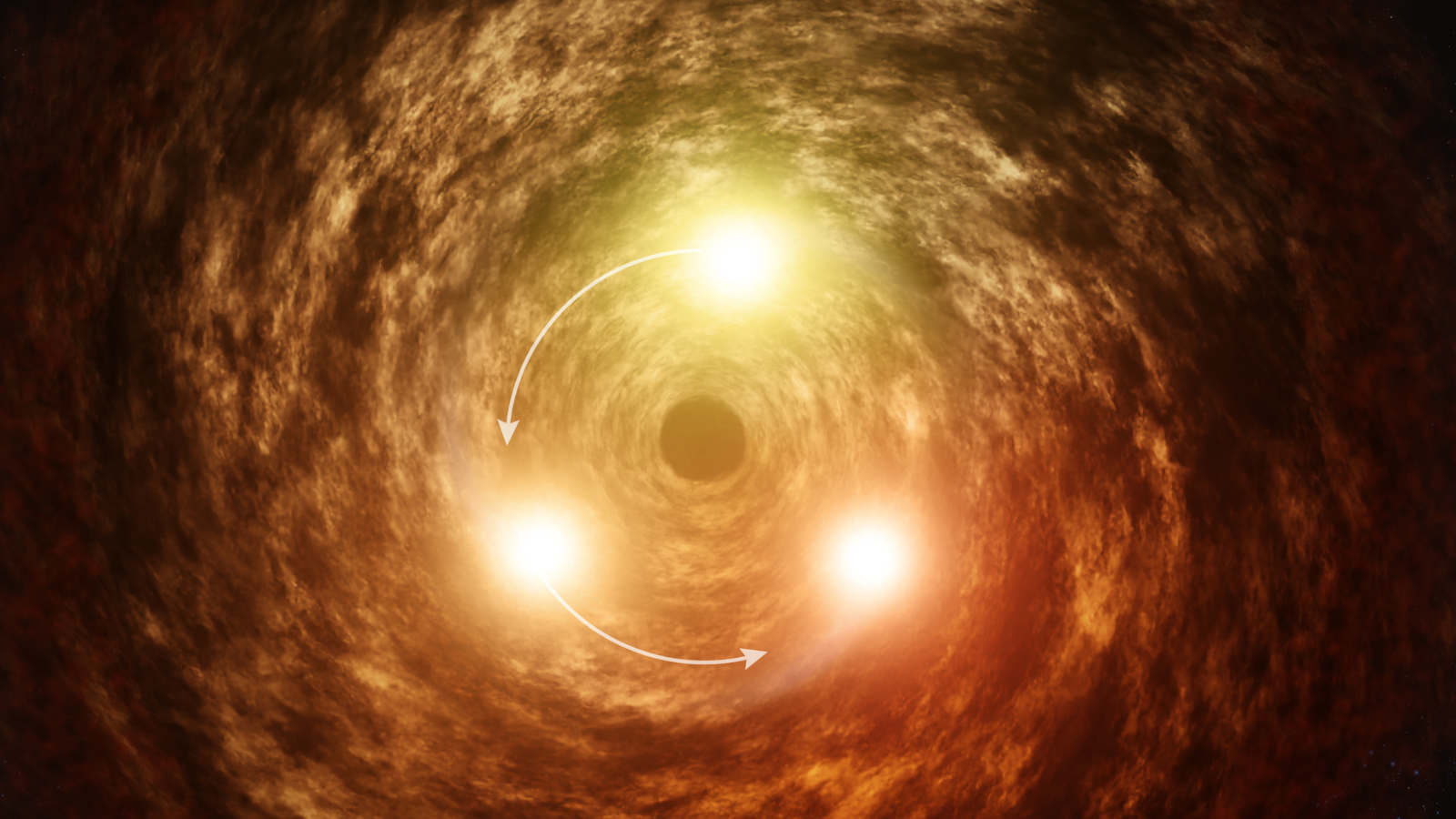
WASHINGTON - New observations from the James Webb Space Telescope (JWST) have confirmed “synchrotron cooling” occurring around Sagittarius A* (Sgr A), the supermassive black hole at the center of our Milky Way galaxy, following a recent flare. This confirmation allows scientists, for the first time, to independently measure the magnetic field strength in the region surrounding the black hole.The findings, published on the preprint server arXiv, offer a crucial step forward in understanding the powerful phenomena driven by Sgr A.
The flare, a burst of energy from the black hole, is believed to originate from interactions between surrounding magnetic fields.When these magnetic field lines connect, they release energy in the form of “synchrotron radiation.” The JWST data revealed that the mid-infrared spectral index of the flare changed over time, indicating that high-speed electrons were losing energy by emitting this synchrotron radiation – a process known as synchrotron cooling. This energy loss is what powers the observed mid-infrared emissions.
“In the absence of high-sensitivity multi-frequency observations, the presence of this expected behavior hadn’t been confirmed before,” said Dr. Florian von Fellenberg, a researcher involved in the study. “What is cool about this is that since the speed of this cooling, the cooling time scale, depends on the magnetic field strength, we can now measure it for the given flare.”
Previously, magnetic field strength around Sgr A* could be estimated from near-infrared flares, but those measurements were intertwined with other factors, like the number of electrons present. This new method provides a more “clean” measurement, requiring fewer assumptions.
“This new way of determining the magnetic field strength is especially useful as it’s quite ‘clean’ in that not a lot of assumptions have to go into the measurement,” von Fellenberg explained. “This is very useful for theoretical models, which are poorly constrained in that regard for Sgr A, because magnetic field strengths are quite important.”
the observations were made possible by JWST’s unique capabilities, specifically the Medium-Resolution Spectrometer (MRS) operating mode of its Mid-Infrared Instrument (MIRI).
“In order to get such high sensitivity in the mid-infrared, one needs to go to space, as the atmosphere severely messes up ground-based observations at this wavelength,” von Fellenberg stated. “In addition, the MIRI/MRS instrument is the first instrument to give you such broad wavelength coverage for Sgr A, a prerequisite to measure the spectral index, so it’s really a double whammy!”
The team’s research is available on arXiv, alongside two companion papers: https://arxiv.org/abs/2511.14836 and https://arxiv.org/abs/2511.14850.
