
Evidence of a “Proto-Earth” Reservoir Deep Within Our Planet Revealed by Potassium Isotopes
New research suggests a distinct, ancient component of Earth’s building blocks persists deep within the mantle, offering a glimpse into the planet’s earliest history.
Scientists have uncovered compelling evidence for a “proto-Earth” reservoir hidden beneath our feet, a region with a unique chemical signature that predates the Moon-forming impact. The findings, published in Nature Geoscience, stem from meticulous analysis of potassium-40 isotopes in ancient rocks and modern volcanic lavas.
Isotopes, variations of an element with differing numbers of neutrons, can separate in subtle, mass-dependent ways. Researchers noticed a specific potassium-40 deficit in certain samples,prompting them to investigate how common magmatic processes – like partial melting and crystallization – might create this pattern. Their calculations demonstrated that standard geological activity within Earth could not readily explain the observed signal.
This led the team to explore models of Earth’s early evolution. They simulated a young planet initially possessing a potassium-40-poor composition, then factored in the effects of a giant impact (believed to have formed the Moon), subsequent smaller impacts, and billions of years of mantle convection and mixing.
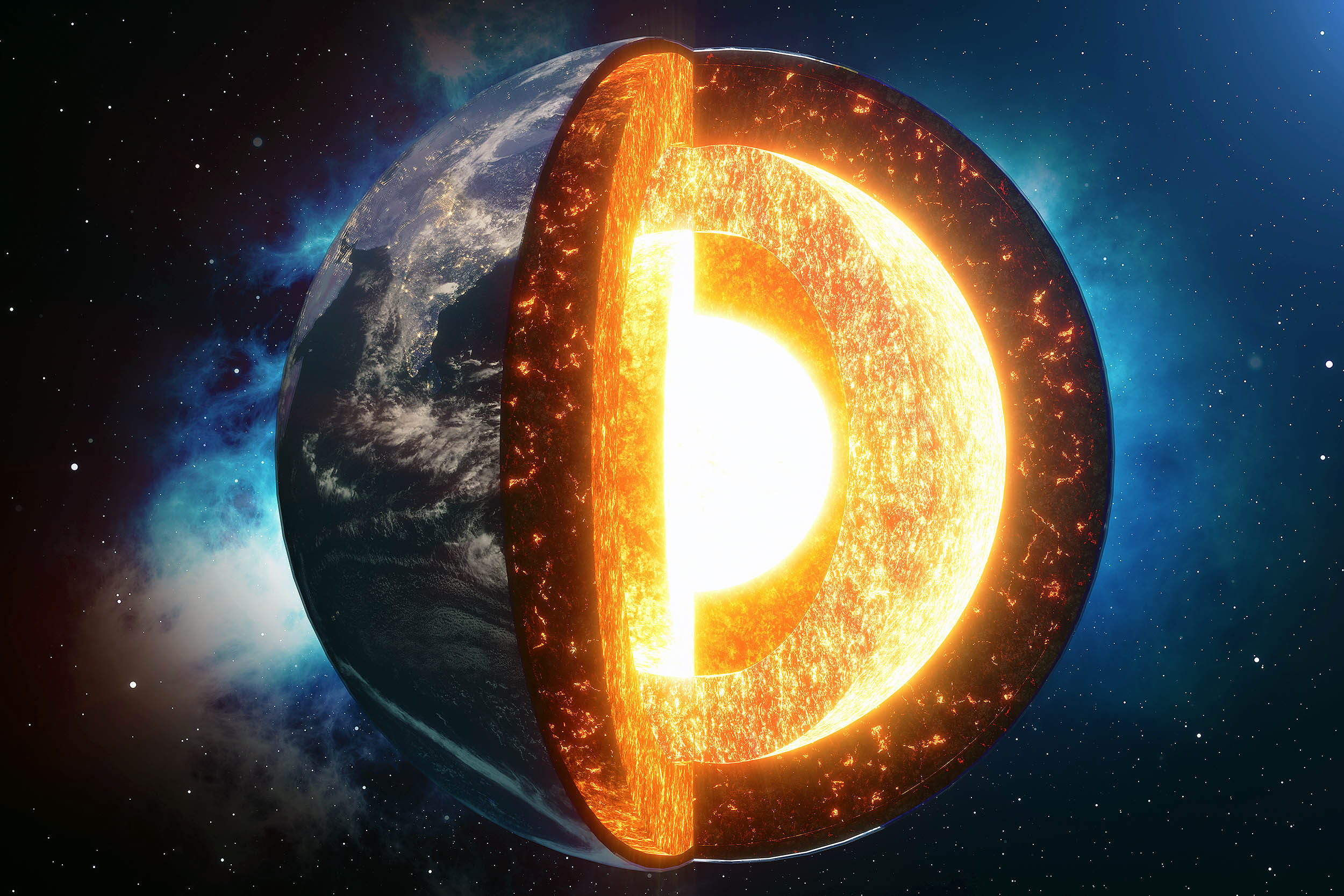
The simulations revealed that while most of the mantle homogenized over time, deep regions shielded from intense mixing retained the older, potassium-40-poor isotopic signature.These long-lived mantle domains, formed early in Earth’s history, appear to have remained relatively isolated despite the planet’s tumultuous evolution.
The researchers propose that rocks exhibiting the potassium-40 deficit originate from these ancient domains, which existed before the Moon-forming impact and somehow survived it. These reservoirs likely reside deep within the mantle and periodically contribute to mantle plumes that rise to the surface, manifesting as hotspot volcanism. the consistency of the potassium isotope pattern in both extremely old crustal rocks and modern hotspot lavas supports the idea that they tap into the same hidden reservoir.
Intriguingly, the potassium isotope pattern found in these suspected “proto-Earth” rocks doesn’t align with any known meteorite group. This suggests that the meteorites currently available for study may not represent the full spectrum of materials that originally accreted to form Earth. Some of these original building blocks may be lost to space, or remain undiscovered.
“By carefully measuring tiny differences in potassium isotopes, scientists can test ideas about events that happened more than 4.5 billion years ago inside Earth,” the study highlights. This research exemplifies the power of combining chemistry, physics, and geology to connect laboratory measurements with the planet’s deep history.
