
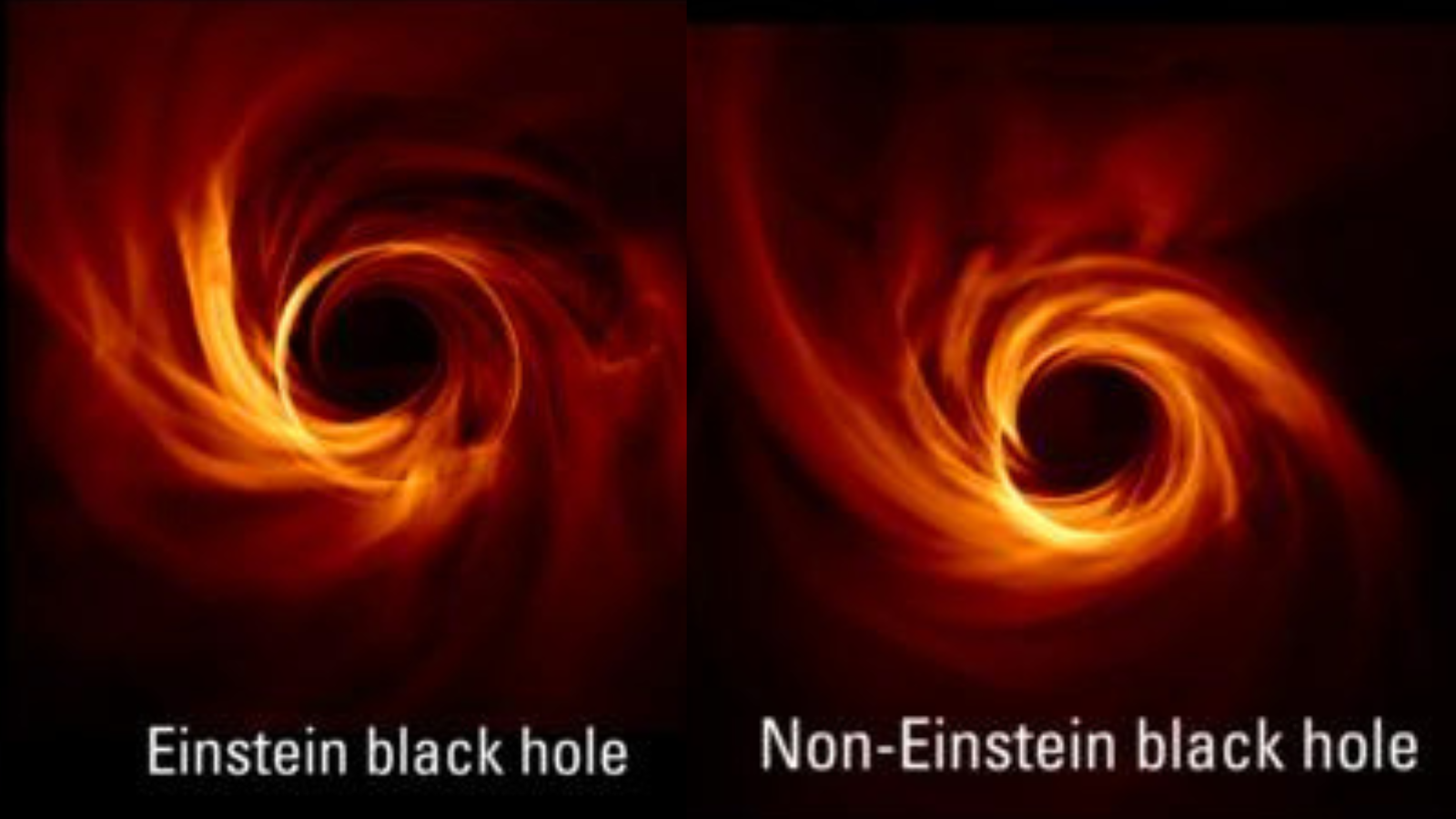
Sharper Black Hole Images Could reveal flaws in einstein’s Theory of Relativity
Recent research suggests that increasingly detailed images of black holes may hold the key to testing-and possibly refining-Albert Einstein’s theory of general relativity. Scientists are meticulously analyzing the “shadows” of black holes, the dark silhouettes formed by gravity’s intense pull on light, to search for deviations from Einstein’s predictions.
The black hole shadow, as explained by researcher Priyamvada Uniyal, “encodes the spacetime geometry very close to the compact object.” Even slight differences in the fabric of spacetime, known as “metric deviations,” would manifest as subtle changes in the shadow’s size and shape, as well as in the formation of light rings surrounding it. “Measuring the shadow precisely provides a direct diagnostic of whether the underlying gravity matches Einstein’s predictions,” Uniyal stated.
These subtle changes aren’t limited to the shadow itself. The spacetime around a black hole influences the orbits of particles and the paths of light, meaning alterations to the spacetime geometry would also affect how gas orbits the black hole, how it radiates energy, and even the brightness and polarization of light observed from Earth. in extreme scenarios, a black hole lacking a true event horizon would produce distinctly different observational signatures.
The research team aims to determine if future observations are more consistent with a black hole described by general relativity (“black hole ‘a'”) or one described by an alternative theory (“black hole ‘b'”). Their findings indicate that any differences between these models will be small, necessitating highly accurate measurements.
“What our results show is that whatever ‘a’ or ‘b’ black holes one considers, the differences will be small and hence very accurate measurements are needed,” Uniyal said.”Fortunately, these observations will be possible in the not-too-distant future.” Importantly, the study revealed that improvements in imaging resolution will predictably increase the ability to detect these differences, and provided concrete, percent-level estimates for image mismatches that would indicate a divergence from Einstein’s theory.
To achieve the necessary precision, scientists are working to enhance black hole imaging through two primary avenues: expanding the network of telescopes currently used – the Event Horizon Telescope (EHT), which currently comprises 11 instruments – and exploring the potential of space-based Very-long-baseline interferometry.
Uniyal concluded, “Pursuing different astrophysical scenarios could place quantitative constraints on deviations from Kerr black holes or, if present, detect signatures of alternative theories with the help of future observations.”
The team’s research was published on Thursday, October 30, in the journal Nature Astronomy.
