
Chameleon Eyes: The secret Behind Their Independent Gaze Finally Revealed
By Rachel Kim, World-Today-News.com – November 21, 2023
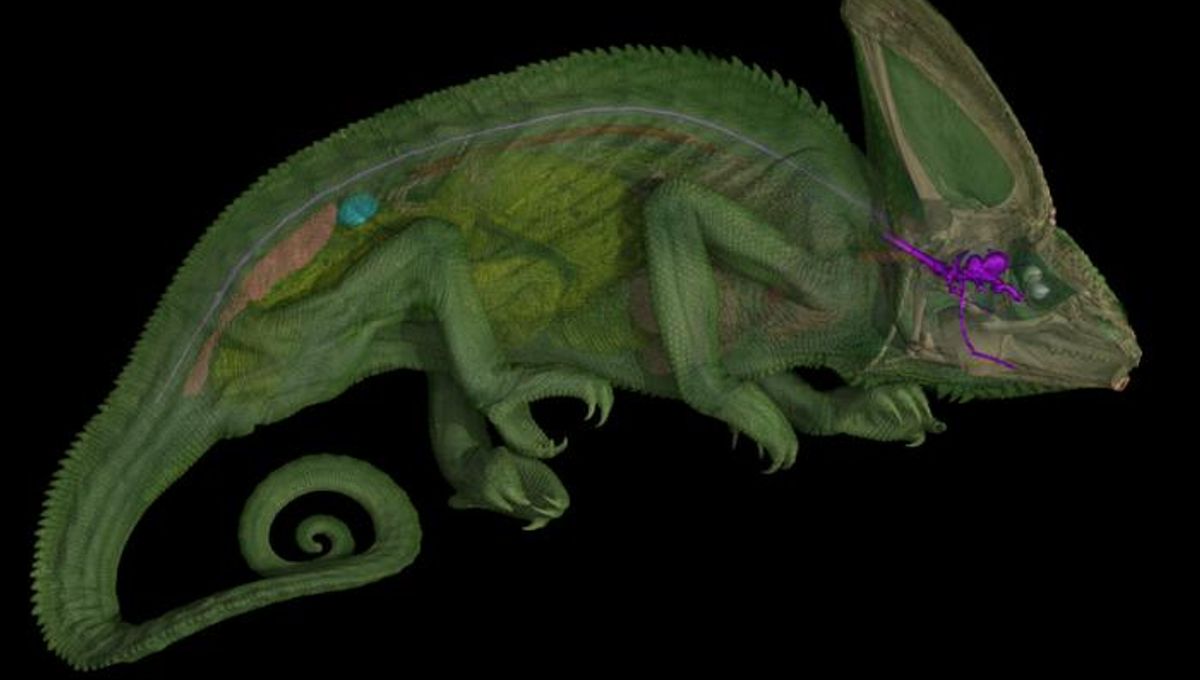
For millennia, humans have been captivated by the chameleon’s remarkable ability to move its eyes independently, seemingly with a mind of their own. From ancient Greek philosophers to modern scientists, the mechanism behind this unique vision has remained a mystery – until now. Cutting-edge CT scans and 3D modeling have revealed that chameleons possess a uniquely coiled, “spiral” optic nerve, a discovery that finally explains how these lizards can scan their surroundings with unparalleled precision.
“Chameleon eyes are like security cameras,moving in all directions,” explains Dr. Juan Daza of Sam Houston State University, led author of the groundbreaking study. “They move their eyes independently while scanning their surroundings to find prey. And the moment they find their prey, their eyes coordinate and go in one direction so they can calculate where to shoot their tongues.”
The research, focused on the incredibly tiny Brookesia minima chameleon species, uncovered a looping optic nerve structure unlike anything seen in other reptiles. Dr. Daza and Dr. Edward Stanley of the florida Museum of Natural History were initially surprised by the finding, and even more astonished that it had gone unnoticed for so long.
“I was surprised by the structure itself, but I was more surprised that nobody else had noticed it,” Dr. Daza stated. “Chameleons are well studied, and people have been doing anatomical studies of them for a long time.”
A History of Misconceptions
The quest to understand chameleon vision is a surprisingly long one, riddled with incorrect assumptions. Ancient thinkers like Aristotle famously – and incorrectly - believed chameleons didn’t have optic nerves at all, claiming their eyeballs were directly connected to the brain. Later, 17th-century scientists debated whether the nerves crossed, with Isaac Newton even championing a flawed theory based on the work of Roman doctor Domenico Panaroli.
While some past anatomical drawings hinted at the coiled structure, they were incomplete or misinterpreted.Even a 2015 master’s thesis described the nerve as merely “C-shaped,” falling far short of capturing its true complexity.
the Power of Modern Technology
The breakthrough came thanks to modern imaging technology. Previous anatomical studies relied on dissecting deceased chameleons, which distorted the delicate nerve structure. By utilizing CT scans of a living specimen, Daza and Stanley were able to visualize the spiral shape in its natural state.
This discovery not only solves a long-standing biological puzzle but also highlights the importance of revisiting established knowledge with new tools and perspectives. The chameleon’s unique optic nerve is a testament to the amazing diversity of the natural world and a reminder that even well-studied creatures can still hold secrets waiting to be uncovered.
Keywords: Chameleon, vision, optic nerve, reptile, anatomy, biology, CT scan, 3D modeling, animal behavior, Brookesia minima, independent eye movement, Aristotle, Isaac Newton.
