
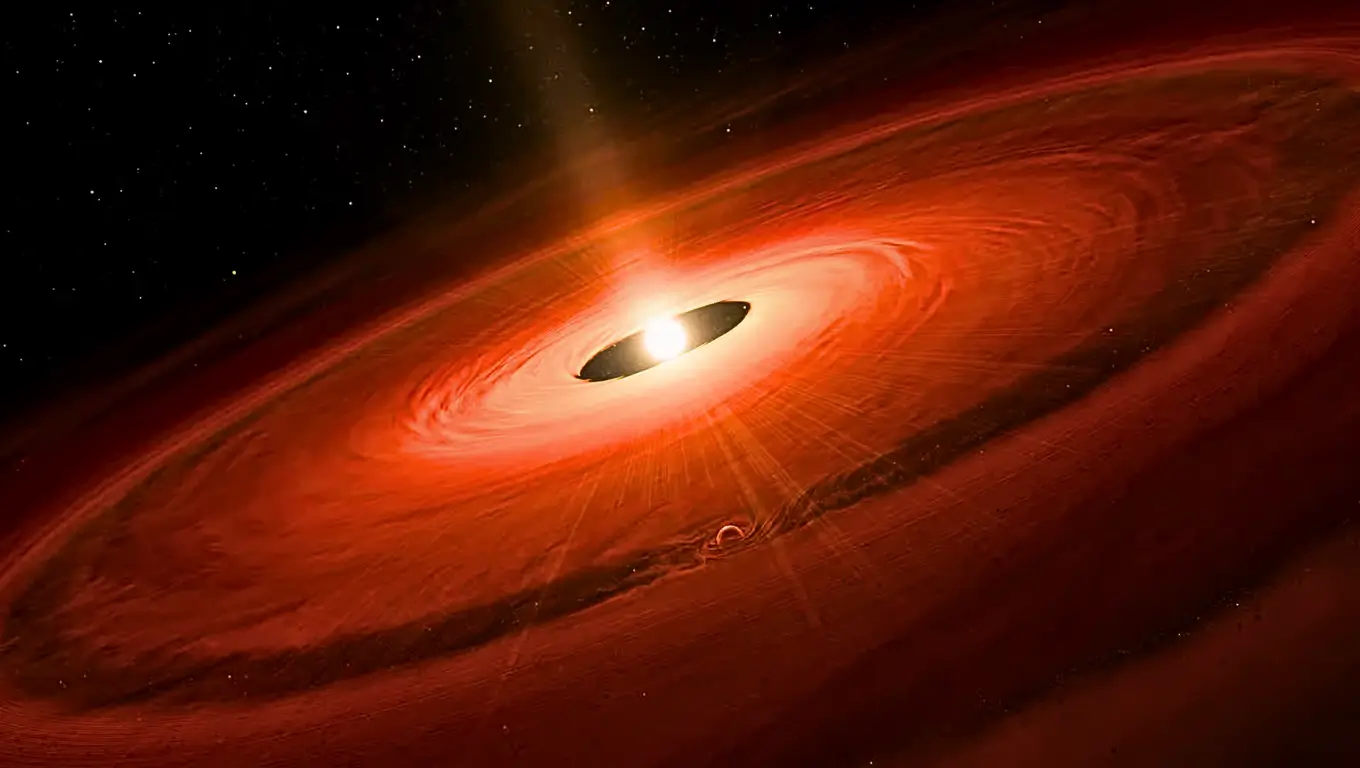
James Webb Telescope Witnesses Potential Moon Birth Around Distant Gas Giant
New observations from the James Webb Space Telescope suggest the possible formation of moons around the exoplanet CT Cha b, offering a unique opportunity to study the process and refine theories about moon formation in both our solar system and beyond.
Until recently, models explaining how moons form relied heavily on simulations and analysis of our own Solar System. Now, researchers have a direct observational window into this phenomenon occurring within a protoplanetary disk around CT Cha b, a young gas giant. Astrophysicists describe the situation as akin to observing a Jupiter in its early stages of growth within a stellar nursery. This empirical data allows for a crucial comparison between theoretical predictions and real-world observations.
The revelation positions CT Cha b as a “natural laboratory” for understanding the formation of exomoons - moons orbiting exoplanets, which have never been directly observed. By studying the organization, cooling, and change of matter around CT Cha b, scientists hope to unlock the secrets of these elusive satellites.
“The Webb telescope allows us to observe the process of moon formation for the first time. We can finally study these phenomena empirically,” explained Gabriele Cugno, an astrophysicist at the university of Zurich.
This finding also provides insight into the origins of our own Solar System. The Galilean moons of Jupiter – Io, Ganymede, and Callisto - share a common orbital plane, indicating a similar birth within a circumplanetary disk. Notably, Ganymede and Callisto contain up to 50% water ice, while Io is volcanically active.These parallels strengthen the idea that the processes observed by James Webb are global.
Understanding moon formation is also crucial in the search for habitable worlds. If Webb confirms the birth of moons around CT Cha b, it would represent a world premiere and contribute significantly to the field of comparative planetology, offering clues about the potential for life to emerge on distant moons.
Each observation, researchers emphasize, serves as a reminder of the vastness of the cosmos and the potential for future discoveries.
