
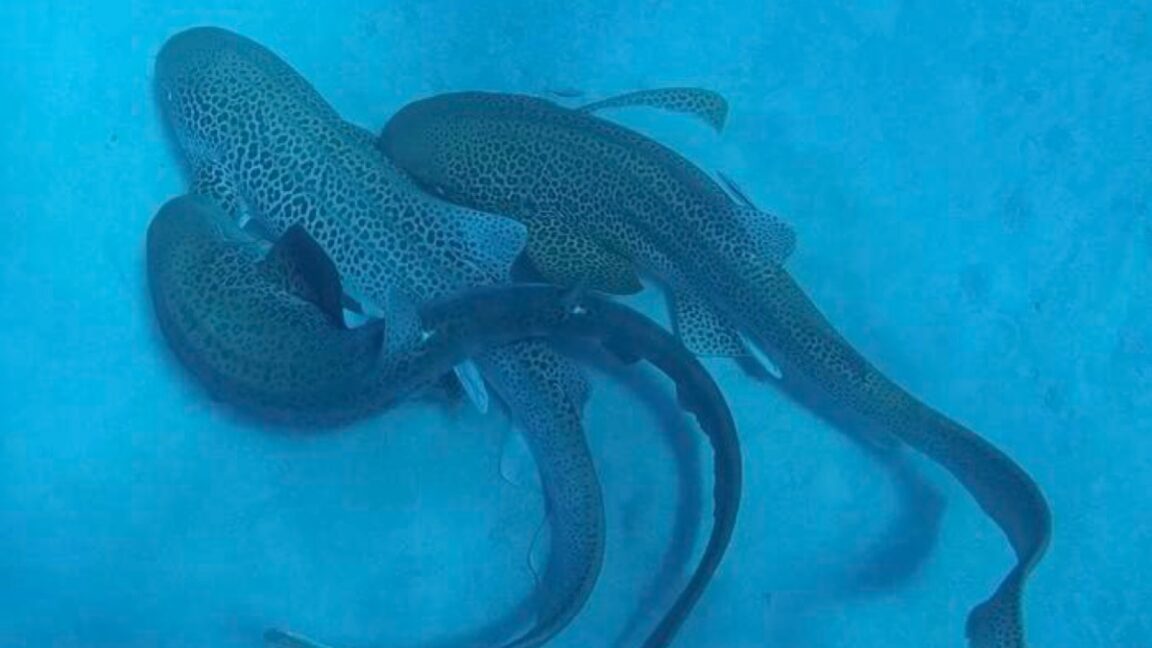
Rare Shark Mating Ritual captured on Camera in New Caledonia
Nouméa, New Caledonia – In a groundbreaking first, scientists have documented the complete mating sequence of leopard sharks, including the participation of two male sharks, off the coast of New Caledonia. The remarkable footage, captured by marine biologist Hugo Lassauce using two GoPro Hero 5 cameras, provides unprecedented insight into the reproductive behavior of this vulnerable species.
The observation, detailed in a forthcoming paper in the Journal of Ethology, is significant because it confirms a previously suspected, but never visually recorded, mating behavior and highlights the importance of the New Caledonia region as a critical leopard shark habitat. This discovery could inform conservation efforts and potentially aid in artificial insemination programs aimed at bolstering leopard shark populations in Australia and othre countries.
Lassauce’s recording faced technical challenges, including limited battery life on the GoPros, requiring him to pause and switch cameras during the nearly hour-long pre-copulation period. Despite the interruptions, he successfully captured the entire sequence: the female shark remaining motionless on the seafloor with one male shark biting onto each of her pectoral fins, followed by sequential mating from both males. The first male “penetrated the female’s cloaca with his left clasper,” – modified pelvic fins used for sperm transfer – before becoming motionless, allowing the second male to repeat the process. The female then swam away, followed shortly by the males.
“it’s surprising and interesting that two males were involved sequentially on this occasion,” said co-author Christine Dudgeon of the University of the Sunshine Coast (UniSC). “From a genetic diversity viewpoint, we want to find out how many fathers contribute to the batches of eggs laid each year by females.”
The research team believes this observation underscores the need for increased conservation measures in the area. The study’s DOI is 10.1007/S10164-025-00866-4.
