
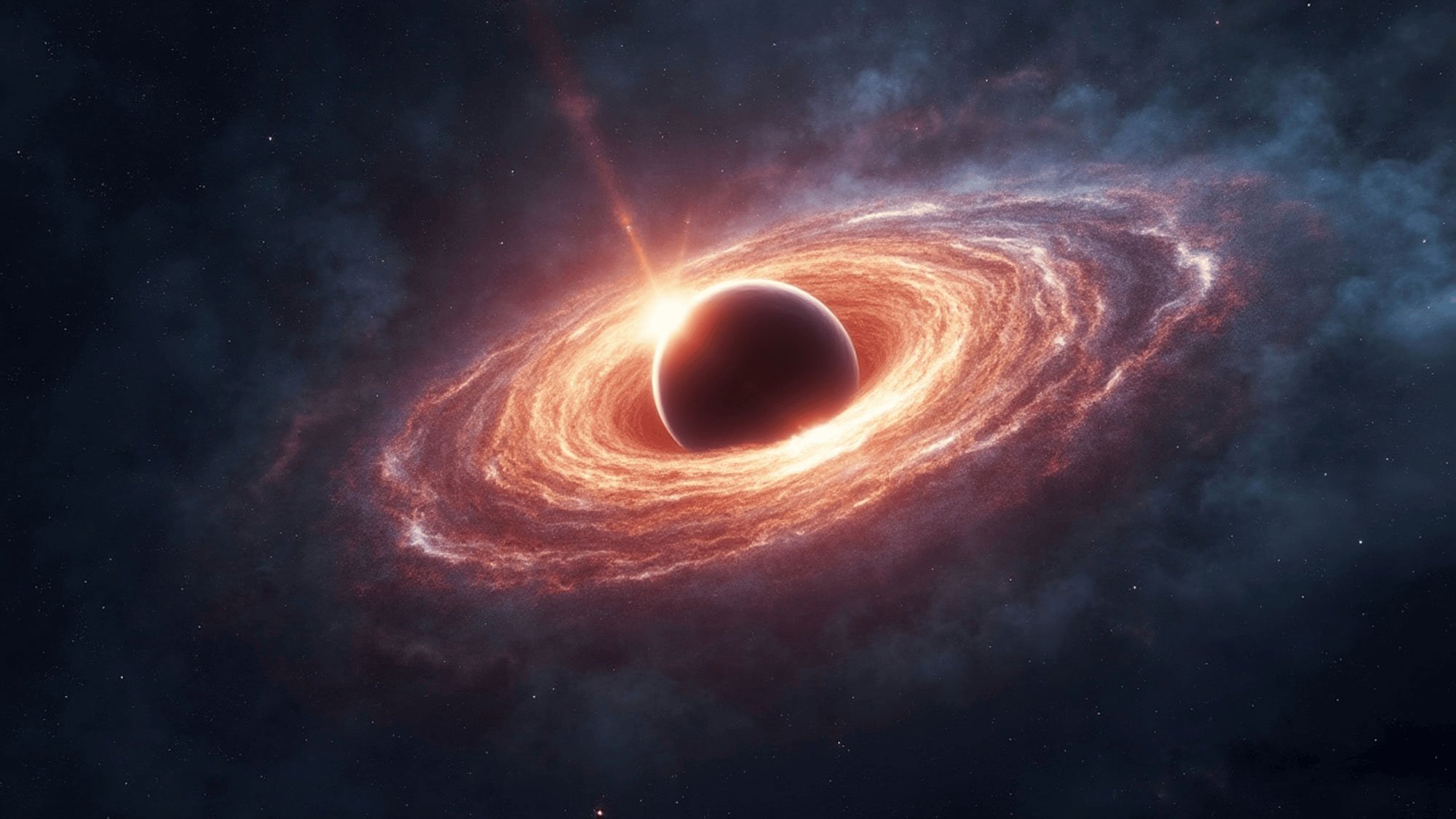
Rogue Black Hole Discovered Wandering a Dwarf Galaxy
Astronomers have confirmed the existence of a wandering, actively accreting intermediate-mass black hole (IMBH) located outside the center of a dwarf galaxy, a rare find offering new insights into black hole growth and galactic evolution. The black hole, residing in the galaxy MaNGA 12772-12704, is approximately 300,000 times the mass of our Sun and lies 230 million light-years away.The discovery, published September 4, 2025, in Science Bulletin, represents the nearest and most robustly confirmed case of an off-nuclear black hole with jets.
The research team, led by Yuanqi Liu, identified the black hole through observations from the Mapping Nearby Galaxies at Apache Point Observatory (MaNGA) survey.The confirmation relied on what the researchers termed “triple solid evidence”: a compact, high-brightness core, the detection of parsec-scale jets, and decades-long variability in its emissions. This combination distinguishes it from other potential candidates and solidifies its identification as an actively feeding black hole.
The discovery is meaningful due to the rarity of confirmed off-nuclear active galactic nuclei (AGN). Of the 628 galaxies within the MaNGA survey exhibiting possible AGN activity, only 62% showed offsets from their optical centers. However,MaNGA 12772-12704 was the sole galaxy to meet all three criteria for confirmation. As Dr. Mar Mezcua of the Institute of Space Sciences of Spain noted,obtaining clear observational evidence for wandering AGN is “extremely difficult,” notably in dwarf galaxies.
Traditionally, black hole growth has been understood as a central process, with supermassive black holes rapidly consuming gas at the cores of galaxies. This finding challenges that model, demonstrating that an IMBH can sustain accretion and generate jets even when displaced from the galactic nucleus. This supports the theory of “distributed feeding” and “multi-site growth” as a viable pathway for the rapid formation of supermassive black holes in the early universe.
“This discovery prompts us to rethink black hole-galaxy co-evolution,” explained Dr. An, a co-author of the study. “Black holes are not only central ‘engines’, thay may also quietly reshape their host galaxies from the outskirts.” The energy injected into the surrounding environment through powerful outflows from the wandering black hole can influence galactic dynamics and star formation.
Looking ahead, advancements in telescope technology promise to reveal a larger population of thes “lost black holes.” Extremely large optical telescopes will provide higher-precision measurements of galactic structures,while deep radio surveys utilizing facilities like the Five-hundred-meter Aperture Spherical Telescope (FAST) core array and the Square Kilometre array will detect fainter radio signals,perhaps resolving even smaller jets. These future observations could demonstrate that wandering black holes are not uncommon, but rather play a significant, yet frequently enough unseen, role in cosmic evolution.
The study’s authors are Yuanqi Liu, Tao An, Mar Mezcua, Yingkang Zhang, Ailing Wang, Jun Yang, and Xiaopeng Cheng. The research is detailed in the paper “A jetted wandering massive black hole candidate in a dwarf galaxy” (DOI: 10.1016/j.scib.2025.09.001).
