
Scientists Track First-Ever ’Natal Kick’ as Newborn Black Hole Rockets Across Space
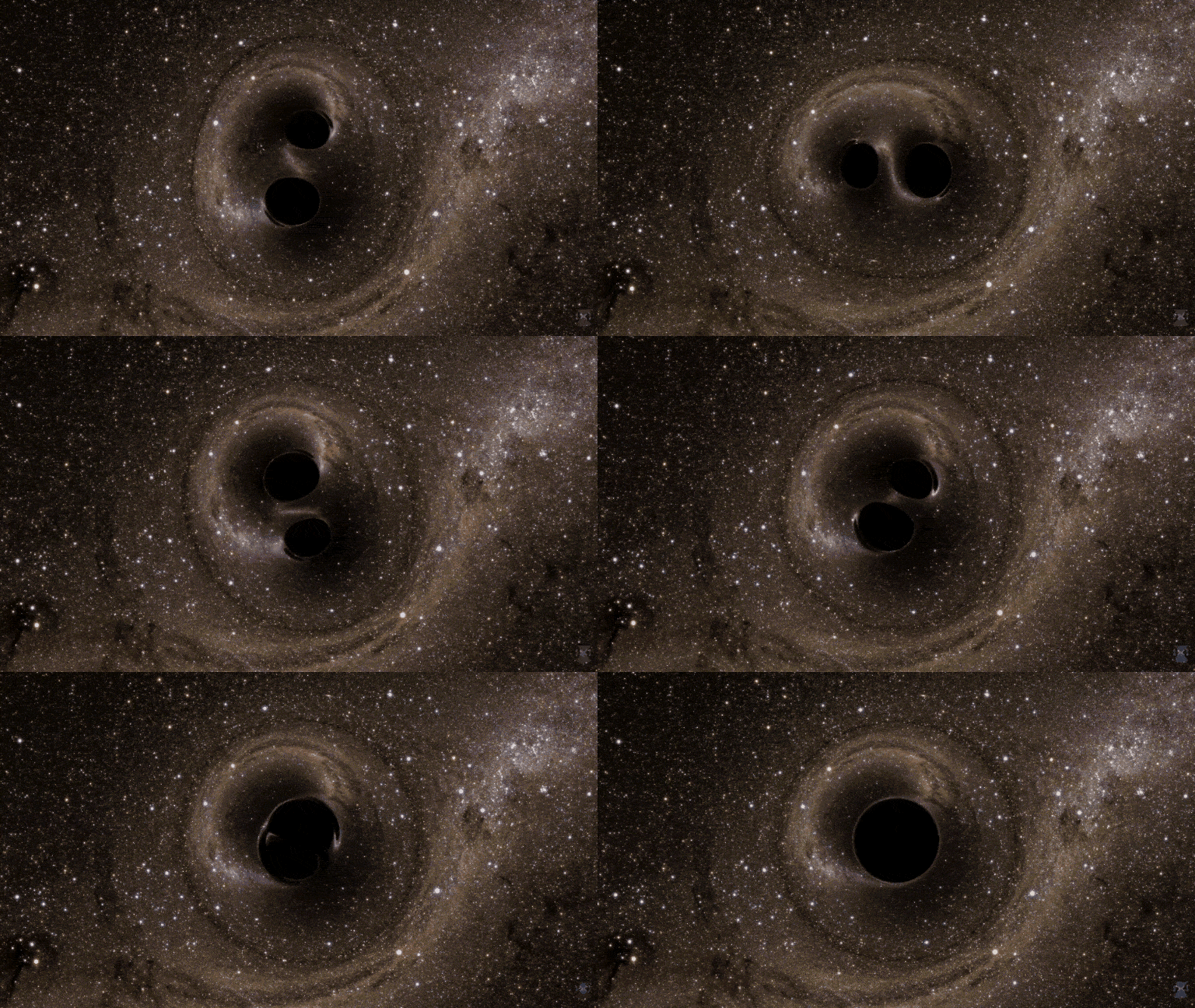
For the first time, scientists have directly measured the powerful “natal kick” that propels a newly formed black hole through space, confirming decades-old predictions about these energetic events. The groundbreaking observation, detailed in research published in The astrophysical Journal Letters, tracked a black hole birthed from the merger of two smaller black holes, sending the resulting object hurtling away at an astonishing 111,600 miles per hour (179,600 kilometers per hour).
The merger, designated GW190412, was detected on April 12, 2019, by the Advanced LIGO detectors in Louisiana and Washington State, and the virgo detector in Italy. The event involved the collision of black holes 29.7 and 8.4 times the mass of our sun, located more than 2.4 billion light-years away. Researchers then used two angles relative to Earth to pinpoint the direction and speed of the resulting black hole’s recoil.
“This is one of the few phenomena in astrophysics were we’re not just detecting something,” said researcher Chandra. “We’re reconstructing the full 3D motion of an object that’s billions of light-years away, using only ripples in spacetime.”
the concept of a “natal kick” – a significant velocity imparted to a newly merged black hole – has been theorized since the 1970s. These kicks are thought to arise from the uneven emission of gravitational waves during the merger process. Understanding these kicks is crucial for modeling the evolution of supermassive black holes,wich can range from 100,000 to 50 billion times the mass of the sun.
In 2018, Juan Calderón Bustillo and colleagues developed a method to measure natal kicks using gravitational wave signals, but it relied on simulations until a real-world event could be observed. The speed measured in GW190412 is sufficient to allow the newborn black hole to escape its birthplace, likely a globular cluster, becoming a “runaway black hole.”
the research team plans to continue searching for more black hole mergers detectable through both gravitational waves and visible light, hoping to further refine our understanding of how these cosmic giants grow and evolve.
