
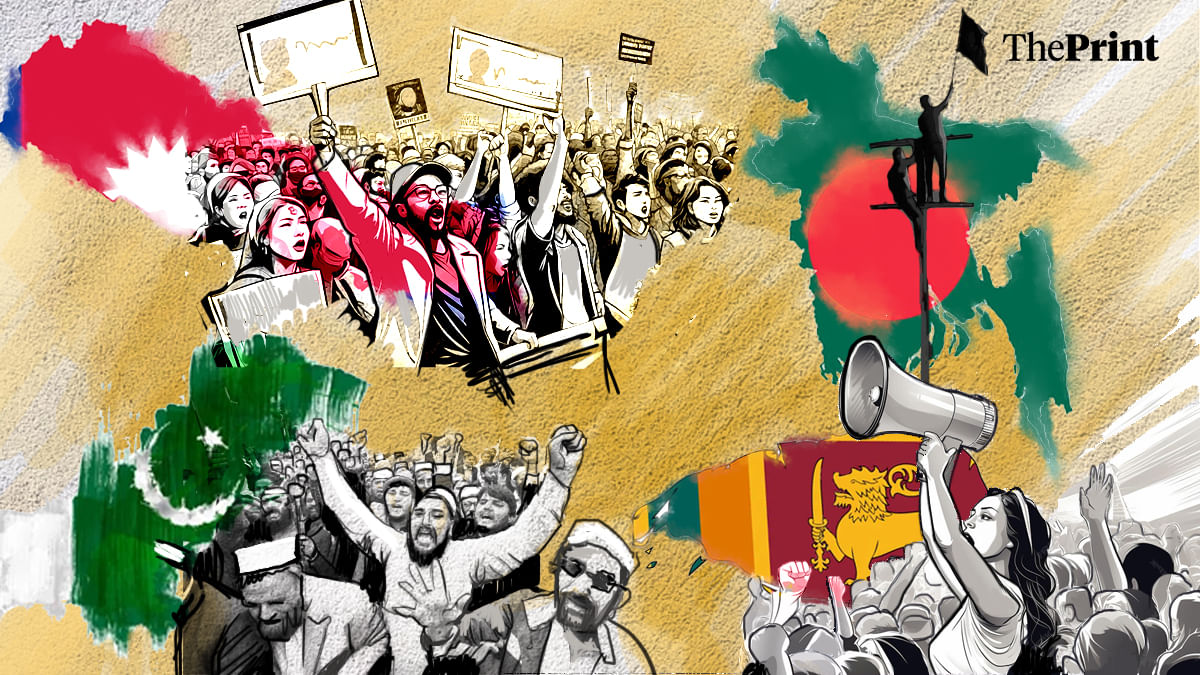
Nepal‘s Regime Shift & Why India Remains Secure: A Look at State Strength and Social Valves
Kathmandu/New Delhi – Recent political upheaval in Nepal, culminating in a change in government, has sparked debate about the potential for similar “street-level” regime changes elsewhere in South Asia. However,experts argue that the conditions allowing for this shift in Nepal are fundamentally different from those in India,where a robust constitutional framework and established mechanisms for dissent significantly mitigate the risk of similar outcomes.
The discussion stems from observations that a nation’s true power resides not solely within its formal institutions – the “Deep State” – but within the “shallow State,” encompassing the practical ability to maintain order and manage dissent.This concept was highlighted in a recent conversation recalling a dinner hosted by India Today editor Aroon Purie, where former Home Minister Buta Singh recounted a discussion wiht Soviet Foreign Minister Eduard Shevardnadze.Shevardnadze reportedly inquired about India’s handling of large protests, contrasting it with the Soviet army’s use of poison gas against a smaller crowd in Tbilisi. Singh’s response – offering CRPF companies - underscored the importance of a state’s capacity to maintain law and order through trained forces,negotiation,and democratic patience.
Crucially, the absence of a strong opposition is not indicative of a “hard state,” but rather the opposite. A functioning opposition acts as a vital “pressure-release valve,” allowing citizens to vent grievances through established channels rather than resorting to disruptive or destabilizing actions. Several of India’s neighbors have experienced instability after suppressing their opposition, in varying degrees.
While India experiences localized unrest – with “a couple of dozen mutinies” occurring at any given time – two important challenges to the state from public movements in the past 50 years failed to achieve regime change. The first, beginning in 1974, was Jayaprakash Narayan’s (JP) Navnirman Andolan, compounded by the George Fernandes-led railway strike. Despite widespread disruption, it did not dislodge Prime Minister Indira gandhi, ultimately requiring an election to resolve the political situation.
The second major challenge came with Anna Hazare’s anti-corruption protests, backed by new television media and elements within the opposition, including the RSS – mirroring support seen during JP’s movement. Even a comparatively weak UPA-2 government was able to withstand the pressure. A late-night debate on the Jan Lok Pal Bill proved pivotal,with Samajwadi party MP Sharad Yadav’s impassioned defense of the democratic system – pointing to a fellow MP,Pakauri Lal,as an example of how even humble citizens could participate in governance – effectively ending the momentum of the Anna movement. “in this system a man as humble as him can be here. And this is the system you’ve come to destroy?” Yadav reportedly asked, resonating with Parliament’s resolve to protect the state.
the article further highlights the importance of a state’s internal conviction in maintaining unity, recalling a 2010 conversation with then-National Security Advisor M.K. Narayanan during a period of intense unrest in Kashmir. When voices suggested allowing Kashmiris to secede if they were unhappy, Narayanan reportedly emphasized the need for the state to “have it in its gut to stay together.” Fifteen years later, the situation in Kashmir has demonstrably changed, suggesting the effectiveness of this approach.
These examples demonstrate that India, despite being labeled by some as a “soft state,” possesses the institutional strength and established mechanisms to navigate significant challenges to its authority without succumbing to “tool kit”-driven regime change.The essential difference lies in India’s commitment to constitutional democracy,where a “regime” does not exist in the same vulnerable sense as in nations with weaker institutions and suppressed dissent.
