
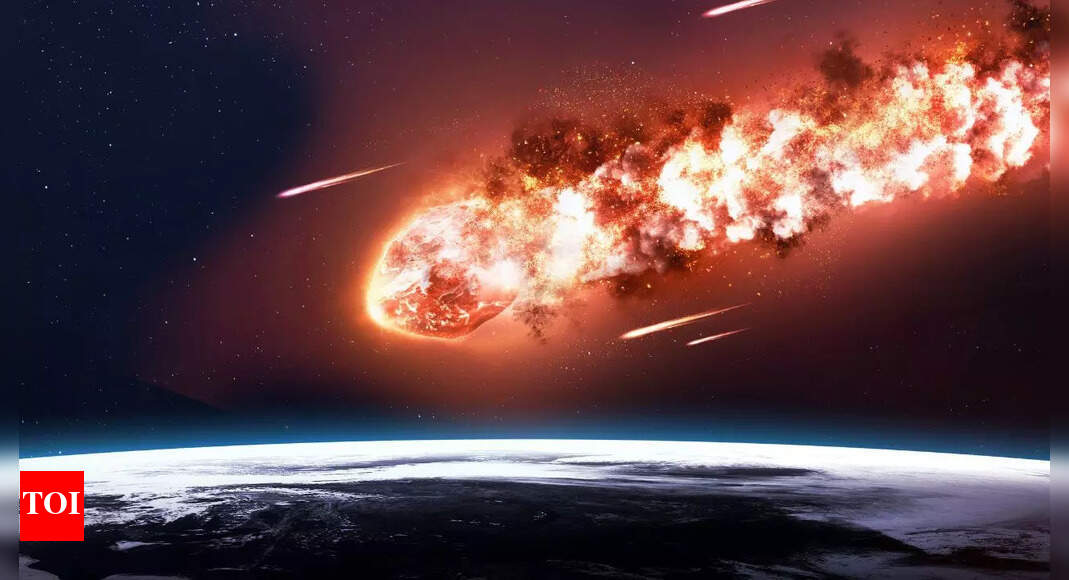
WASHINGTON – NASA has confirmed that asteroid 2025 QV9, measuring approximately 100 feet in diameter, is projected to pass extremely close to Earth on September 10, 2025, traveling at a velocity exceeding 10,000 miles per hour. The near-Earth object’s trajectory has prompted monitoring from space agencies,though current calculations indicate a very low probability of impact.
The close approach of 2025 QV9 underscores the ongoing need for planetary defense efforts. While the asteroid is not currently anticipated to strike Earth, its predicted path warrants continued observation to refine trajectory predictions and assess any potential risk. NASA’s Center for Near Earth Object Studies (CNEOS) is tracking the asteroid, and further analysis will be conducted as the date approaches.this event highlights the constant, though statistically infrequent, threat posed by near-Earth asteroids and the importance of early detection and mitigation strategies.
discovered in August 2025, 2025 QV9 is categorized as an Apollo asteroid, meaning its orbit crosses Earth’s orbit. Initial observations placed the asteroid on a path that raised concerns, leading to increased scrutiny from NASA and other astronomical organizations. Subsequent data analysis has substantially reduced the estimated impact probability, but the close flyby remains a noteworthy event.
The asteroid’s speed, exceeding 10,000 mph, is typical for near-Earth objects. An impact from an asteroid of this size could cause significant regional damage, though it is unlikely to pose a global threat. NASA continues to refine its asteroid tracking capabilities and is developing technologies for potential asteroid deflection missions, such as the Double Asteroid Redirection Test (DART) which successfully altered the orbit of asteroid Dimorphos in September 2022.
Detailed information regarding 2025 QV9, including its orbital parameters and risk assessment, is available on the CNEOS website: https://cneos.jpl.nasa.gov/. NASA will provide updates as new data becomes available.
