
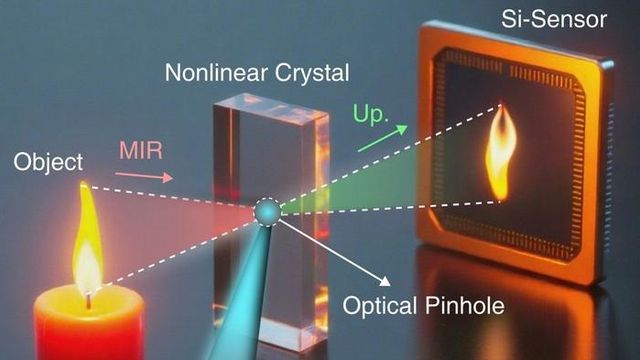
Researchers Revive the Pinhole Camera for Advanced Infrared Imaging
A team of researchers has successfully demonstrated a lensless infrared imaging system inspired by the principles of the pinhole camera, offering a pathway too distortion-free, wide-field-of-view imaging with high sensitivity. Published in Optica in September 2025, the work details a method for converting infrared light into visible light using a specially engineered nonlinear crystal, allowing for capture by standard silicon cameras.
The core of the innovation lies in creating an “optical hole,” or artificial aperture, within a nonlinear crystal. This crystal converts infrared images into visible light, enabling recording with conventional silicon cameras. Crucially, the researchers utilized a crystal with a “chirped-period structure” capable of accepting light from a broad range of angles, resulting in a substantially expanded field of view.
“Lensless nonlinear pinhole imaging is a practical way to achieve distortion-free, large-depth, wide-field-of-view mid-infrared imaging with high sensitivity,” explained researcher Kun Huang. He further noted the system’s inherent advantages, stating, “The ultrashort synchronized laser pulses also provide a built-in ultrafast optical time gate that can be used for sensitive, time-of-flight depth imaging, even with very few photons.”
The team determined an optimal optical pinhole radius of 0.20 mm for achieving sharp image detail. Using this aperture, they successfully imaged targets at distances of 11 cm, 15 cm, and 19 cm at a mid-infrared wavelength of 3.07 μm, demonstrating a substantial depth range. Images remained sharp for objects up to 35 cm away, confirming a large depth of field.
3D Imaging capabilities
The researchers explored two distinct 3D imaging techniques. In time-of-flight imaging, they reconstructed the 3D shape of a ceramic rabbit with micron-level axial precision using synchronized ultrafast laser pulses as an optical gate. Remarkably, the system produced 3D images even under extremely low-light conditions – simulating an input of approximately 1.5 photons per pulse – after employing correlation-based denoising.
They also demonstrated two-snapshot depth imaging by capturing images of a stacked ”ECNU” target at slightly varying distances. This allowed them to calculate object sizes and depths over a 6 cm range without relying on complex pulsed timing methods.
While currently a proof-of-concept requiring a complex laser setup, the researchers anticipate future advancements in nonlinear materials and integrated light sources will lead to more compact and easily deployable systems. Current efforts are focused on increasing conversion efficiency, dynamically controlling the optical pinhole shape for diverse scenes, and expanding the camera’s operational range within the mid-infrared spectrum.
The research was conducted by Li Y, Huang K, Fang J, Wei Z, and Zeng H, and detailed in their paper, “Mid-infrared nonlinear pinhole imaging,” published in Optica, 2025;12(9):1478.(doi: 10.1364/OPTICA.566042)
