
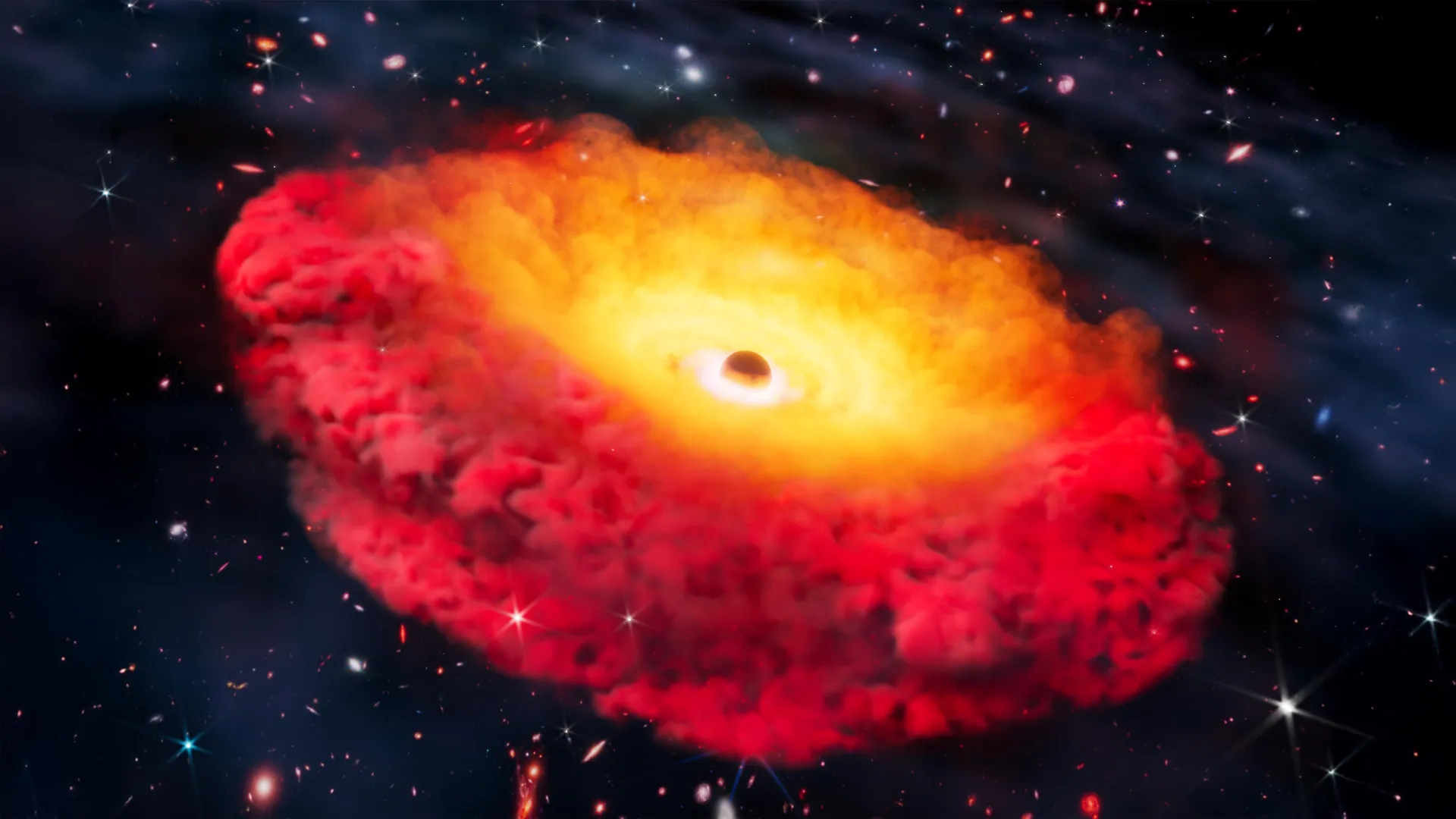
A Glimpse into the Early Universe: A Massive Black Hole adn the Mystery of ‘little Red Dots’
For years, a fundamental challenge in astronomy has been the elusive search for definitive proof of early black holes. Despite theoretical predictions,astronomers ”have yet to find the distinct spectroscopic signature associated with a black hole.” Now,a team of researchers utilizing the james Webb space Telescope (JWST) believes they’ve made a critically important breakthrough,identifying strong evidence of a supermassive black hole within a distant galaxy dubbed CAPERS-LRD-z9.
The key to this finding lies in spectroscopy – the process of splitting light into its component wavelengths to analyze an object’s characteristics. Astronomers specifically look for the telltale signs of gas swirling into a black hole: light stretched to redder wavelengths as gas moves away, and compressed to bluer wavelengths as it approaches. As explained by researcher taylor, “There aren’t many other things that create this signature,” and CAPERS-LRD-z9 exhibits precisely that.
The search was conducted using data from JWST’s CAPERS (CANDELS-Area prism Epoch of Reionization Survey) program, launched in 2021. CAPERS focuses on observing the most distant reaches of space, leveraging JWST’s unparalleled capabilities. Initially appearing as a mere speck in the program’s imagery, CAPERS-LRD-z9 turned out to be a member of a newly identified class of galaxies called “Little Red Dots.” These galaxies, appearing only in the universe’s frist 1.5 billion years, are remarkably compact, red, and unexpectedly luminous.
The emergence of Little Red Dots was a surprise, as they bear little resemblance to galaxies observed by the Hubble Space Telescope. “Now, we’re in the process of figuring out what they’re like and how they came to be,” noted Finkelstein. CAPERS-LRD-z9 may hold crucial clues.The galaxy’s brightness, initially puzzling, now appears to support the theory that supermassive black holes are the driving force behind the luminosity of Little Red Dots. While high brightness typically indicates a large number of stars, such a stellar population is unlikely to have formed so early in the universe. Black holes, however, shine intensely as they consume matter, heating it to extreme temperatures and releasing tremendous energy. Confirming a black hole’s presence in CAPERS-LRD-z9 provides a compelling example of this phenomenon.
moreover, the galaxy may explain the distinctive red hue of Little Red Dots. Researchers hypothesize that a dense cloud of gas surrounding the black hole could be scattering light, shifting it towards redder wavelengths – a phenomenon observed in other galaxies. Taylor confirmed the similarity, stating the object was “a dead ringer” when compared to known sources.
The black hole itself is exceptionally massive,estimated to be up to 300 million times the mass of our sun. Remarkably, this represents half the mass of all the stars within the galaxy. Even within the realm of supermassive black holes, this is a particularly considerable size.
This discovery offers a unique prospect to study the early evolution of black holes. Black holes that formed later in the universe had ample time to grow through accretion and mergers. Though, a black hole existing in the first few hundred million years would have had limited opportunities for growth. Finkelstein explained, “This adds to growing evidence that early black holes grew much faster than we thought possible, or they started out far more massive than our models predict.”
The team plans to continue their investigation with further, higher-resolution observations from JWST, hoping to unlock more secrets about CAPERS-LRD-z9 and the role of black holes in the formation of Little Red Dots. “This is a good test object for us,” Taylor concluded. ”We haven’t been able to study early black hole evolution until recently, and we are excited to see what we can learn from this unique object.” Data from the Dark energy Spectroscopic Instrument (DESI) at Kitt Peak National Observatory also contributed to this research.
