
telescope-breaks-the-record-for-detecting-the-most-distant-galaxies/” title=”The James Webb … breaks the record for detecting the most distant …”>Webb telescope Detects Hundreds of Surprisingly Bright Objects in Early Universe, Challenging Galaxy Formation Theories
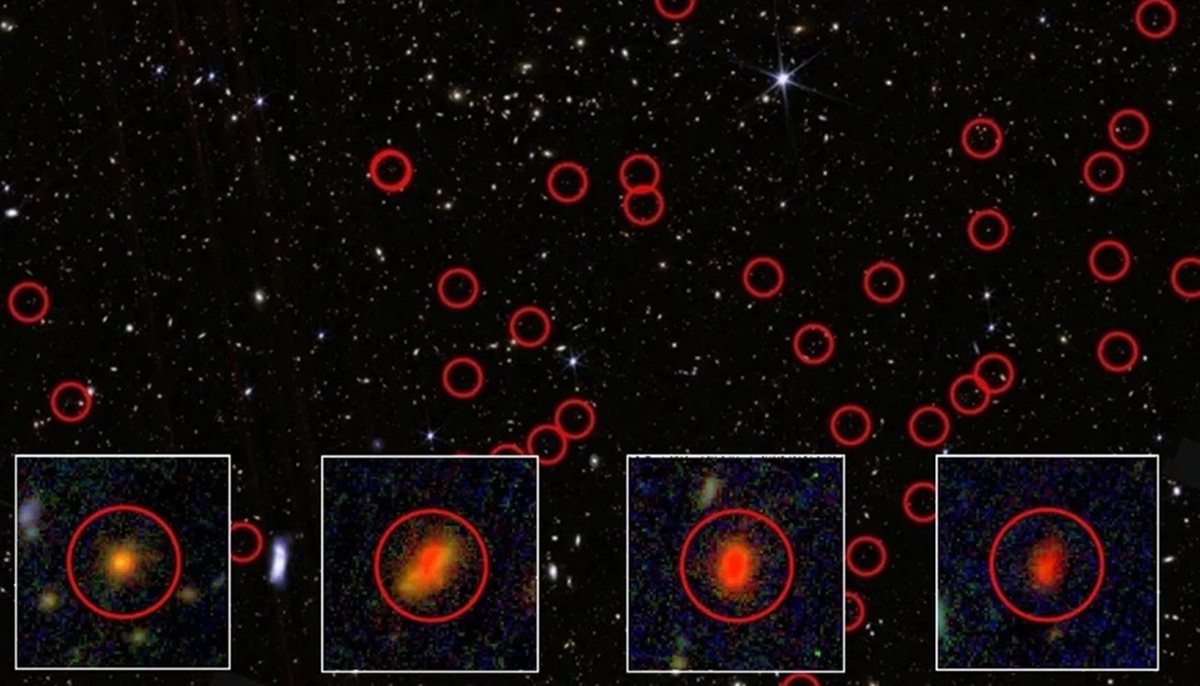
Washington D.C. – The James Webb Space Telescope (JWST) has identified approximately 300 remarkably luminous objects in deep space, potentially representing some of the earliest galaxies formed after the Big Bang. The finding, detailed by researchers at the University of Missouri, is prompting a re-evaluation of current understanding regarding galaxy formation in the universe’s infancy.
The objects were revealed in images captured by JWST’s infrared camera, and their brightness is proving to be a meaningful puzzle. Current cosmological models suggest galaxies forming shortly after the Big Bang should be relatively dim, constrained by the rate at which stars can form. These newly detected objects, however, are unexpectedly bright, hinting at the possibility that galaxies may have assembled much faster and reached greater mass earlier in the universe’s history than previously thought.
“If these objects are indeed galaxies, the level of light we’re seeing really challenges our current ideas about how galaxies formed in the early universe,” explained researcher Yan Sun, as reported by Media Indonesia.
The team employed a technique known as the “dropout technique” to identify these distant candidates. This method relies on observing objects that are visible in red (infrared) wavelengths but disappear in blue wavelengths. This phenomenon indicates extreme distance – exceeding 13 billion light-years – and is caused by the redshift effect, where the expansion of the universe stretches the wavelength of light traveling towards us.
Astronomers analyze the brightness of these objects across different wavelengths to estimate their redshift, age, and mass.JWST’s powerful infrared capabilities are crucial to this process. As Yan explained, “When the light from the initial galaxies moves across space, it stretches to a longer wavelength, shifting from the light appears to become infrared. This stretch is referred to as a red shift. The task is to help us determine how far these galaxies are. The higher the red shift, the closer the galaxy with the beginning of the universe.”
While the dropout technique provides a strong initial indication of distance, definitive confirmation requires spectroscopic analysis. Spectroscopy breaks down light into its constituent wavelengths, revealing a “fingerprint” that provides precise measurements of redshift, chemical composition, and age. Researchers are now working to conduct spectroscopic follow-up observations to definitively determine whether these mysterious objects are, in fact, ancient galaxies.
Context: The Dawn of Galaxy Formation & the James Webb Space Telescope
This discovery builds upon JWST’s ongoing mission to peer back in time to the universe’s earliest epochs. The telescope, launched in December 2021, is designed to observe infrared light, which is less affected by dust and gas and allows it to see further back in time than previous telescopes like Hubble.The early universe was opaque to visible light, but infrared light can penetrate this cosmic fog, revealing the first stars and galaxies.
Understanding the formation of the first galaxies is a fundamental goal of modern cosmology. These early galaxies are believed to be the building blocks of the larger galaxies we see today, including our own Milky Way. The conditions in the early universe - a much hotter, denser environment - were vastly different from today, and the processes that governed galaxy formation are still not fully understood.
Recent discoveries by JWST, including the identification of 14 “sleeping” galaxies in the early universe, are already reshaping our understanding of this period. These “sleeping” galaxies, while present, showed little to no ongoing star formation, challenging previous assumptions about the rapid star formation expected in the early universe.
The current findings of these 300 bright objects add another layer of complexity. If confirmed as galaxies,they suggest that the early universe may have been a more dynamic and active place than previously imagined,with galaxies forming and evolving at a much faster pace. Further research, utilizing JWST’s spectroscopic capabilities, will be critical to unraveling the mysteries of these distant objects and refining our understanding of the universe’s origins.
Source: media Indonesia – https://mediaindonesia.com/teknologi/800361/teleskop-james-webb-temukan-300-objek-terang-di-alam-semesta-awal and Live Science (as referenced in the original article).
