
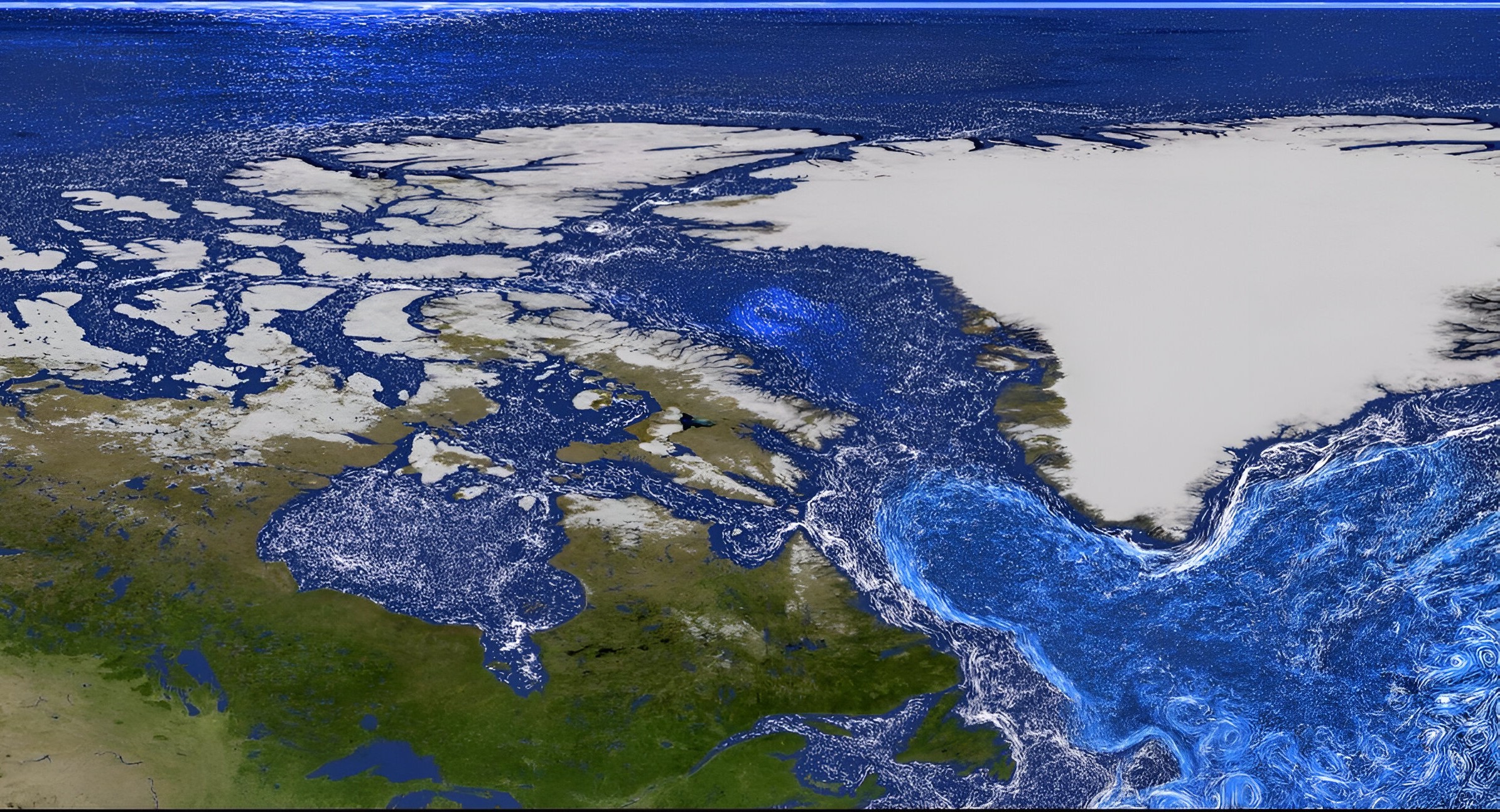
Greenland’s Meltwater Fuels Arctic Phytoplankton Blooms
New research reveals how glacial runoff boosts ocean’s base of the food chain
Melting ice from Greenland’s vast ice sheet is not only contributing to rising sea levels but also unexpectedly nourishing microscopic life. Scientists have discovered this meltwater may be a significant factor in the thriving of phytoplankton, crucial organisms that form the foundation of marine ecosystems and impact global climate.
Unlocking Ocean Secrets with Advanced Simulation
A collaborative effort involving researchers from San José State University, NASA’s Jet Propulsion Laboratory, and the Massachusetts Institute of Technology utilized sophisticated supercomputers to model these complex interactions. Their findings suggest that freshwater runoff from Greenland’s glaciers is playing a vital role in promoting phytoplankton growth.
Greenland’s ice sheet, in some areas exceeding a mile in thickness, is losing an estimated 293 billion tons of ice annually. During warmer months, this meltwater discharges into the ocean at an immense rate. For instance, from the base of Jakobshavn Glacier, over 300,000 gallons of freshwater pour into the sea each second.
This influx of freshwater rises through the denser saltwater, potentially carrying nutrients from deeper ocean layers to the surface. This phenomenon, known as upwelling, has long been suspected by scientists to support phytoplankton, particularly when surface nutrients diminish during summer.
Phytoplankton: Essential to Life and Climate
These microscopic, plant-like organisms are fundamental to the planet’s systems. They absorb carbon dioxide and serve as the primary food source for creatures ranging from krill to whales. Despite their minuscule size, phytoplankton are indispensable to marine biodiversity worldwide.
Data from NASA satellites indicate a substantial increase in Arctic phytoplankton growth, a 57% rise between 1998 and 2018. The timing of this surge led researchers to investigate the potential link with glacial melt, though direct evidence in Greenland’s remote, iceberg-laden fjords has been challenging to obtain.
Simulating a Hidden Marine World
Dustin Carroll, an oceanographer at San José State University and affiliated with NASA’s Jet Propulsion Laboratory, described the challenge. We were faced with this classic problem of trying to understand a system that is so remote and buried beneath ice,
he stated. We needed a gem of a computer model to help.
The research team employed ECCO-Darwin, an advanced simulation tool developed at JPL and MIT, referred to as a virtual ocean laboratory. This sophisticated model integrates decades of data, including billions of measurements from satellites and ocean instruments, to simulate the intricate interactions of water, heat, salt, nutrients, and marine life across the globe.
Meltwater’s Impact on Phytoplankton Vitality
Michael Wood, a computational oceanographer at San José State University, highlighted the immense complexity of simulating the interplay between biology, chemistry, and physics in a specific region like Greenland’s fjords. To address this, the team developed a nested modeling approach, creating a model within a model within a model,
allowing for detailed examination of the fjord at the glacier’s base.
Calculations performed on NASA’s supercomputers in Silicon Valley indicated that glacial meltwater could boost summer phytoplankton growth in the studied fjord by an estimated 15% to 40%. This enhanced growth is a direct consequence of the nutrient-rich meltwater reaching the surface.
The implications of these findings are significant, with projections suggesting that melt from the Greenland ice sheet will accelerate in the coming decades. This acceleration is expected to influence numerous environmental factors, from sea level rise and land vegetation to the salinity of coastal waters. As Carroll noted, We reconstructed what’s happening in one key system, but there’s more than 250 such glaciers around Greenland.
The team aims to extend their simulations to encompass other coastal areas.
Furthermore, the study investigated how these changes affect the ocean’s capacity to absorb atmospheric carbon dioxide. While meltwater can reduce seawater’s ability to dissolve carbon, the resulting increase in phytoplankton blooms appears to compensate for this loss through heightened photosynthesis, thereby drawing down more CO2.
Wood emphasized the broad applicability of their modeling techniques, stating, We didn’t build these tools for one specific application. Our approach is applicable to any region, from the Texas Gulf to Alaska. Like a Swiss Army knife, we can apply it to lots of different scenarios.
This adaptable methodology promises to yield insights into marine ecosystems globally.
The increase in phytoplankton blooms, driven by Greenland’s melting ice, is a dynamic response within the Arctic ecosystem. For instance, recent studies suggest that in some Arctic regions, phytoplankton blooms have become more intense and widespread, potentially altering food web dynamics. The U.S. National Oceanic and Atmospheric Administration (NOAA) reported in its 2023 Arctic Report Card that while some areas are seeing increased productivity, the overall long-term impacts remain complex and vary regionally (NOAA Arctic Report Card 2023).
