
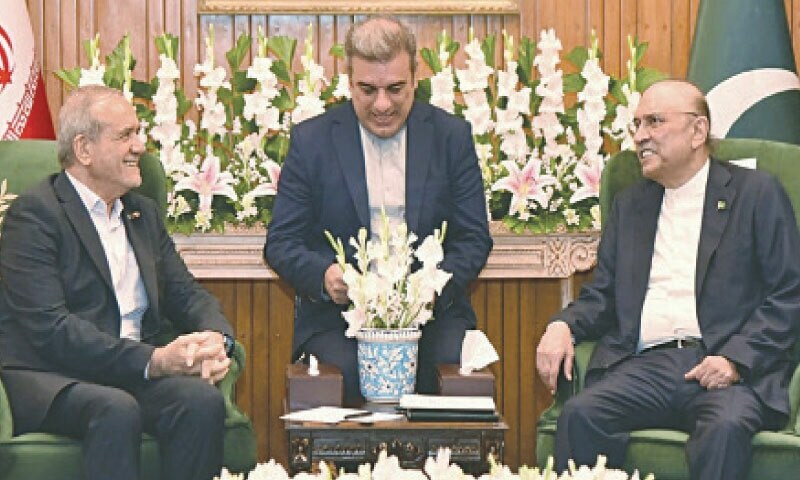
Pakistan, Iran Forge Closer Ties Amid Trade Ambitions
Joint efforts to combat terrorism and boost bilateral trade to $10 billion highlighted during President Pezeshkian’s visit.
Islamabad and Tehran have committed to a significant escalation in bilateral trade, aiming for $10 billion annually, and have emphasized unified action against terrorism as crucial for regional stability.
Boosting Trade and Security Cooperation
During a two-day visit, Iranian President **Masoud Pezeshkian** and Pakistani Prime Minister **Shehbaz Sharif** confirmed a shared understanding that peace and prosperity along their roughly 900-kilometer border are intrinsically linked to effectively tackling terrorism. The leaders met at the Prime Minister’s House, where they discussed economic and trade partnerships, underscoring that mutual prosperity is hindered by terrorist threats.
President **Pezeshkian** stated, “The development of economic and trade ties will be achieved through peace, stability, and tranquillity.”
He further noted the importance of increased cooperation to ensure border security and the well-being of citizens in border cities, particularly given threats from groups like Jaish al-Adl and the Balochistan Liberation Army.
Prime Minister **Shehbaz Sharif** echoed this sentiment, declaring, “There will be zero tolerance for all forms of terrorism. If anyone falls victim to terrorism in Iran, it is the same as someone being affected by terrorism in Pakistan.”
He added, “For peace and development in our region, and along our hundreds of kilometres-long shared border, we must cooperate against terrorism and take effective steps to eliminate the scourge of terrorism once and for all.”
High-Level Consultations
President **Pezeshkian** also engaged in separate meetings with Pakistan’s senior military leadership, including Chief of Army Staff Field Marshal **Asim Munir**, Chairman Joint Chiefs of Staff Gen **Sahir Shamshad Mirza**, Air Chief Marshal **Zaheer Babar Sidhu**, and ISI chief Lt Gen **Asim Malik**. These discussions were believed to cover operational details of security cooperation.
Reaching for a $10 Billion Trade Target
Both nations reaffirmed their ambition to elevate annual bilateral trade to $10 billion, a goal initially set during the late Iranian President **Ebrahim Raisi’s** visit in April 2024. Current estimates place bilateral trade at approximately $2.8 billion.
President **Pezeshkian** expressed optimism, stating, “We can easily, in a short time, increase the volume of trade from the current $3 billion to the projected goal of $10 billion.”
Prime Minister **Shehbaz** concurred, “We also jointly hope that the $10bn trade target is achieved at the earliest.”
Factors such as international sanctions on Iran, border security concerns, and infrastructural limitations have historically constrained trade. Discussions focused on strategies like facilitating barter trade, increasing export quotas for agricultural products, operationalizing cross-border markets, and removing existing trade barriers.
Pakistan and Iran aim to convene the long-delayed 22nd meeting of the Pakistan-Iran Joint Economic Commission to advance these trade initiatives. The development of transit routes, expansion of border markets, and establishment of joint free economic zones were identified as critical needs.
Expanding Cooperation Through Agreements
A total of 12 agreements and Memorandums of Understanding (MoUs) were signed, spanning cooperation in trade, transit, science and technology, tourism, agriculture, cultural exchange, maritime safety, and judicial matters. Notably, a joint ministerial statement on the intent to finalize a Free Trade Agreement (FTA) was exchanged, with Deputy Prime Minister and Foreign Minister **Ishaq Dar** welcoming the “positive momentum” toward its completion.
These agreements include collaboration on plant quarantine, the joint use of the Mirjaveh-Taftan border crossing, Information and Communication Technology (ICT), tourism for 2025-27, and the FTA finalization. President **Pezeshkian** highlighted that these accords would facilitate and promote engagement across commerce, culture, tourism, transportation, and scientific and educational exchanges.
The Iranian President departed for Iran following a reception hosted by President **Asif Ali Zardari**.
