
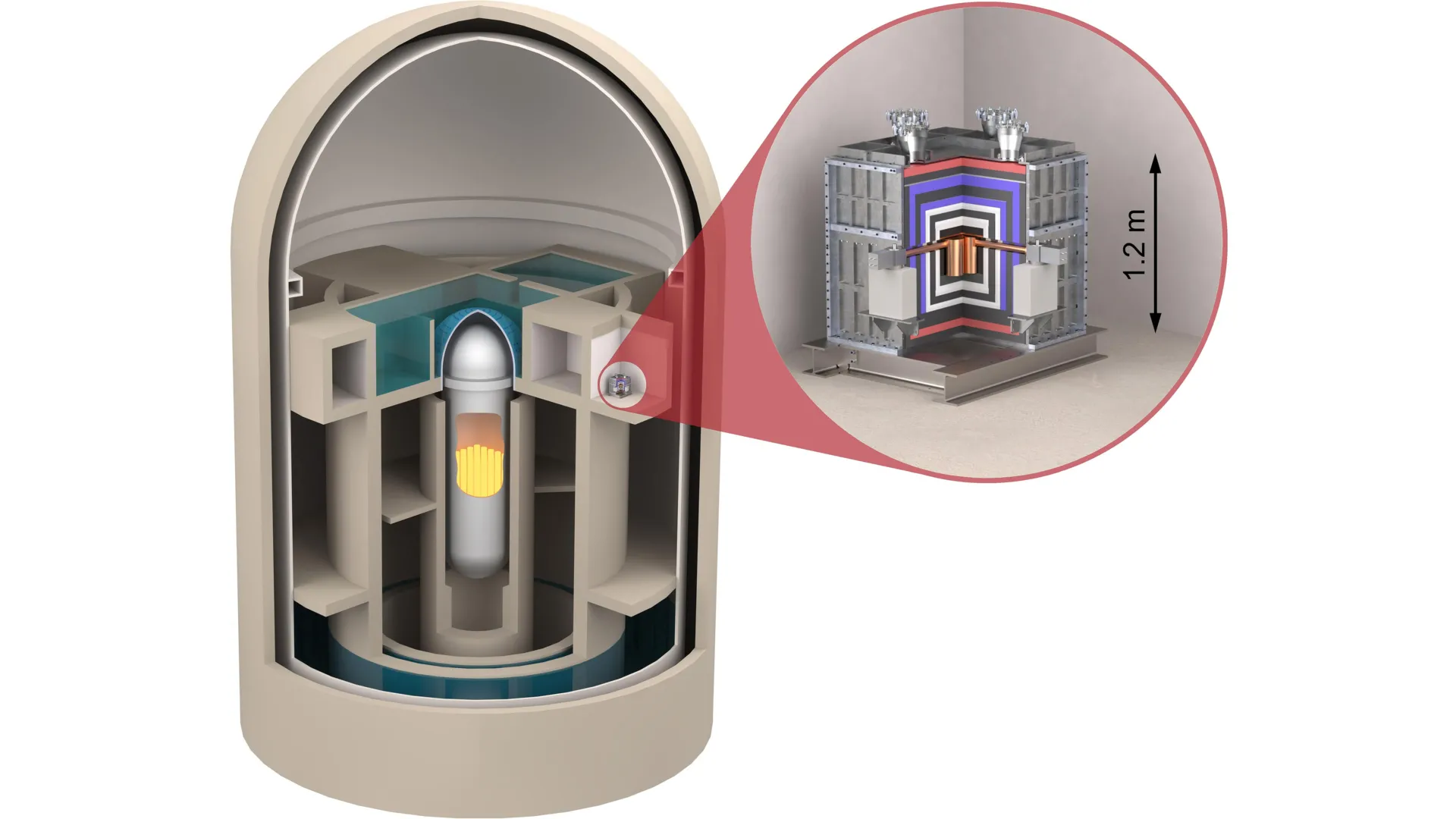
Scientists at the Max Planck Institute for Nuclear Physics (MPIK) in Heidelberg have achieved a significant breakthrough in neutrino detection, successfully observing antineutrinos from a nuclear power plant reactor using the compact CONUS+ experiment.This achievement marks the first time Coherent elastic Neutrino-Nucleus Scattering (CEvNS) has been measured at full coherence and lower energies in a reactor surroundings, utilizing a detector mass of just 3 kg.
Neutrinos, notoriously elusive elementary particles, stream through Earth in immense quantities. Detecting them typically requires massive experimental setups due to their weak interaction with matter. The CONUS+ experiment, relocated to the Leibstadt nuclear power plant (KKL) in Switzerland, employed improved germanium semiconductor detectors to capture the subtle CEvNS effect. This process involves neutrinos interacting coherently with entire atomic nuclei, rather than individual components, resulting in a minute but detectable nuclear recoil – akin to a ping-pong ball altering a car’s motion.
The CEvNS phenomenon, predicted in 1974 and first confirmed in 2017, was observed by CONUS+ with remarkable success. Positioned just 20.7 meters from the reactor core,the experiment recorded over 10 trillion neutrinos per square centimeter per second.Over approximately 119 days of measurement, researchers identified an excess of 395±106 neutrino signals, a result aligning closely with theoretical predictions after accounting for background noise.
“We have thus successfully confirmed the sensitivity of the CONUS+ experiment and its ability to detect antineutrino scattering from atomic nuclei,” stated Dr. Christian Buck, a study author. He highlighted the potential for developing small,mobile neutrino detectors for applications such as monitoring reactor heat output or isotope concentrations.
The CEvNS measurements offer invaluable insights into fundamental physics within the Standard Model. The CONUS+ experiment’s reduced reliance on nuclear physics aspects enhances its sensitivity to physics beyond the Standard Model, prompting upgrades with improved and larger detectors in autumn 2024.
