
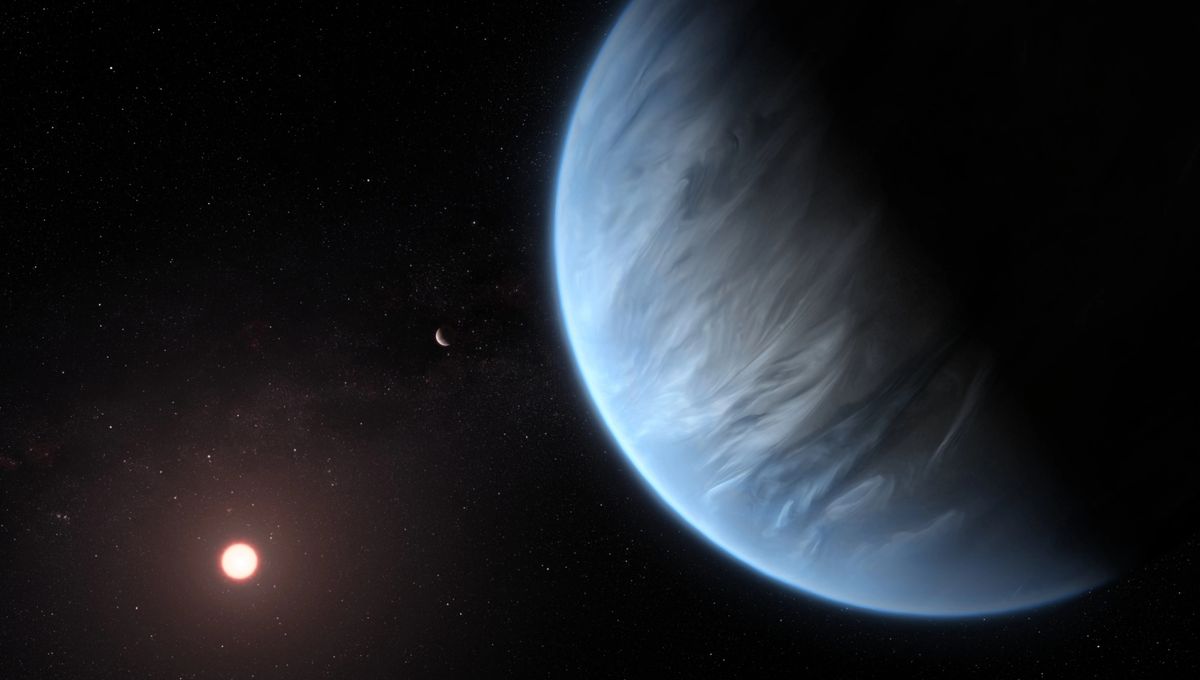
K2-18b’s Life Signs Re-evaluated Amidst New Data
Controversial Biosignature Hint Now Under Scrutiny
New observations are casting doubt on earlier claims of potential biological activity detected in the atmosphere of exoplanet K2-18b. While initial research suggested a significant hint of life, subsequent analysis offers a different perspective.
Atmospheric Clues Re-examined
Researchers had previously suggested the presence of dimethyl sulfide (DMS) and dimethyl disulfide (DMDS) in K2-18b’s atmosphere, gases on Earth produced by microbes and phytoplankton, thus considered potential biosignatures. This finding built upon years of study by a University of Cambridge-led team.
The planet itself, located 124 light-years away, is a sub-Neptune with a radius 2.6 times that of Earth. It orbits a red dwarf star within its habitable zone, a characteristic that fueled excitement about its potential to host life.
Hycean World Hypothesis Questioned
The initial research also proposed K2-18b as a “hycean” world, suggesting a vast ocean beneath a hydrogen-rich atmosphere. However, this aspect has also faced challenges, with other teams finding no evidence to support the existence of an ocean.
The latest work, utilizing data from the James Webb Space Telescope (JWST), confirms the presence of an ocean on the exoplanet. However, it remains uncertain whether the planet possesses a thick or thin atmosphere. The absence of detected water vapor suggests an efficient “cold trap” mechanism, limiting evaporation on this temperate world.
Furthermore, the potential biosignatures previously identified were below the threshold for definitive detection. The new models indicate that the observed presence of DMS could originate from non-biological sources, prompting calls for the investigation of a broader range of molecules as potential biosignatures.
“I think it’s difficult to be able to claim biosignatures in hydrogen-dominated atmospheres if the underlying chemical properties of these gases, such as their absorption strengths at different pressures, are still not well understood.”
—Dr Jake Taylor, Exoplanet Atmosphere Expert, Oxford University
While the current findings may temper expectations of finding life on K2-18b, the planet remains an object of fascination. It represents a cool water world, significantly larger than Earth, orbiting a dimmer star within its star’s habitable zone.
The new study has been submitted for peer review to the AAS Journals. A preprint of the research is available on arXiv.
