
Dinosaur Stampede Reveals Unexpected Social Dynamics
Ancient Alberta Tracks Show Mixed Herds Grazing Together
Seventy-six million-year-old mud in southern Alberta has yielded an astonishing discovery: a densely packed layer of dinosaur footprints showcasing several species walking in proximity, a first for the Late Cretaceous period.
A Window into Prehistoric Gatherings
The find, unearthed at the Skyline Tracksite in Dinosaur Provincial Park, a location previously known more for its fossilized skeletons than its track record, offers unprecedented insight into dinosaur behavior. “It was incredibly exciting to be walking in the footsteps of dinosaurs 76 million years after they laid them down,” stated **Dr. Brian Pickles** of the University of Reading, who was involved in the excavation.
A Diverse Assemblage
Spanning an area comparable to two parking spaces, the fossilized slab preserves thirteen tracks from horned ceratopsians, a likely ankylosaurid, three prints from two large tyrannosaurids, and a single, delicate track from a small carnivore. All the tracks are oriented in nearly the same direction and are imprinted on the same mud layer, suggesting the animals traversed the area within hours, possibly minutes, of each other.
Coordinated Movement Suspected
The close spacing of the ceratopsian footprints leads researchers to believe these herbivores were moving as a coordinated unit. This orderly trackway supports earlier evidence from bonebeds in the same formation, which indicated herds of *Styracosaurus*. Such findings strengthen the hypothesis that horned dinosaurs frequently traveled in groups for mutual protection.
Predators on the Trail
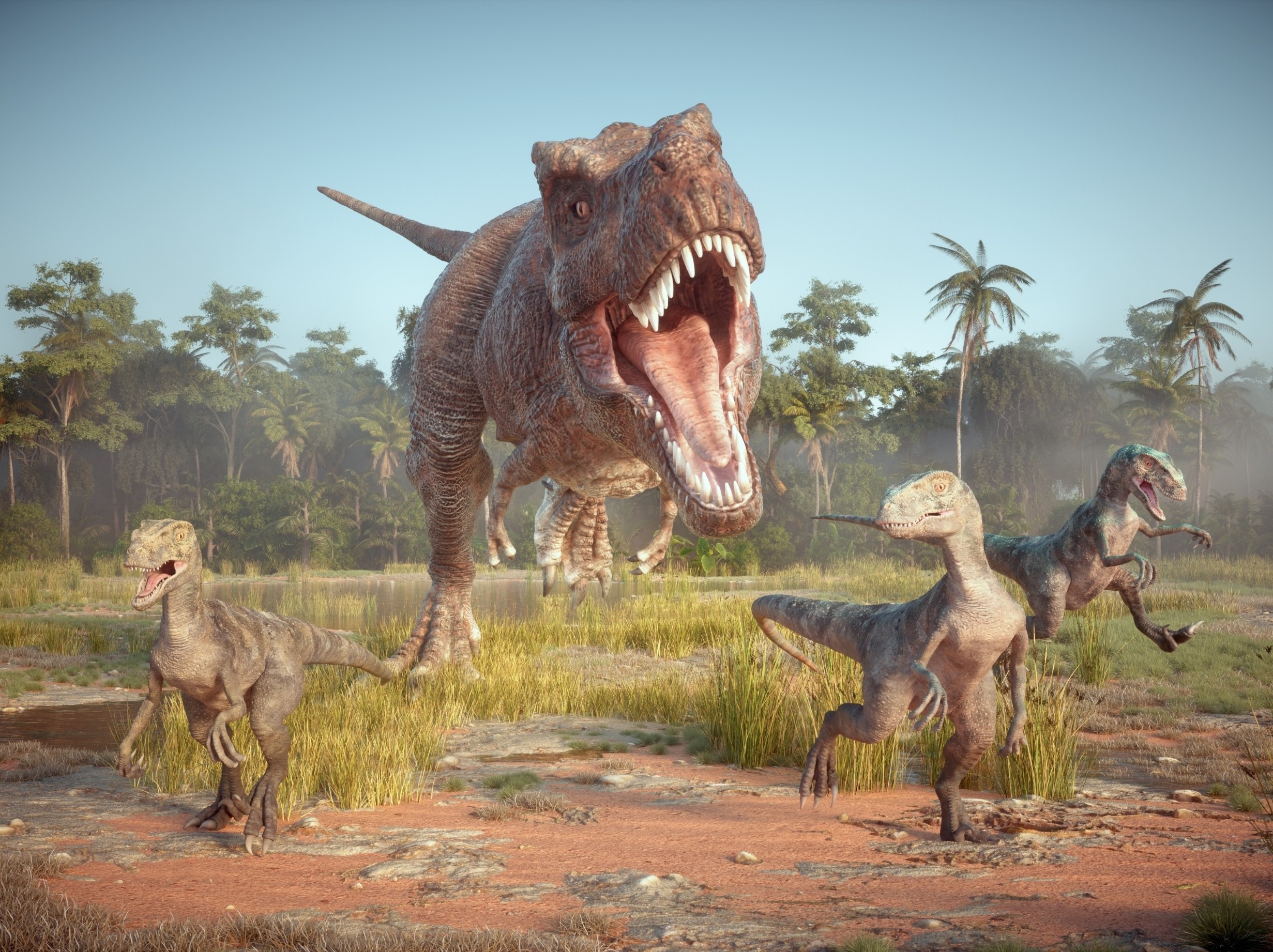
Adding a layer of drama, two tyrannosaur prints cut across the herbivore tracks, appearing as if the predators were shadowing the herd from a safe distance. These three-toed marks, approximately 18 inches long, are similar to those found in the *Bellatoripes fredlundi* trackways further north, which previously suggested tyrannosaurs sometimes hunted in pairs or packs. The presence of predators may explain the herbivores’ decision to band together.
This behavior mirrors modern savanna ecosystems, where species like zebras and wildebeest merge their herds. A 2024 study in the Serengeti National Park found that mixed herds offer enhanced predator vigilance for all participating species (PNAS Nexus). In this Cretaceous scenario, the combined defense of armored ankylosaurs and the increased sensory input of numerous ceratopsians could have significantly complicated hunting strategies for large carnivores.
Preservation: A Delicate Balance
The tracks were preserved in a thin band of mudstone deposited when a meandering river shifted its course, leaving behind a shallow lake. The pressure of the animals’ feet pushed the wet clay aside, creating raised rims that are still visible. The impressions were then rapidly covered by sand, and iron minerals later cemented the layer, forming the rust-colored bedrock.
Exposing such flat bedding planes is rare due to erosion, making these discoveries particularly significant. The research team’s systematic approach, looking for iron-rich rims amidst softer sandstone, has already led to the identification of several more promising track sites within the park, suggesting many such imprints may have gone unnoticed for decades.
Researchers utilized portable GPS equipment to map the site meticulously. They then captured overlapping grid photographs to generate a precise 3D digital model. This virtual replica allows for detailed measurements of stride length, toe angles, and the subtle suction effects when feet were pulled free, all without further disturbing the fragile fossil layer.
The Rarity and Fragility of Footprints
Fossilized footprints are considerably more vulnerable than dinosaur bones. While skeletons can be preserved deep underground for millennia, tracks are surface impressions that vanish quickly if not rapidly buried under specific conditions. Even after exposure, the thin ironstone layers containing them can disintegrate rapidly due to environmental factors like wind, rain, and temperature fluctuations.
Furthermore, accurately identifying the dinosaur species responsible for specific tracks presents a challenge, especially when skeletal features overlap between different groups. Differentiating between ceratopsian and ankylosaurid tracks, for example, can be difficult without clear impressions of both fore and hind limbs, which limits the precision with which behavior can be inferred from fossil evidence.
Unlocking Deeper Social Insights
Previously, evidence of dinosaur social behavior primarily came from mass mortality bonebeds or trackways of single species. This discovery at the Skyline Tracksite fills a crucial gap by documenting different herbivores moving side-by-side, a behavior that parallels modern large mammal guilds that share resources and face common predators. The find encourages paleontologists to reconsider areas previously thought to be devoid of tracks.
The study, published in the journal *PLOS One*, highlights how recognizing subtle geological cues could revolutionize the study of paleontology in regions with similar sedimentary deposits.
